Spotted Wood Kingfisher
Actenoides lindsayi
Avilumen editorial team ·

The spotted wood kingfisher or spotted kingfisher is a species of bird in the family Alcedinidae. It is endemic to the Philippines found on the islands of Luzon, Catanduanes, Marinduque, Negros and Panay where its natural habitat is tropical moist lowland forests.
The spotted wood kingfisher or spotted kingfisher (Actenoides lindsayi) is a species of bird in the family Alcedinidae. It is endemic to the Philippines found on the islands of Luzon, Catanduanes, Marinduque, Negros and Panay where its natural habitat is tropical moist lowland forests.
Description and taxonomy
The spotted wood kingfisher is a colourful bird that can readily be distinguished from other kingfishers in the Philippines. It is about 26 cm (10 in) long with spotting above and scalloping beneath. The male has a dark green crown with black spots and a light green stripe above a pale blue supercilium with a black band beneath. A blue moustache is bordered above and below by an orange-brown band and collar. The upper parts are dark green, each feather being tipped with buff giving a spotted effect. The rump is bright green and the tail dark green with brown bars on the outer feathers. The throat is orange-brown and the underparts are mainly white, the breast feathers having green margins. The under-wing coverts are buff. The upper mandible of the bill is black and the lower mandible yellow, the iris is brown and the legs pale green.The female is similar in appearance but less brightly coloured, the supercilium is green rather than blue, the moustache brownish-green, the hind-neck collar brownish-black and the throat the same colour as the breast. The juvenile resembles the female but has a generally duller colouration.
It is believed to be a sister species to the Blue-capped kingfisher and Rufous-collared kingfisher.
Subspecies
A. l. lindseyi – Found on Luzon and Catanduanes;
A. l. moseleyi – Found Panay and Negros; Darker and browner above, buff spots somewhat larger and more rounded.
Ecology and behaviour
The spotted wood kingfisher occurs in pairs or as a solitary bird but is seldom seen because it moves around in dense cover in the lower storey of the forest. It feeds on beetles and other insects, snails and small vertebrates which it probably finds while foraging on the ground. Typically most vocal at dawn and dusk.
Little is known of its breeding behaviour; it is thought to nest in termite nests in trees, but this may not be the case because other members of the genus mostly choose to nest in holes in trees or in the ground.
Habitat and Conservation Status
It inhabits moist primary forest in both lowland and hilly areas. It was more abundant on Luzon in the past but logging has reduced the area of suitable habitat. On Negros, it has been recorded on dense scrub and gardens.
The International Union for Conservation of Nature has rated its conservation status as least concern but is believed to be declining due to deforestation from land conversion, Illegal logging and slash-and-burn farming. it is generally uncommon but has a large range across West Visayas and Luzon. More surveys and understanding of its biology are needed and it is highly possible that this species be uplisted due to habitat destruction.
It is found in multiple protected areas such as Mount Banahaw, Mount Makiling, Mount Isarog, Bataan National Park and Northern Sierra Madre Natural Park, Mt. Kanlaon Natural Park and Northern Negros Natural Park but like all areas in the Philippines, protection is lax and deforestation and hunting continues despite this protection on paper.
Text adapted from Wikipedia · CC BY-SA 4.0
Where it lives
Plumage colours
Taxonomy
- Order
- Coraciiformes
- Family
- Alcedinidae
- Genus
- Actenoides
- Conservation status
- Least concern
Listen to its call
No recording yet
Illustration gallery
6 illustrations of Actenoides lindsayi (Spotted Wood Kingfisher) in different styles, true to its real plumage. Shown watermarked; the art pack includes the high-resolution originals, ready to print.
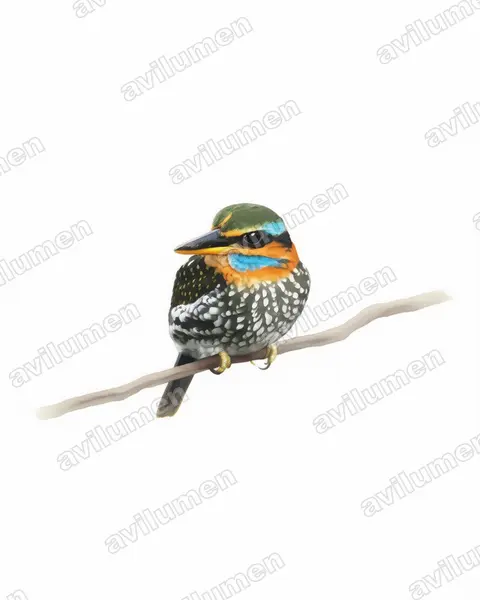
Watercolor 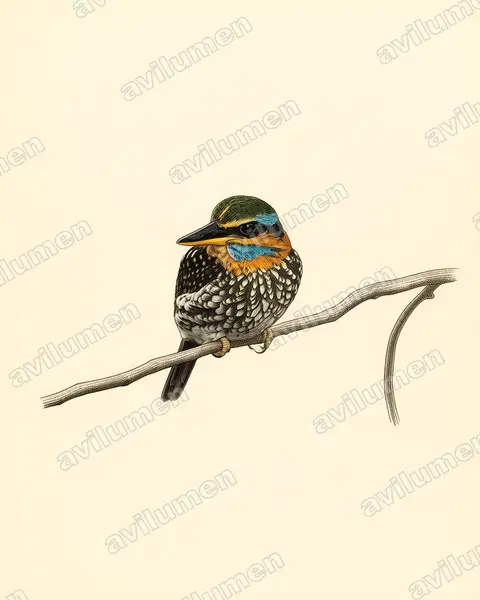
Vintage plate 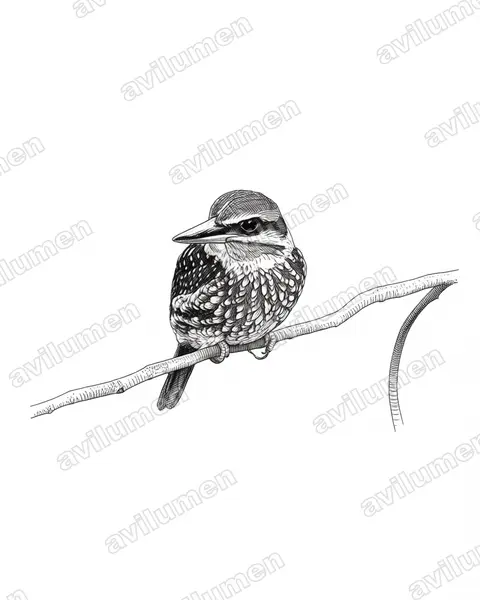
Ink 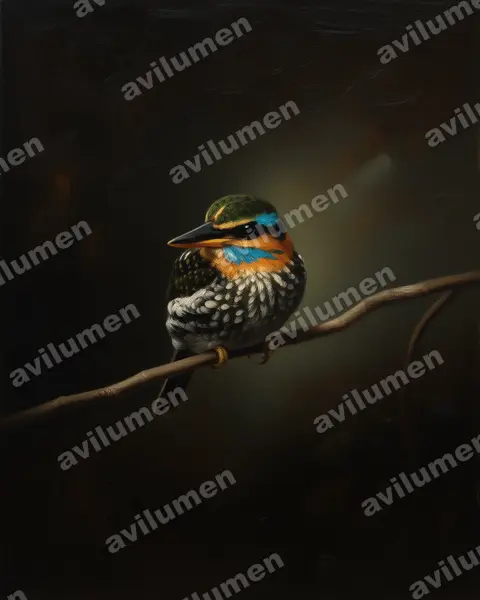
Oil 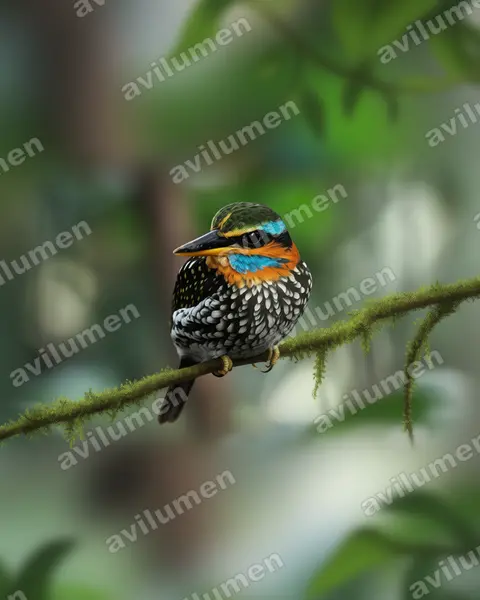
Realistic 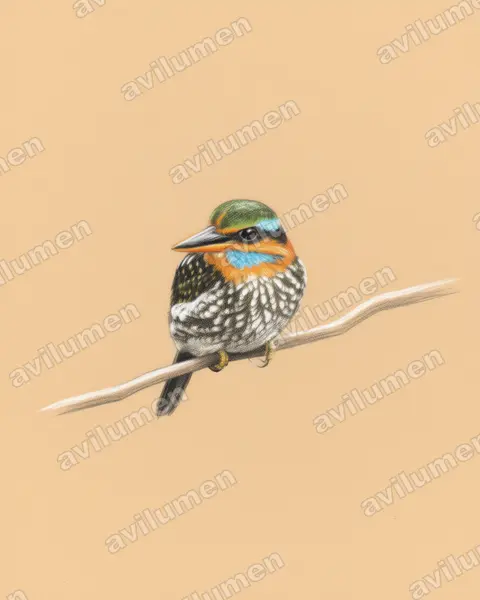
Colored pencil
Illustrations based on the photograph by Doing BIG YEAR! (CC BY 2.0), from Wikimedia Commons.
Digital editions
HD Digital Art Pack — Spotted Wood Kingfisher
Digital download: 6 high-resolution illustrations of the Spotted Wood Kingfisher (Actenoides lindsayi), print-ready. This is a digital file; no animal or physical item is included.
AI Avatar — Spotted Wood Kingfisher
Generate an avatar fusing your face with the Spotted Wood Kingfisher (Actenoides lindsayi). Delivered digitally in 8K, watermark-free. Digital product; no animals are sold or brokered.
Instant download. No live birds are sold.
Frequently asked questions
- Is Actenoides lindsayi (Spotted Wood Kingfisher) endangered?
- The IUCN Red List places Actenoides lindsayi, commonly known as the Spotted Wood Kingfisher, in the «Least concern» category. «Least concern» means it is not currently threatened.
- Where does Actenoides lindsayi (Spotted Wood Kingfisher) live?
- Actenoides lindsayi (Spotted Wood Kingfisher) is found in Philippines.
- What family does Actenoides lindsayi (Spotted Wood Kingfisher) belong to?
- Actenoides lindsayi (Spotted Wood Kingfisher) belongs to the family Alcedinidae, in the order Coraciiformes.
- What colour is Actenoides lindsayi (Spotted Wood Kingfisher)?
- The plumage of Actenoides lindsayi (Spotted Wood Kingfisher) combines these colours: Multicoloured.
More from the same family
 Least concern
Moustached Kingfisher
Actenoides bougainvillei
The moustached kingfisher, also called Bougainville moustached kingfisher, is a species of bird in the family Alcedinidae. It is endemic to Bougainville Island in Papua New Guinea. An estimated 1,300–7,000 mature individuals are left.
from $1.99
 Near threatened
Rufous-collared Kingfisher
Actenoides concretus
The rufous-collared kingfisher is a species of bird in the family Alcedinidae. It is found in Brunei, Indonesia, Malaysia, Myanmar, and Thailand. Its natural habitats are subtropical or tropical moist lowland forest and subtropical or tropical moist montane forest. It is threatened by habitat loss.
from $1.99
 Least concern
Hombron's Kingfisher
Actenoides hombroni
The blue-capped kingfisher, also known as Hombron's kingfisher, is a species of bird in the family Alcedinidae endemic to the Philippines and found only on Mindanao. It is one of the most colorful kingfishers in the country having a dark blue cap and wings with rufous spots, a striped rufous belly, white chin and red bill.
from $1.99
 Near threatened
Green-backed Kingfisher
Actenoides monachus
The green-backed kingfisher is a species of bird in the family Alcedinidae endemic to Indonesia, where it is restricted to north and central Sulawesi, and the islands of Manadotua and Lembeh. It can be found in the protected areas of Lore Lindu, Bogani Nani Wartabone, and Tangkoko Batuangus.
from $1.99