Little Spiderhunter
Arachnothera longirostra
Avilumen editorial team ·

The little spiderhunter is a species of long-billed nectar-feeding bird in the family Nectariniidae found in the moist forests of South and Southeast Asia. Unlike typical sunbirds, males and females are very similar in plumage. They are usually seen in ones or twos and frequently make a tzeck call. They are most often found near flowering plants where they obtain nectar.
The little spiderhunter (Arachnothera longirostra) is a species of long-billed nectar-feeding bird in the family Nectariniidae found in the moist forests of South and Southeast Asia. Unlike typical sunbirds, males and females are very similar in plumage. They are usually seen in ones or twos and frequently make a tzeck call. They are most often found near flowering plants where they obtain nectar.
Description
The distinctive long beak set it apart from other sunbirds. The sexes are similar, except that the female has a paler base on the lower mandible. Male has all black beak. They are found near their favourite nectar bearing trees, often species of wild Musaceae or flowers in gardens. They have a buzzy zick-zick call that is made regularly when disturbed or when foraging. Additionally, the song is series of rapid chipping notes and these can go on for long periods.
Taxonomy
The genus name Arachnothera means "spider hunter" and the species epithet refers to the long beak. About thirteen geographic races are recognized. The nominate race longirostra (Latham, 1790) is found in southwestern India, central and northeastern India, foothills of the Himalayas and into Thailand and Yunnan. Race sordida La Touche, 1921 is found in southern China and northeastern Thailand. Race pallida Delacour, 1932 is found in eastern Thailand and C & S Indochina. Two species from the Philippines, the orange-tufted and the pale spiderhunter were formerly considered subspecies. Several other island forms are noted:
cinereicollis (Vieillot, 1819) – south of the Isthmus of Kra to Sumatra and satellite islands
zarhina Oberholser, 1912 – Banyak Is, off W Sumatra.
niasensis van Oort, 1910 – Nias I, off W Sumatra.
rothschildi van Oort, 1910 – N Natuna Is.
atita Oberholser, 1932 – S Natuna Is.
buettikoferi van Oort, 1910 – Borneo.
prillwitzi Hartert, 1901 – Java (including Madura I) and Bali
randi Salomonsen, 1953 – Basilan (off W Mindanao).
Distribution and habitat
The species is found in Bangladesh, Bhutan, Brunei, Cambodia, China, India, Indonesia, Laos, Malaysia, Myanmar, Nepal, Philippines, Thailand, and Vietnam. Within India, there are disjunct populations in the Eastern Ghats from Lamasinghi, Visakhapatnam and parts of Orissa) and the Western Ghats apart from the main distribution in north-east India that extends into Southeast Asia. A record from the Nicobar Islands is considered doubtful.
Its natural habitats are subtropical or tropical moist lowland forests, subtropical or tropical mangrove forests, and subtropical or tropical moist montane forests. It is usually found below the canopy. They are also found in gardens, attracted especially by flowers that yield nectar.
Behaviour and ecology
They have been noted as good pollinators of wild banana species and several species of the ginger family and often visit Loranthus sp. (= Dendrophthoe sp.), Bombax malabaricum and Erythrina indica for nectar. They are often seen in plantations in forest areas. Although they are more often seen in secondary forests or in clearings and appear to be tolerant of human activities, they have become extinct in some forest fragments. In Singapore they have gone locally extinct within the botanical garden.The breeding season in northeastern India is March to September but mainly May to August. In southern India it breeds from December to August. Two eggs are the usual clutch. The nest is a compact cup attached under a leaf of banana or similar broad leaved plant. The nest is hammock-like and suspended from the underside of a leaf using 150 or so "pop-rivets" of cobwebs and vegetable fibre, a unique method of using spider silk for animal architecture.
It is suspected that Hodgson's hawk-cuckoo and violet cuckoo are brood parasites on this species in India.
A species of haemosporidian, Leucocytozoon, has been noted in specimens from Malaysia.
In culture
In Sarawak, the Kayan, Kenyah and Punan people consider it a bird of good omen and when they are out collecting camphor, the men would wait until they heard the sit call of one of these spiderhunters.
Other references
Rahman, M. A. 2006. Patterns of morphological variation in the little spiderhunter (Arachnothera longirostra) in Taman Negara, Peninsular Malaysia and Thale Ban National Park, Thailand. In: Othman, S., Yatim, S. H., Elagupillay, S., Md. Nor, S., Ahmad, N., and Mohd Sah, S. H (eds.), Pp: 207–214, Management and Status of Resources in Protected Areas for Peninsular Malaysia. Department of Wildlife and National Parks, Kuala Lumpur. ISBN 983-43010-0-6.
Khan, AR (1977): Territoriality among Sunbirds and Spiderhunter. Newsletter for Birdwatchers . 17(1), 5–6.
Law, SC (1945). "Note on the occurrence of some hitherto unrecorded birds in central and South Bengal". Ibis. 87 (3): 405–408. doi:10.1111/j.1474-919x.1945.tb01372.x.
Text adapted from Wikipedia · CC BY-SA 4.0
Where it lives
Taxonomy
- Order
- Passeriformes
- Family
- Nectariniidae
- Genus
- Arachnothera
- Conservation status
- Least concern
Listen to its call
No recording yet
Illustration gallery
6 illustrations of Arachnothera longirostra (Little Spiderhunter) in different styles, true to its real plumage. Shown watermarked; the art pack includes the high-resolution originals, ready to print.
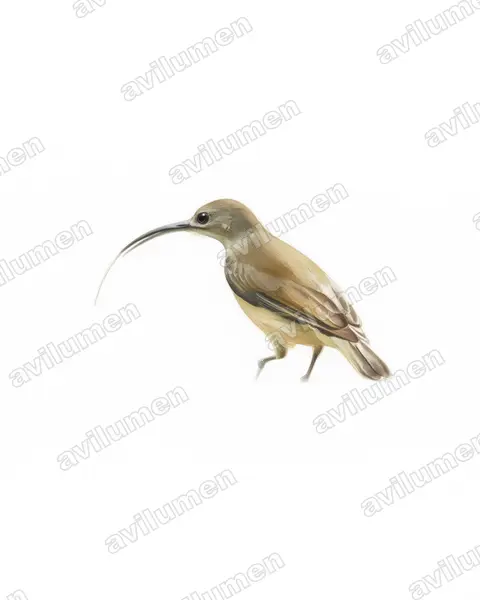
Watercolor 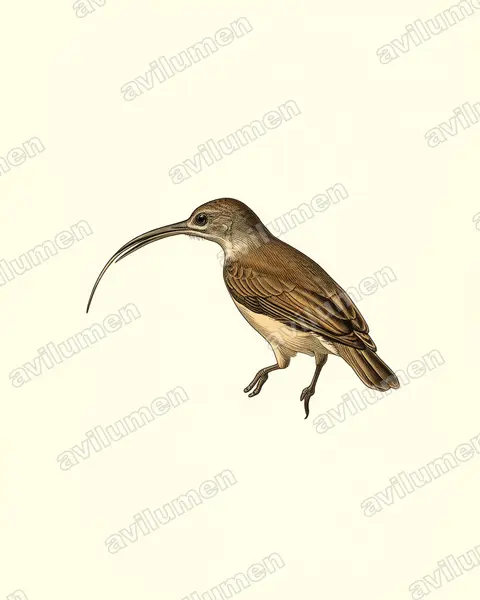
Vintage plate 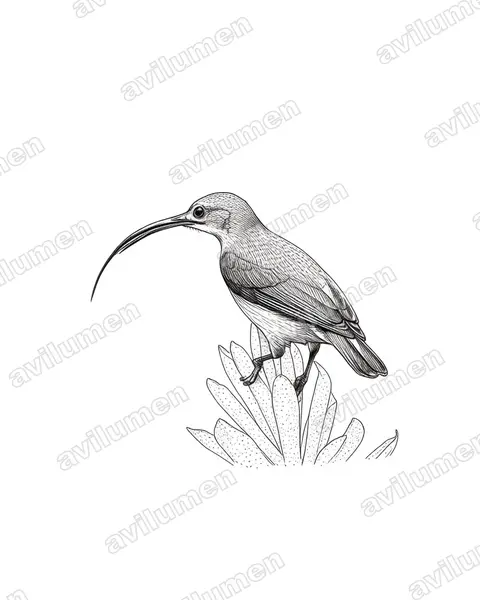
Ink 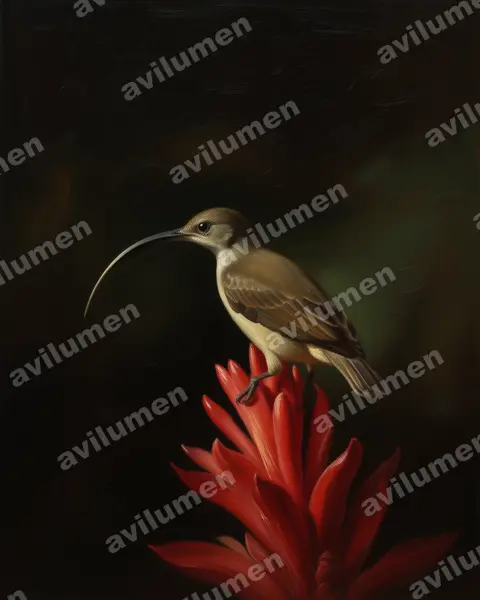
Oil 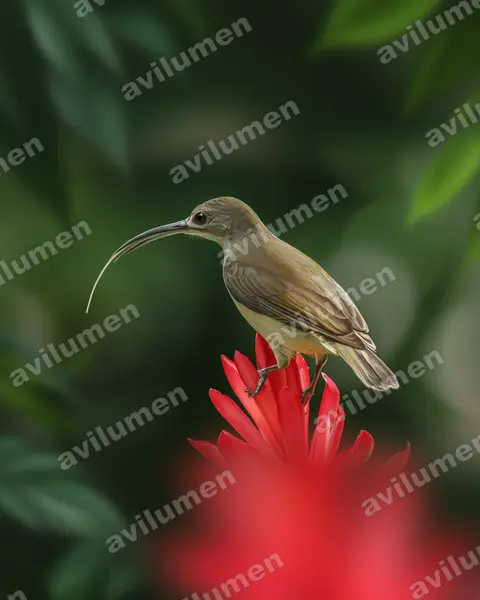
Realistic 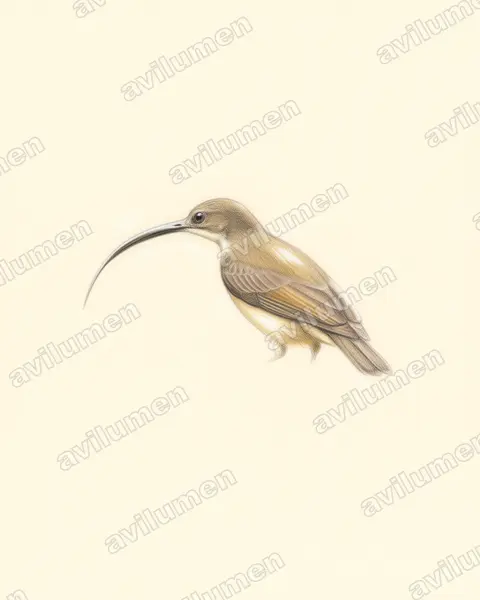
Colored pencil
Illustrations based on the photograph by Drsssuresh1961 (CC0), from Wikimedia Commons.
Digital editions
HD Digital Art Pack — Little Spiderhunter
Digital download: 6 high-resolution illustrations of the Little Spiderhunter (Arachnothera longirostra), print-ready. This is a digital file; no animal or physical item is included.
AI Avatar — Little Spiderhunter
Generate an avatar fusing your face with the Little Spiderhunter (Arachnothera longirostra). Delivered digitally in 8K, watermark-free. Digital product; no animals are sold or brokered.
Instant download. No live birds are sold.
Frequently asked questions
- Is Arachnothera longirostra (Little Spiderhunter) endangered?
- The IUCN Red List places Arachnothera longirostra, commonly known as the Little Spiderhunter, in the «Least concern» category. «Least concern» means it is not currently threatened.
- Where does Arachnothera longirostra (Little Spiderhunter) live?
- Arachnothera longirostra (Little Spiderhunter) is found in Bangladesh and India.
- What family does Arachnothera longirostra (Little Spiderhunter) belong to?
- Arachnothera longirostra (Little Spiderhunter) belongs to the family Nectariniidae, in the order Passeriformes.
More from the same family
 Least concern
Handsome Sunbird
Aethopyga bella
The handsome sunbird is a species of bird in the family Nectariniidae. It is endemic to the Philippines.
from $1.99
 Least concern
Apo Sunbird
Aethopyga boltoni
The Apo sunbird is a species of bird in the sunbird family Nectariniidae. It is endemic to the island of Mindanao in the Philippines. It is found in tropical moist montane forests at elevations ranging from 820 to 2,000 metres above sea level.
from $1.99
 Least concern
Fork-tailed Sunbird
Aethopyga christinae
The fork-tailed sunbird is a bird in the family Nectariniidae. The species was first described by Robert Swinhoe in 1869.
from $1.99
 Endangered
Elegant Sunbird
Aethopyga duyvenbodei
The elegant sunbird is a large, up to 12 cm long, Australasian sunbird in the genus Aethopyga. The male has an iridescent blue-green crown, shoulder patch and uppertail coverts, yellow bar across lower back, red ear coverts, olive back, yellow throat, red neck collar and yellow below. The female has a yellowish olive upperparts, scaly crown and yellow underparts.
from $1.99