Eared Quetzal
Euptilotis neoxenus
Avilumen editorial team ·

The eared quetzal, also known as the eared trogon, is a species of bird in the trogon family, Trogonidae. It is native to streamside pine-oak forests and canyons in the Sierra Madre Occidental of Mexico from northern Sonora and Chihuahua south to western Michoacán. The species has occurred on rare occasions in southeastern Arizona, where it has been recorded nesting.
The eared quetzal (Euptilotis neoxenus), also known as the eared trogon, is a species of bird in the trogon family, Trogonidae. It is native to streamside pine-oak forests and canyons in the Sierra Madre Occidental of Mexico from northern Sonora and Chihuahua south to western Michoacán. The species has occurred on rare occasions in southeastern Arizona, where it has been recorded nesting.
Taxonomy
The eared quetzal was described and illustrated in 1838 by the English ornithologist and bird artist John Gould in his book A Monograph of the Trogonidae, or Family of Trogons based on a specimen collected in Mexico. He coined the binomial name Trogon neoxenus. In 1858, in the second edition of his book, Gould placed the species in its own genus Euptilotis to give the current binomial name Euptilotis neoxenus. The eared quetzal is the only species placed in the genus. The specific epithet combines the Ancient Greek neos meaning "new" with xenos meaning "stranger", "guest" or "visitor". The genus name Euptilotis combines the Ancient Greek eu meaning "good" with ptilon meaning "feather" and -ōtis meaning "-eared". The species is monotypic, with no subspecies being recognized.
A molecular phylogenetic study published in 2005 found that the eared quetzal was sister to a clade containing members of the genus Pharomachrus.
Description
Its body length is 33–36 cm (13–14 in). Both sexes have iridescent green backs, iridescent dark blue central tail feathers, and outer tail feathers that are predominantly white terminally with a band of black at the base (sometimes partially barred black and white in females). The bill is dull gray with a slightly darker band at the tip. The adult male has a blackish head, iridescent green breast, and geranium red belly and undertail coverts. The adult female has a gray head, breast, and upper belly and less extensive (though equally bright) red on the lower belly. Both sexes bear the wispy hair-like auricular plumes that give the species its name, though these are rarely apparent in the field. Both head and bill appear rather small and narrow in comparison to those of typical trogons.
The male's song (tremolo call) is a series of whistled notes increasing in volume. Calls include low-intensity squeals rising in pitch, a loud squeal ending with a sharp "chuck", and a strident cackle given mostly in flight.
Quetzals differ from typical New World trogons in having iridescent wing coverts, less extensive fusion between the two forward-facing toes of their heterodactyl foot, broad tails with distinctly convex (rather than straight or concave) sides, and eggs with pale blue shells. They also average larger in body size than typical trogons, and the eggs and young develop more slowly. The eared quetzal is a seemingly primitive form, lacking the impressively long iridescent upper tail and wing coverts of members of the genus Pharomachrus (including the resplendent quetzal).
Distribution and habitat
It is a resident of the middle to upper levels of pine-oak woodlands and oak-conifer forests, frequently along streams.
Breeding
It nests 5–9 m (16–30 ft) high in an unlined shallow tree cavity, usually selecting an old woodpecker hole. Nests have been observed in pine, fir, maple, and aspen trees. Limited excavation of the cavity is accomplished using the bill to dig into the rotten wood of the walls and opening. The incubation and nestling periods are relatively long when compared to other species (28–31 days and 17–21 days, respectively)
The breeding season is from April to October, possibly starting earlier, as a young bird with an incompletely ossified skull has been found in mid April.
Food and feeding
Eared quetzals feed on insects, small vertebrates, and fruit, including the warty red fruit of madrone trees. Caterpillars, moths, katydids, cicadas, small lizards, and other prey are fed to the young. Like other trogons, eared quetzals often pluck prey and fruit while hovering.
Members of this species have been observed to exhibit aversion to large areas of conspicuous color on and near human observers (negative chromotropic responses), including white, red, orange, and blue. This suggests that the species-confidence hypothesis, which states that birds tend to be attracted to colors that match those found in their species and repelled by colors not found in their species, does not apply to eared quetzals.
Status
Previously thought to be rare, a dedicated year-long survey in Mexico in 1995 recorded the species at 55 sites, with the bird common in suitable habitat, and little affected by logging. The first breeding record in the United States was in southern Arizona in 1991.
Text adapted from Wikipedia · CC BY-SA 4.0
Plumage colours
Distribution

Taxonomy
- Order
- Trogoniformes
- Family
- Trogonidae
- Genus
- Euptilotis
- Conservation status
- Least concern
Listen to its call
No recording yet
Illustration gallery
6 illustrations of Euptilotis neoxenus (Eared Quetzal) in different styles, true to its real plumage. Shown watermarked; the art pack includes the high-resolution originals, ready to print.
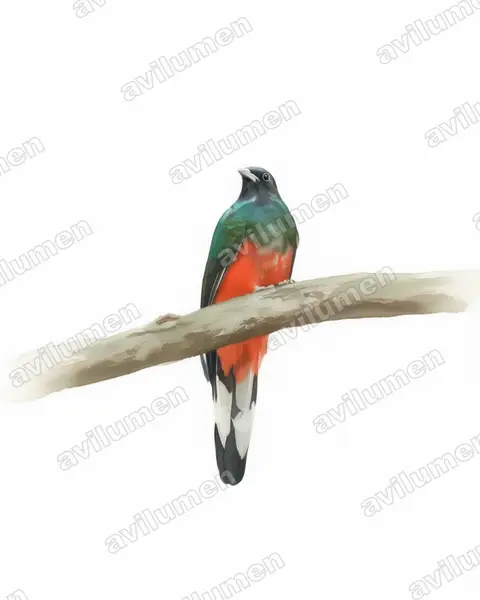
Watercolor 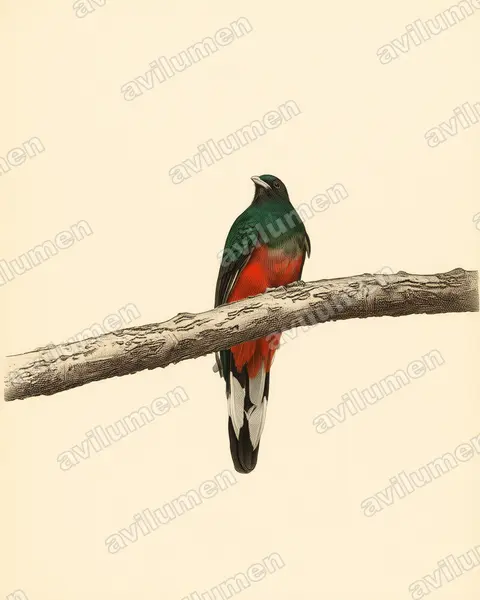
Vintage plate 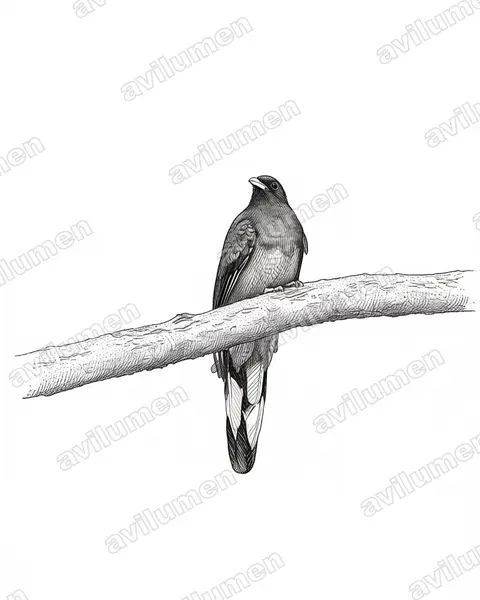
Ink 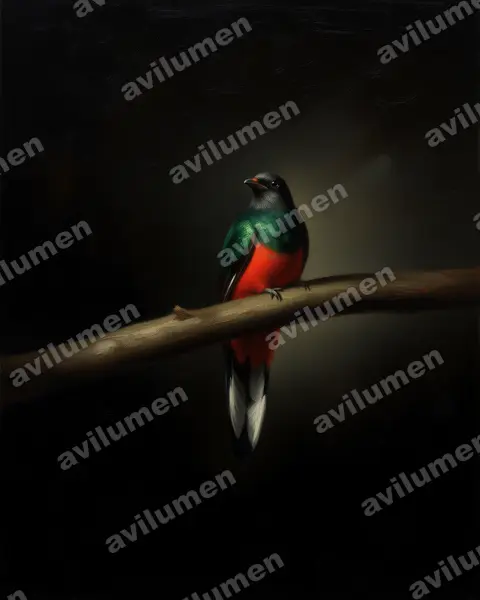
Oil 
Realistic 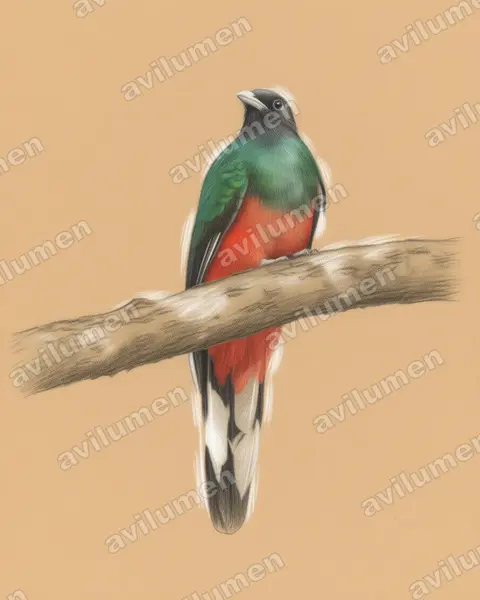
Colored pencil
Illustrations based on the photograph by Dario (CC0), from Wikimedia Commons.
Digital editions
HD Digital Art Pack — Eared Quetzal
Digital download: 6 high-resolution illustrations of the Eared Quetzal (Euptilotis neoxenus), print-ready. This is a digital file; no animal or physical item is included.
AI Avatar — Eared Quetzal
Generate an avatar fusing your face with the Eared Quetzal (Euptilotis neoxenus). Delivered digitally in 8K, watermark-free. Digital product; no animals are sold or brokered.
Instant download. No live birds are sold.
Frequently asked questions
- Is Euptilotis neoxenus (Eared Quetzal) endangered?
- The IUCN Red List places Euptilotis neoxenus, commonly known as the Eared Quetzal, in the «Least concern» category. «Least concern» means it is not currently threatened.
- What family does Euptilotis neoxenus (Eared Quetzal) belong to?
- Euptilotis neoxenus (Eared Quetzal) belongs to the family Trogonidae, in the order Trogoniformes.
- What colour is Euptilotis neoxenus (Eared Quetzal)?
- The plumage of Euptilotis neoxenus (Eared Quetzal) combines these colours: Green.
More from the same family
 Least concern
Sumatran Trogon
Apalharpactes mackloti
The Sumatran trogon is a species of bird in the family Trogonidae. It was formerly considered conspecific with the Javan trogon under the common name blue-tailed trogon.
from $1.99
 Vulnerable
Javan trogon
Apalharpactes reinwardtii
The Javan trogon is a bird species in the family Trogonidae endemic to western Java, Indonesia. It was previously grouped with the Sumatran trogon as a single species, known as the blue-tailed trogon. However, differences in size, weight, and plumage have led to their classification as separate species.
from $1.99
 Least concern
Bare-cheeked Trogon
Apaloderma aequatoriale
The bare-cheeked trogon is a species of bird in the family Trogonidae found in the rainforests of western central Africa.
from $1.99
 Least concern
Narina Trogon
Apaloderma narina
The Narina trogon is a largely green and red, medium-sized bird in the family Trogonidae. It is native to forests and woodlands of the Afrotropics. Though it is the most widespread and diverse in habitat choice of the three Apaloderma species, its numbers are locally depleted due to deforestation. Some populations are sedentary while others undertake regular movements.
from $1.99