Cuban Trogon
Priotelus temnurus
Avilumen editorial team ·

The Cuban trogon or tocororo is a species of bird in the family Trogonidae. It is endemic to Cuba, where it is also the national bird.
The Cuban trogon or tocororo (Priotelus temnurus) is a species of bird in the family Trogonidae. It is endemic to Cuba, where it is also the national bird.
Taxonomy and systematics
The Cuban trogon shares its genus with the Hispaniolan trogon (P. roseigaster). It has two subspecies, the nominate P. t. temnurus and P. t. vescus.
In Cuban Spanish, the bird is known as the tocororo, derived from its onomatopoeic call of "toco-toco-tocoro-tocoro".
It is the national bird of Cuba.
Description
is 23 to 28 cm (9.1 to 11 in) long and weighs 47 to 75 g (1.7 to 2.6 oz). Its plumage colors match those of Cuba's flag, and are the same for both sexes. The two subspecies also differ only slightly. Their beak is reddish pink with a dark culmen. Adults have a blackish face with reddish eyes, a dark metallic blue crown and nape, and a metallic green back and rump. Their cheeks, chin, and throat are white becoming clear gray on the breast and upper belly. Their lower belly and undertail coverts are red. Their tail is graduated, with the innermost feathers forming a point. The three innermost pairs of tail feathers are glossy blue-black with some bronzy highlights. The three outer pairs have blue-black bases and are mostly white beyond. The flight feathers and wing coverts are generally dark metallic green to black with a complex pattern of white spots. Juveniles have similar plumage to adults but generally are duller, with buffy gray underparts and reddish pink undertail coverts.
Distribution and habitat
The nominate subspecies of the Cuban trogon is found throughout the main island of Cuba and on several large cays off the Camagüey Province shore. P. t. vescus is found only on Isla de la Juventud. The species inhabits both primary and secondary forest and also shrublands and smaller woodlands near watercourses. It favors humid shady areas within those landscapes and occurs at all elevations but is most common at higher ones.
Movement
The Cuban trogan is mostly sedentary but makes seasonal local movements in elevation or in response to the availability of food. Their flight style is rather choppy and noisy.
Social behavior
The Cuban trogon is usually found in pairs though sometimes in groups of three or four. They seem "indifferent to human presence in the immediate vicinity."
Feeding
The Cuban trogon usually forages at the middle level of the forest; it takes food by sallying from a perch or by hovering at foliage or fruit. Its diet is mostly insects, fruit, and buds but it also feeds small lizards to young.
Breeding
The Cuban trogon's breeding season is mostly April to July. It nests in natural cavities or abandoned woodpecker holes, usually in trees but sometimes in arboreal termitaria. The clutch size is three or four eggs. The incubation period is about 18 days and fledging occurs about 21 days after hatch
Vocalization
The Cuban trogon's song is "a pleasant toco-toco-tocoro-tocoro..., repeated for long periods at frequent intervals." It also gives "a steady, rapid series of staccato notes" and "a low and short mournful call that makes it difficult to locate."
Status
The IUCN has assessed the Cuban trogon as being of Least Concern. It has a large range, but nonetheless, its population size is not known and is believed to be decreasing. No immediate threats have been identified. It is considered common and widespread throughout the main island of Cuba, but is rare on the small offshore cays and uncommon on Isla de la Juventud. Deforestation and habitat loss are two of the greatest threats to the Cuban trogon.
Cultural significance
The Cuban trogon has appeared on Cuban stamps, as well as on Cuban money.
Text adapted from Wikipedia · CC BY-SA 4.0
Plumage colours
Distribution

Taxonomy
- Order
- Trogoniformes
- Family
- Trogonidae
- Genus
- Priotelus
- Conservation status
- Least concern
Listen to its call
No recording yet
Illustration gallery
6 illustrations of Priotelus temnurus (Cuban Trogon) in different styles, true to its real plumage. Shown watermarked; the art pack includes the high-resolution originals, ready to print.
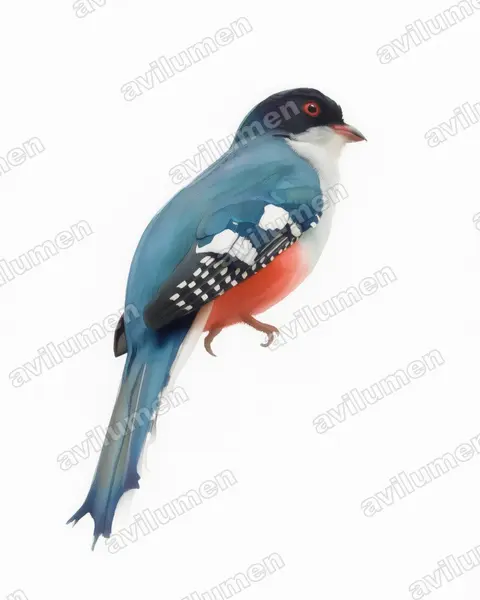
Watercolor 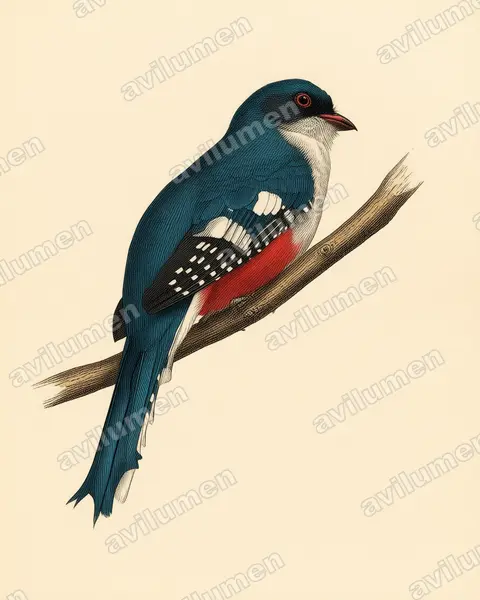
Vintage plate 
Ink 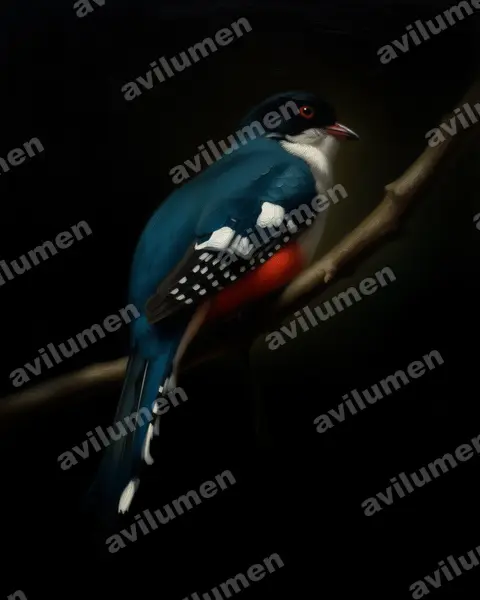
Oil 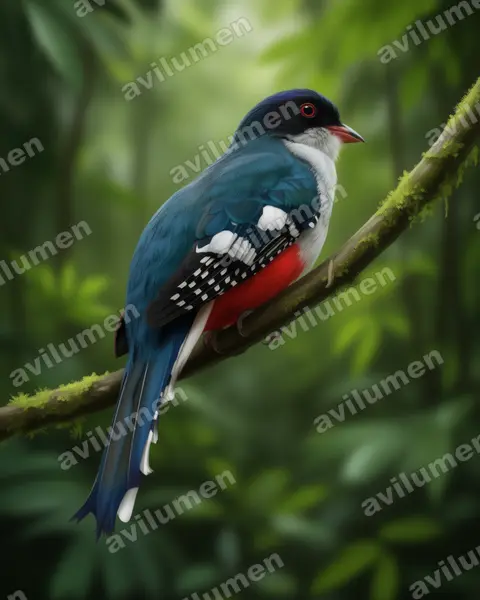
Realistic 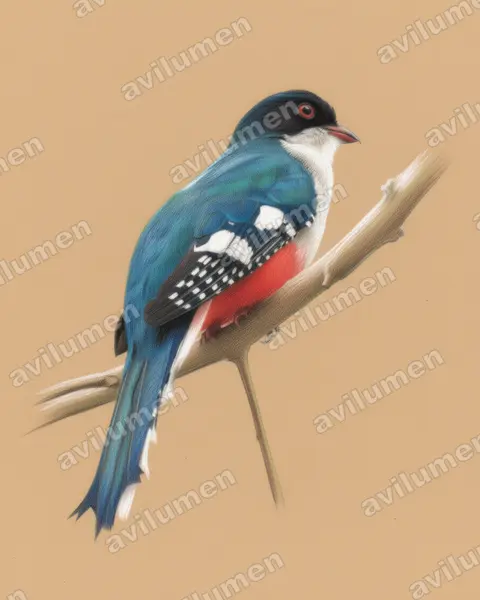
Colored pencil
Illustrations based on the photograph by Laura Gooch (CC BY-SA 2.0), from Wikimedia Commons.
Digital editions
HD Digital Art Pack — Cuban Trogon
Digital download: 6 high-resolution illustrations of the Cuban Trogon (Priotelus temnurus), print-ready. This is a digital file; no animal or physical item is included.
AI Avatar — Cuban Trogon
Generate an avatar fusing your face with the Cuban Trogon (Priotelus temnurus). Delivered digitally in 8K, watermark-free. Digital product; no animals are sold or brokered.
Instant download. No live birds are sold.
Frequently asked questions
- Is Priotelus temnurus (Cuban Trogon) endangered?
- The IUCN Red List places Priotelus temnurus, commonly known as the Cuban Trogon, in the «Least concern» category. «Least concern» means it is not currently threatened.
- What family does Priotelus temnurus (Cuban Trogon) belong to?
- Priotelus temnurus (Cuban Trogon) belongs to the family Trogonidae, in the order Trogoniformes.
- What colour is Priotelus temnurus (Cuban Trogon)?
- The plumage of Priotelus temnurus (Cuban Trogon) combines these colours: Multicoloured.
More from the same family
 Least concern
Sumatran Trogon
Apalharpactes mackloti
The Sumatran trogon is a species of bird in the family Trogonidae. It was formerly considered conspecific with the Javan trogon under the common name blue-tailed trogon.
from $1.99
 Vulnerable
Javan trogon
Apalharpactes reinwardtii
The Javan trogon is a bird species in the family Trogonidae endemic to western Java, Indonesia. It was previously grouped with the Sumatran trogon as a single species, known as the blue-tailed trogon. However, differences in size, weight, and plumage have led to their classification as separate species.
from $1.99
 Least concern
Bare-cheeked Trogon
Apaloderma aequatoriale
The bare-cheeked trogon is a species of bird in the family Trogonidae found in the rainforests of western central Africa.
from $1.99
 Least concern
Narina Trogon
Apaloderma narina
The Narina trogon is a largely green and red, medium-sized bird in the family Trogonidae. It is native to forests and woodlands of the Afrotropics. Though it is the most widespread and diverse in habitat choice of the three Apaloderma species, its numbers are locally depleted due to deforestation. Some populations are sedentary while others undertake regular movements.
from $1.99