Diopsittaca nobilis
Diopsittaca nobilis
Equipo editorial de Avilumen ·

El guacamayo noble o guacamayo de Hahn es una especie de ave de la familia de los loros (Psittacidae).
The red-shouldered macaw (Diopsittaca nobilis) is a small green South American parrot, a member of a large group of Neotropical parrots called macaws. The species is named for the red coverts on its wings. It is the smallest macaw, being 30 cm (12 in) in length – similar in size to the Aratinga parakeets. It is native to the tropical lowlands, savannahs, and swamplands of Brazil, the Guianas, Bolivia, Venezuela, and far south-eastern Peru. There are three subspecies: The noble macaw (Diopsittaca nobilis cumanensis), Hahn's macaw (Diopsittaca nobilis nobilis), and the long-winged macaw (Diopsittaca nobilis longipennis). The long-winged macaw is a poorly distinct third subspecies that has longer wings, but is otherwise similar to the noble macaw. The Hahn's subspecies is named for German zoologist Carl-Wilhelm Hahn, who in 1834 began compiling Ornithologischer Atlas oder naturgetreue Abbildung und Beschreibung der aussereuropäischen Vögel (Engl: Ornithological Atlas or natural depiction and description of birds from outside Europe).
Red-shouldered macaws are frequently bred in captivity for the pet trade, where they are sometimes described as mini-macaws.
Though wild populations of red-shouldered macaws have declined locally due to habitat loss, they are listed as Least Concern by IUCN. They are listed on Appendix II of CITES, and trade is restricted.
Taxonomy
The red-shouldered macaw was formally described in 1758 by the Swedish naturalist Carl Linnaeus in the tenth edition of his Systema Naturae. He placed it with all the other parrots in the genus Psittacus and coined the binomial name Psittacus nobilis. The red-shouldered macaw is now the only species placed in the genus Diopsittaca, which was introduced in 1912 by the American ornithologist Robert Ridgway. The genus name combines the Ancient Greek dios, "noble" with psittakē, meaning "parrot". The specific epithet noblilis is Latin meaning "noble". There are two distinct subspecies, D. n. nobilis (Hahn's macaw) and D. n. cumanensis (noble macaw), and some with longer wings might represent a poorly differentiated subspecies, D. n. longipennis, which intergrades with D. n. cumanensis in central Goiás, Brazil. The species is sometimes subsumed into the genus Ara.
Taxonomy proposed by BirdLife International splits the red-shouldered macaw into two species.
Northern red-shouldered macaw (Diopsittaca nobilis)
Southern red-shouldered macaw (Diopsittaca cumanensis)
Description
The red-shouldered macaw, at 30 cm (12 in) long and 165 g (5.8 oz), is the smallest of all the macaws. Like all macaws, it has a long narrow tail and a large head. It has bright green feathers on the body, with dark or slate blue feathers on the head just above the beak. The wings and tail have feathers that are bright green above and olive-green below. The leading edges of the wings, especially on the underside, are red. (These red feathers appear at puberty.) Their eyes are orange, and the skin around the eyes is white without feathers, just as in the larger macaws. This bare patch of facial skin is smaller in proportion to the head than the one seen in most larger macaws. The Hahn's macaw and noble macaw can be distinguished by the upper mandible, which is black in the Hahn's macaw and horn-colored in the noble macaw.
Their natural vocalizations are more akin to screeches than they are to whistles.
Behavior
Red-shouldered macaws are very kind-natured, similar to the large macaws.
Breeding
The red-shouldered macaw nests in a hole in a tree. There are usually three or four white eggs in a clutch. The female incubates the eggs for about 24 to 26 days, and the chicks fledge from the nest about 54 days after hatching.
Aviculture
Although a noisy bird that is not suitable for apartment living, the red-shouldered macaw can be an excellent pet. If properly socialized, it is typically a gentle, intelligent bird that bonds well with humans and gets along well with well-behaved children. In addition, it is an excellent talker that can be taught many tricks. It may be a more suitable pet parrot for those who lack the space in their homes for a larger macaw, although it requires daily exercise outside of its cage. It is also recommended by the World Parrot Trust that this parrot should have access to an outside enclosure for at least part of the year. The red-shouldered macaw can live for 25–40 years in captivity.
Texto adaptado de Wikipedia · CC BY-SA 4.0
Dónde vive
Distribución

Taxonomía
- Orden
- Psittaciformes
- Familia
- Psittacidae
- Género
- Diopsittaca
- Estado de conservación
- Preocupación menor
Escucha su canto
Aún sin grabación
Guía de cuidado
Guacamayos: guía de cuidado, alimentación y cría
Cómo cuidar un guacamayo: dieta, tamaño de jaula o aviario, salud, cría, ruido y requisitos legales CITES. Guía práctica para dueños y futuros dueños.
Leer la guía →Galería de ilustraciones
6 ilustraciones de Diopsittaca nobilis (Diopsittaca nobilis) en estilos distintos, fieles a su plumaje real. Se muestran con marca de agua; el pack de arte incluye los originales en alta resolución, listos para imprimir.
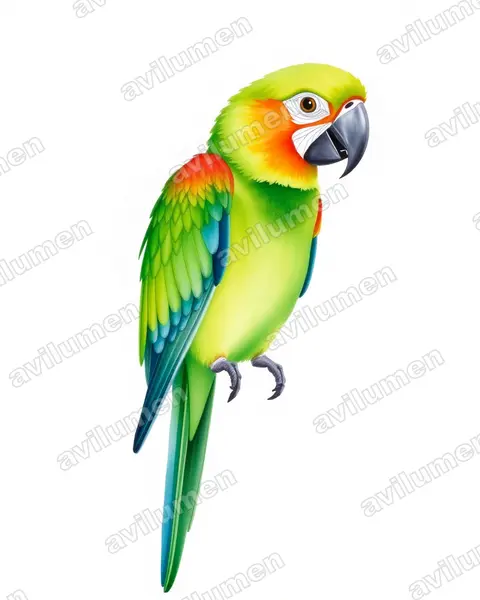
Acuarela 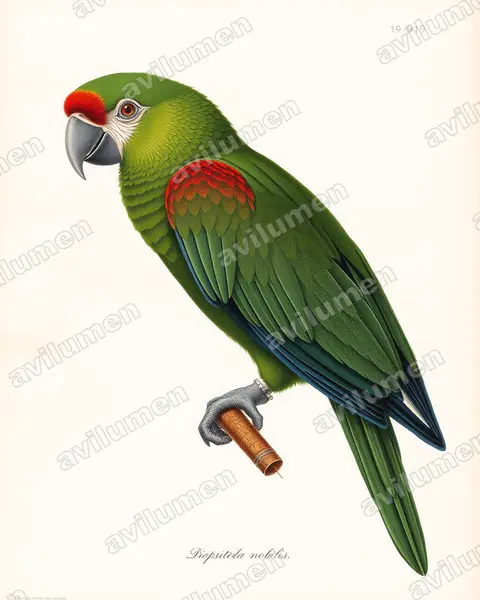
Lámina antigua 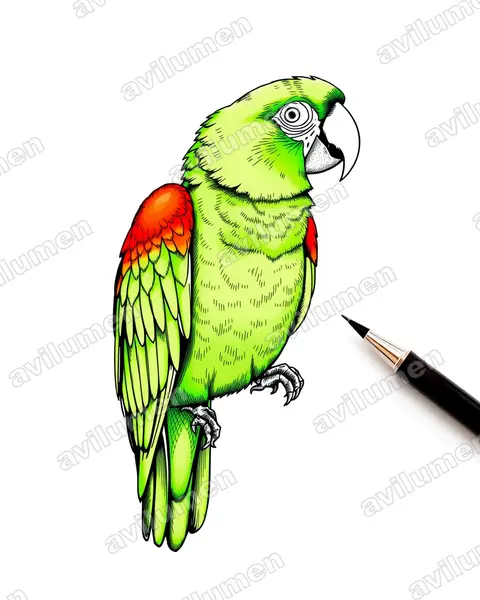
Tinta 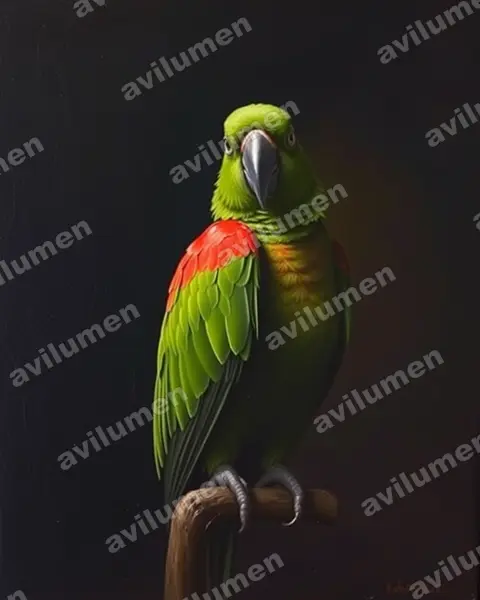
Óleo 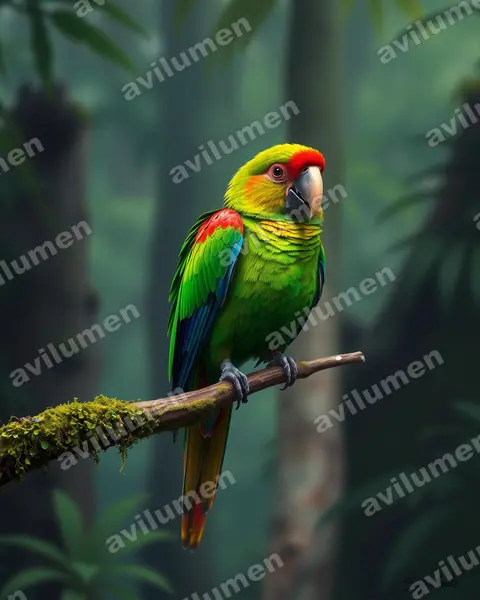
Realista 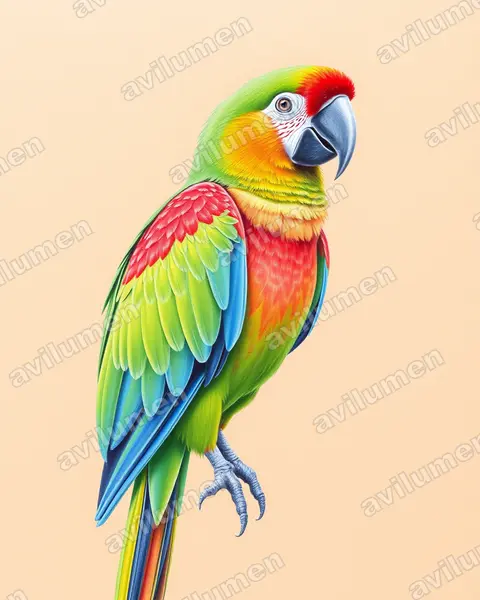
Lápiz de color
Ediciones digitales
Pack de arte digital HD — Diopsittaca nobilis
Descarga digital: 6 ilustraciones en alta resolución del Diopsittaca nobilis (Diopsittaca nobilis), listas para imprimir. Es un archivo digital; no incluye ningún animal ni producto físico.
Avatar con IA — Diopsittaca nobilis
Genera un avatar fusionando tu rostro con el Diopsittaca nobilis (Diopsittaca nobilis). Entrega digital en 8K y sin marca de agua. Producto digital; no se venden ni intermedian animales.
Descarga inmediata. No se venden aves vivas.
Preguntas frecuentes
- ¿Está Diopsittaca nobilis (Diopsittaca nobilis) en peligro de extinción?
- La Lista Roja de la UICN clasifica a Diopsittaca nobilis, cuyo nombre común es Diopsittaca nobilis, en la categoría «Preocupación menor». «Preocupación menor» significa que no está amenazada en este momento.
- ¿Dónde vive Diopsittaca nobilis (Diopsittaca nobilis)?
- Diopsittaca nobilis (Diopsittaca nobilis) habita en América del Sur y Brasil.
- ¿A qué familia pertenece Diopsittaca nobilis (Diopsittaca nobilis)?
- Diopsittaca nobilis (Diopsittaca nobilis) pertenece a la familia Psittacidae, dentro del orden Psittaciformes.
- ¿De qué color es Diopsittaca nobilis (Diopsittaca nobilis)?
- El plumaje de Diopsittaca nobilis (Diopsittaca nobilis) combina estos colores: Verde y Rojo.
Otras de la misma familia
 Casi amenazada
Amazona del Cerrado
Alipiopsitta xanthops
La amazona del Cerrado, también denominada loro cara amarilla o amazona chica, es una especie de ave de la familia de los loros. Puebla las sabanas del cerrado brasileño y parte de Bolivia. Es la única especie del género Alipiopsitta
desde 1,99 US$
 Preocupación menor
Papagayo moluqueño
Alisterus amboinensis
El papagayo moluqueño es una especie de ave psitaciforme de la familia Psittaculidae endémica del este del archipiélago malayo.
desde 1,99 US$
 Preocupación menor
Papagayo papú
Alisterus chloropterus
El papagayo papú es una especie de ave psitaciforme de la familia Psittaculidae endémica del este de Nueva Guinea.
desde 1,99 US$
 Preocupación menor
Papagayo australiano
Alisterus scapularis
El papagayo australiano o cotorra real es una especie de ave psitaciforme de la familia Psittaculidae endémica del este de Australia. Se encuentra en los bosques húmedos de regiones altas del este del continente australiano, incluidos los bosques de Eucalyptus de la zona templada como las selvas de las zonas tropicales y subtropicales. Se alimentan de frutos, semillas e insectos.
desde 1,99 US$