Red-shouldered Macaw
Diopsittaca nobilis
Avilumen editorial team ·

The red-shouldered macaw is a small green South American parrot, a member of a large group of Neotropical parrots called macaws. The species is named for the red coverts on its wings. It is the smallest macaw, being 30 cm (12 in) in length – similar in size to the Aratinga parakeets. It is native to the tropical lowlands, savannahs, and swamplands of Brazil, the Guianas, Bolivia, Venezuela, and far south-eastern Peru.
The red-shouldered macaw (Diopsittaca nobilis) is a small green South American parrot, a member of a large group of Neotropical parrots called macaws. The species is named for the red coverts on its wings. It is the smallest macaw, being 30 cm (12 in) in length – similar in size to the Aratinga parakeets. It is native to the tropical lowlands, savannahs, and swamplands of Brazil, the Guianas, Bolivia, Venezuela, and far south-eastern Peru. There are three subspecies: The noble macaw (Diopsittaca nobilis cumanensis), Hahn's macaw (Diopsittaca nobilis nobilis), and the long-winged macaw (Diopsittaca nobilis longipennis). The long-winged macaw is a poorly distinct third subspecies that has longer wings, but is otherwise similar to the noble macaw. The Hahn's subspecies is named for German zoologist Carl-Wilhelm Hahn, who in 1834 began compiling Ornithologischer Atlas oder naturgetreue Abbildung und Beschreibung der aussereuropäischen Vögel (Engl: Ornithological Atlas or natural depiction and description of birds from outside Europe).
Red-shouldered macaws are frequently bred in captivity for the pet trade, where they are sometimes described as mini-macaws.
Though wild populations of red-shouldered macaws have declined locally due to habitat loss, they are listed as Least Concern by IUCN. They are listed on Appendix II of CITES, and trade is restricted.
Taxonomy
The red-shouldered macaw was formally described in 1758 by the Swedish naturalist Carl Linnaeus in the tenth edition of his Systema Naturae. He placed it with all the other parrots in the genus Psittacus and coined the binomial name Psittacus nobilis. The red-shouldered macaw is now the only species placed in the genus Diopsittaca, which was introduced in 1912 by the American ornithologist Robert Ridgway. The genus name combines the Ancient Greek dios, "noble" with psittakē, meaning "parrot". The specific epithet noblilis is Latin meaning "noble". There are two distinct subspecies, D. n. nobilis (Hahn's macaw) and D. n. cumanensis (noble macaw), and some with longer wings might represent a poorly differentiated subspecies, D. n. longipennis, which intergrades with D. n. cumanensis in central Goiás, Brazil. The species is sometimes subsumed into the genus Ara.
Taxonomy proposed by BirdLife International splits the red-shouldered macaw into two species.
Northern red-shouldered macaw (Diopsittaca nobilis)
Southern red-shouldered macaw (Diopsittaca cumanensis)
Description
The red-shouldered macaw, at 30 cm (12 in) long and 165 g (5.8 oz), is the smallest of all the macaws. Like all macaws, it has a long narrow tail and a large head. It has bright green feathers on the body, with dark or slate blue feathers on the head just above the beak. The wings and tail have feathers that are bright green above and olive-green below. The leading edges of the wings, especially on the underside, are red. (These red feathers appear at puberty.) Their eyes are orange, and the skin around the eyes is white without feathers, just as in the larger macaws. This bare patch of facial skin is smaller in proportion to the head than the one seen in most larger macaws. The Hahn's macaw and noble macaw can be distinguished by the upper mandible, which is black in the Hahn's macaw and horn-colored in the noble macaw.
Their natural vocalizations are more akin to screeches than they are to whistles.
Behavior
Red-shouldered macaws are very kind-natured, similar to the large macaws.
Breeding
The red-shouldered macaw nests in a hole in a tree. There are usually three or four white eggs in a clutch. The female incubates the eggs for about 24 to 26 days, and the chicks fledge from the nest about 54 days after hatching.
Aviculture
Although a noisy bird that is not suitable for apartment living, the red-shouldered macaw can be an excellent pet. If properly socialized, it is typically a gentle, intelligent bird that bonds well with humans and gets along well with well-behaved children. In addition, it is an excellent talker that can be taught many tricks. It may be a more suitable pet parrot for those who lack the space in their homes for a larger macaw, although it requires daily exercise outside of its cage. It is also recommended by the World Parrot Trust that this parrot should have access to an outside enclosure for at least part of the year. The red-shouldered macaw can live for 25–40 years in captivity.
Text adapted from Wikipedia · CC BY-SA 4.0
Where it lives
Distribution

Taxonomy
- Order
- Psittaciformes
- Family
- Psittacidae
- Genus
- Diopsittaca
- Conservation status
- Least concern
Listen to its call
No recording yet
Care guide
Macaw Care Guide: Diet, Housing and Breeding
How to care for a macaw: diet, cage and aviary size, health, breeding, noise and CITES legal requirements. A practical guide for current and future owners.
Read the guide →Illustration gallery
6 illustrations of Diopsittaca nobilis (Red-shouldered Macaw) in different styles, true to its real plumage. Shown watermarked; the art pack includes the high-resolution originals, ready to print.
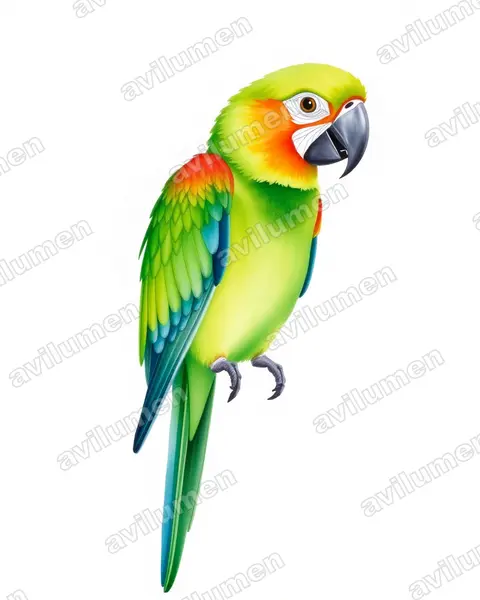
Watercolor 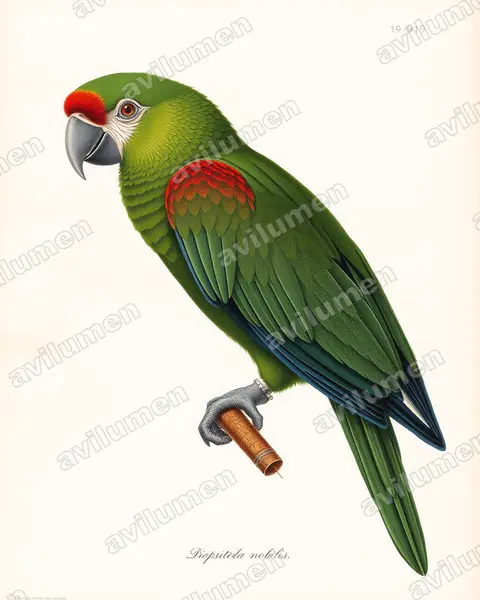
Vintage plate 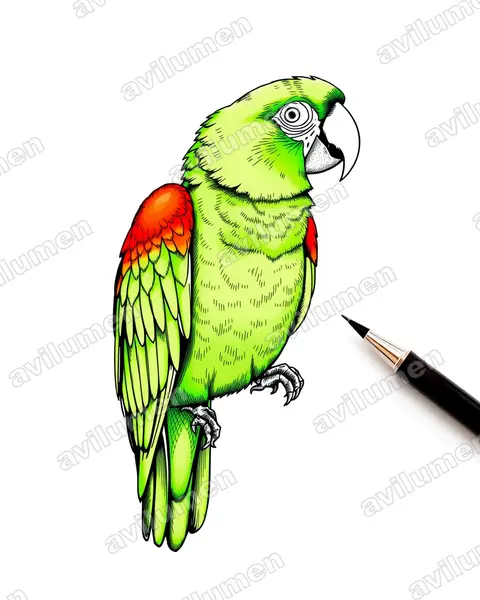
Ink 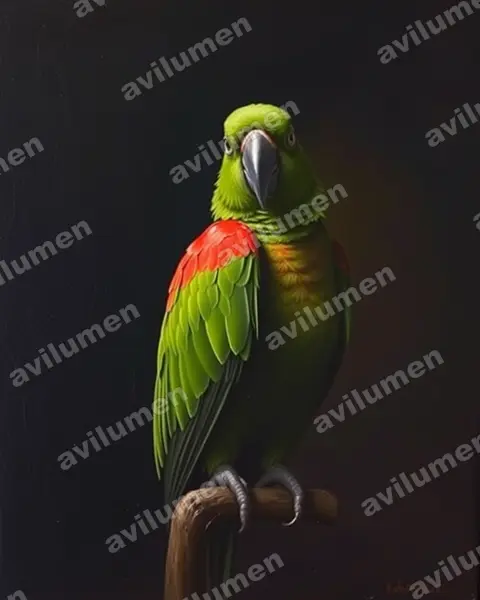
Oil 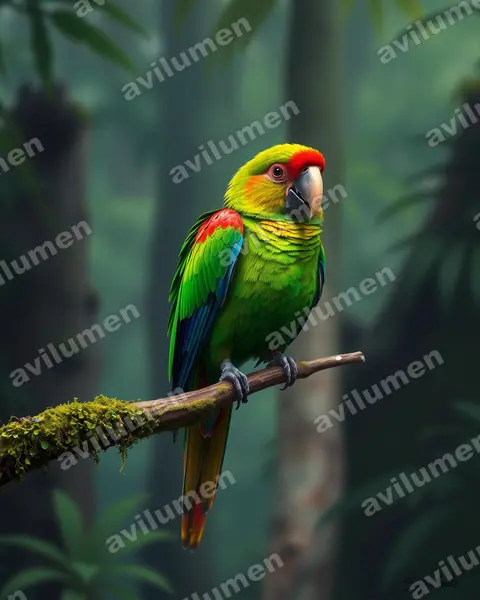
Realistic 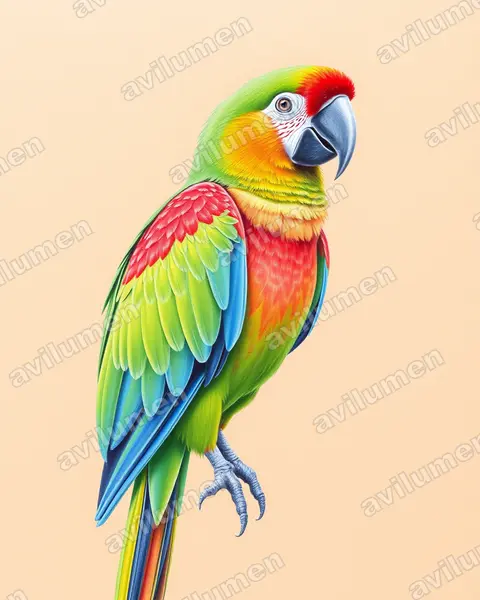
Colored pencil
Digital editions
HD Digital Art Pack — Red-shouldered Macaw
Digital download: 6 high-resolution illustrations of the Red-shouldered Macaw (Diopsittaca nobilis), print-ready. This is a digital file; no animal or physical item is included.
AI Avatar — Red-shouldered Macaw
Generate an avatar fusing your face with the Red-shouldered Macaw (Diopsittaca nobilis). Delivered digitally in 8K, watermark-free. Digital product; no animals are sold or brokered.
Instant download. No live birds are sold.
Frequently asked questions
- Is Diopsittaca nobilis (Red-shouldered Macaw) endangered?
- The IUCN Red List places Diopsittaca nobilis, commonly known as the Red-shouldered Macaw, in the «Least concern» category. «Least concern» means it is not currently threatened.
- Where does Diopsittaca nobilis (Red-shouldered Macaw) live?
- Diopsittaca nobilis (Red-shouldered Macaw) is found in Brazil and South America.
- What family does Diopsittaca nobilis (Red-shouldered Macaw) belong to?
- Diopsittaca nobilis (Red-shouldered Macaw) belongs to the family Psittacidae, in the order Psittaciformes.
- What colour is Diopsittaca nobilis (Red-shouldered Macaw)?
- The plumage of Diopsittaca nobilis (Red-shouldered Macaw) combines these colours: Green and Red.
More from the same family
 Near threatened
Yellow-faced Parrot
Alipiopsitta xanthops
The yellow-faced parrot, formerly also known as the yellow-faced amazon, is the only species of the genus Alipiopsitta. It is a Neotropical parrot, and was classified in the genus Amazona for many years. It is a predominantly green and yellow-plumaged bird with a yellow head. It is a semi-nomadic species found in the cerrado region of Brazil and adjacent Bolivia.
from $1.99
 Least concern
Moluccan King Parrot
Alisterus amboinensis
The Moluccan king parrot is a parrot endemic to Peleng Island, Maluku, and West Papua in Indonesia. It is sometimes referred to as the Ambon king parrot or Amboina king parrot, but this is potentially misleading, as it is found on numerous other islands than Ambon. The male and female are similar in appearance, with a predominantly red head and underparts, green wings, and blue back and tail.
from $1.99
 Least concern
Papuan King Parrot
Alisterus chloropterus
The Papuan king parrot, also known as the green-winged king parrot, is a species of parrot in the family Psittaculidae found in New Guinea. Its natural habitats are subtropical or tropical moist lowland forest and subtropical or tropical moist montane forest.
from $1.99
 Least concern
Australian King Parrot
Alisterus scapularis
The Australian king parrot is a species of parrot endemic to eastern Australia ranging from Cooktown in Queensland to Port Campbell in Victoria. Found in humid and heavily forested upland regions of the eastern portion of the continent, including eucalyptus wooded areas in and directly adjacent to subtropical and temperate rainforest. They feed on fruits and seeds gathered from trees or on the ground.
from $1.99