Scaled Fruiteater
Ampelioides tschudii
Avilumen editorial team ·

The scaled fruiteater is a species of bird in the family Cotingidae. It is the only member of the genus Ampelioides. This bird is found in Bolivia, Colombia, Ecuador, Peru, and Venezuela, where its natural habitat is the high elevation tropical forests of the Andes mountains. The scaled fruiteater is a chunky, short-tailed, flat-headed bird measuring 19–20 cm (7.5–7.9 in) in length.
The scaled fruiteater (Ampelioides tschudii) is a species of bird in the family Cotingidae. It is the only member of the genus Ampelioides. This bird is found in Bolivia, Colombia, Ecuador, Peru, and Venezuela, where its natural habitat is the high elevation tropical forests of the Andes mountains. The scaled fruiteater is a chunky, short-tailed, flat-headed bird measuring 19–20 cm (7.5–7.9 in) in length. It uses its green scaled feather pattern to blend in with the dense vegetation of the South American rainforest.
Physical characteristics
The scaled fruiteater is characterized by its olive-green plumage with fine scaling on the chest and belly. The Scaled Fruiteater has a short and sharp beak, specialized for eating fruits, seeds, and insects. Males have an all-black head, display a more vibrant green color on their bodies, and have longer tails than females.
Distribution and habitat
The scaled fruiteater is found in the montane forests of the Andes mountains. They inhabit dense rainforests where they stay below the canopy, often near streams or other water sources. This species is found at high elevations, ranging from 1,000 to 3,500 meters (3,300 to 11,500 ft) above sea level.
Behavior and ecology
Scaled fruiteaters feed on a variety of fruits and berries that are unique to the South American mountain ranges. They supplement their diet with insects during the breeding season when protein-rich food is essential for raising young. These birds are known for their camouflage ability, utilizing their green scales to remain hidden within the dense vegetation. The Scaled Fruiteater is non-migratory and will stay in the Andes region year-round.
Reproduction
During the breeding season, males establish territories and attract female mates through vocalizations and aerial displays. The nest is a shallow cup constructed from plant fibers where Females will typically lay two eggs, which are incubated for about two weeks. Both parents participate in feeding and caring for the chicks until they develop wings large enough for flight.
Conservation status
The scaled fruiteater is considered a species of least concern by the International Union for Conservation of Nature (IUCN). While the bird continues to thrive, populations may be declining due to habitat loss caused by deforestation and human development. Conservation efforts focus on preserving and restoring their forest habitats and raising awareness about the importance of protecting these unique birds and their ecosystems.
Cultural Significance
Scaled fruiteaters have captured the interest of birdwatchers and ecotourists, attracting visitors to the Andean regions where they are found. Their unique appearance and elusive behavior make them a sought-after sighting for bird enthusiasts. Because of their elusiveness there is a lack of research and knowledge on these birds.
Text adapted from Wikipedia · CC BY-SA 4.0
Where it lives
Plumage colours
Distribution

Taxonomy
- Order
- Passeriformes
- Family
- Cotingidae
- Genus
- Ampelioides
- Conservation status
- Least concern
Listen to its call
No recording yet
Illustration gallery
6 illustrations of Ampelioides tschudii (Scaled Fruiteater) in different styles, true to its real plumage. Shown watermarked; the art pack includes the high-resolution originals, ready to print.
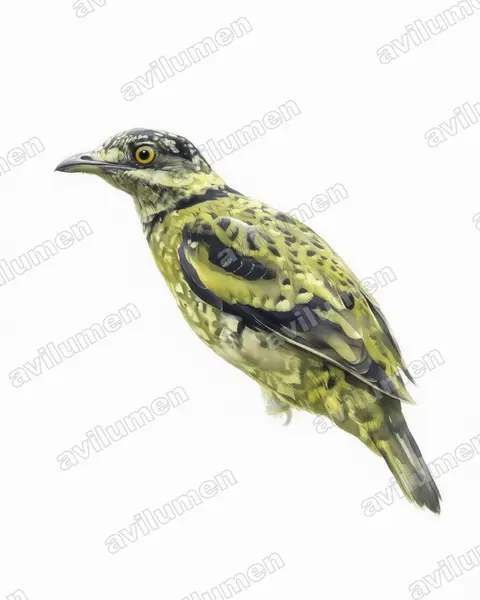
Watercolor 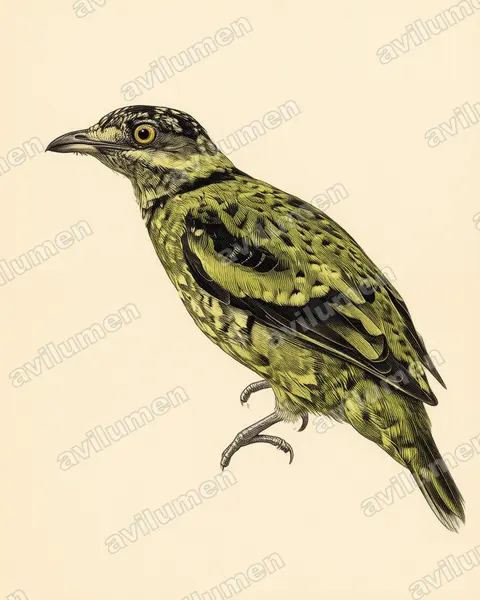
Vintage plate 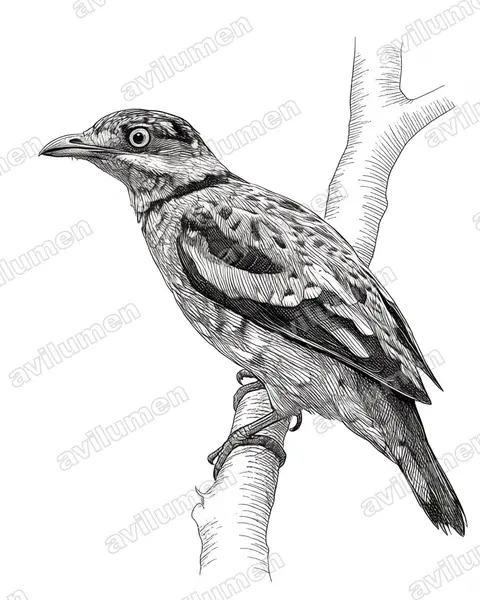
Ink 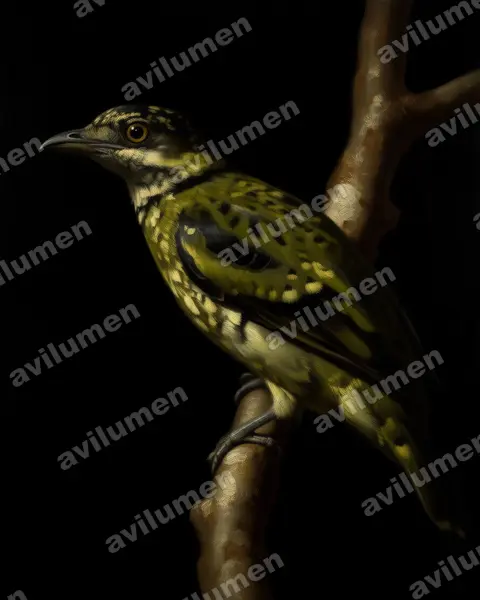
Oil 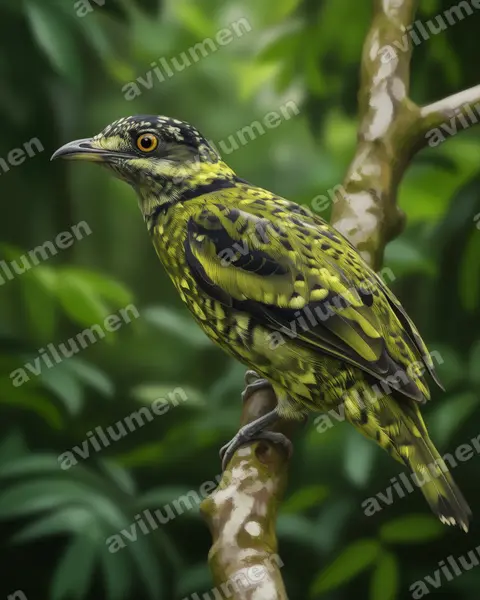
Realistic 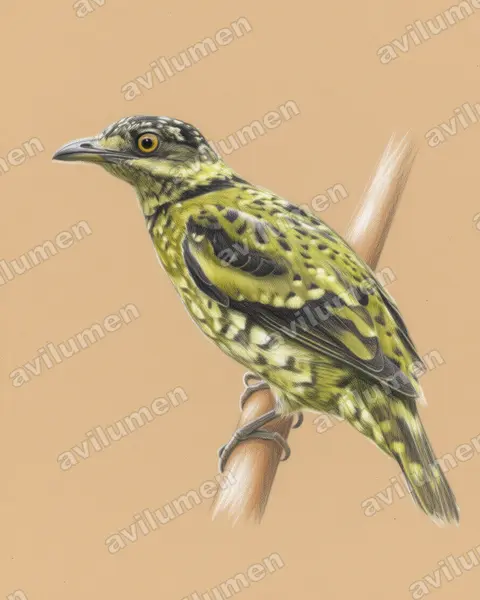
Colored pencil
Illustrations based on the photograph by Charles J. Sharp (CC BY-SA 4.0), from Wikimedia Commons.
Digital editions
HD Digital Art Pack — Scaled Fruiteater
Digital download: 6 high-resolution illustrations of the Scaled Fruiteater (Ampelioides tschudii), print-ready. This is a digital file; no animal or physical item is included.
AI Avatar — Scaled Fruiteater
Generate an avatar fusing your face with the Scaled Fruiteater (Ampelioides tschudii). Delivered digitally in 8K, watermark-free. Digital product; no animals are sold or brokered.
Instant download. No live birds are sold.
Frequently asked questions
- Is Ampelioides tschudii (Scaled Fruiteater) endangered?
- The IUCN Red List places Ampelioides tschudii, commonly known as the Scaled Fruiteater, in the «Least concern» category. «Least concern» means it is not currently threatened.
- Where does Ampelioides tschudii (Scaled Fruiteater) live?
- Ampelioides tschudii (Scaled Fruiteater) is found in South America.
- What family does Ampelioides tschudii (Scaled Fruiteater) belong to?
- Ampelioides tschudii (Scaled Fruiteater) belongs to the family Cotingidae, in the order Passeriformes.
- What colour is Ampelioides tschudii (Scaled Fruiteater)?
- The plumage of Ampelioides tschudii (Scaled Fruiteater) combines these colours: Green.
More from the same family
 Least concern
Red-crested Cotinga
Ampelion rubrocristatus
The red-crested cotinga is a species of bird in the family Cotingidae. It is found in Bolivia, Colombia, Ecuador, Peru, and Venezuela.
from $1.99
 Least concern
Chestnut-crested Cotinga
Ampelion rufaxilla
The chestnut-crested cotinga is a species of bird in the family Cotingidae. It is found in Bolivia, Colombia, Ecuador, and Peru.
from $1.99
 Critically endangered
Kinglet Calyptura
Calyptura cristata
The kinglet calyptura is a small Critically Endangered passerine bird in the family Tyrannidae, the tyrant flycatchers. It is endemic to southeastern Brazil.
from $1.99
 Near threatened
Yellow-billed Cotinga
Carpodectes antoniae
The yellow-billed cotinga is a species of bird in the family Cotingidae. It is found in the Pacific lowlands of Costa Rica and Panama. Its natural habitats are subtropical or tropical moist lowland forest, subtropical or tropical mangrove forest, and subtropical or tropical moist shrubland. It is threatened by habitat destruction.
from $1.99