Arfak astrapia
Astrapia nigra
Avilumen editorial team ·

The Arfak astrapia is a species of astrapia, a group of birds found in the birds-of-paradise family Paradiseidae.
The Arfak astrapia (Astrapia nigra) is a species of astrapia, a group of birds found in the birds-of-paradise family Paradiseidae.
Taxonomy
The Arfak astrapia was formally described in 1788 by the German naturalist Johann Friedrich Gmelin in his revised and expanded edition of Carl Linnaeus's Systema Naturae. He placed it with the birds of paradise in the genus Paradisea (now spelled Paradisaea) and coined the binomial name Paradisea nigra. Gmelin based his description on the "Gorget paradise bird" that had been described in 1782 by the English ornithologist John Latham in his book A General Synopsis of Birds. Lathan had examined a specimen in the collection of the naturalist Joseph Banks. The type location is the Arfak Mountains in the Bird's Head Peninsula of northwest New Guinea. The Arfak astrapia is now placed in the genus Astrapia that was introduced in 1816 by the French ornithologist Louis Pierre Vieillot. The genus name is derived from Ancient Greek astrapios or astrapaios meaning "of lightning". The specific epithet nigra is from Latin niger meaning "black". The species is monotypic: no subspecies are recognised.
Description
The Arfak astrapia is the third largest of its genus, being approximately 76 cm (30 in) long, including the tail. The male has a black head with a bluish-purple sheen, or iridescence, an elongated jet-black nape crests extending up along the sides of the up to the eyes on each side, a shiny, metallic greenish-yellow cape from the mantle up to the nape, very black, dense and elongated upper breast feathers, and an almost exaggeratedly long tail almost two times the length of its body. The female is less appealing, being dark brown over most of its body and a blackish head, and sporting much shorter tail feathers. The female is also exceptionally shorter than the male.
Levaillant of France described this bird as L'Incomparable or Incomparable bird-of-paradise.
Distribution
Astrapia nigra is endemic to the Arfak Mountains in Vogelkop Peninsula, West Papua.
Behaviour and ecology
The habits of the Arfak astrapia are very little known. The birds are found mostly in cloud forests at 1,700 to 2,250 m (5,580 to 7,380 ft) at the apex of the Arfak Mountains. Foraging habits observed include the birds probing fruits, mostly pandanus fruits, off of moss and epiphytes in the montane canopy. Arthropods also recorded in the diet. Breeding habits mostly unknown; female definitely builds the nests and tend the chicks, as with most other birds-of-paradise, though the exact rearing period is unknown. All that is known about the courtship display is that the males display on a branch upside-down with their nape crests spread out, dense breast feathers flared up, and tail standing vertically upwards above the branch. No other information.
Conservation status
Protected by its geographical isolation and undisturbed forests home, the Arfak astrapia is evaluated as Least Concern on the IUCN Red List of Threatened Species. It is listed on Appendix II of CITES.
Text adapted from Wikipedia · CC BY-SA 4.0
Taxonomy
- Order
- Passeriformes
- Family
- Paradisaeidae
- Genus
- Astrapia
- Conservation status
- Least concern
Listen to its call
No recording yet
Illustration gallery
6 illustrations of Astrapia nigra (Arfak astrapia) in different styles, true to its real plumage. Shown watermarked; the art pack includes the high-resolution originals, ready to print.
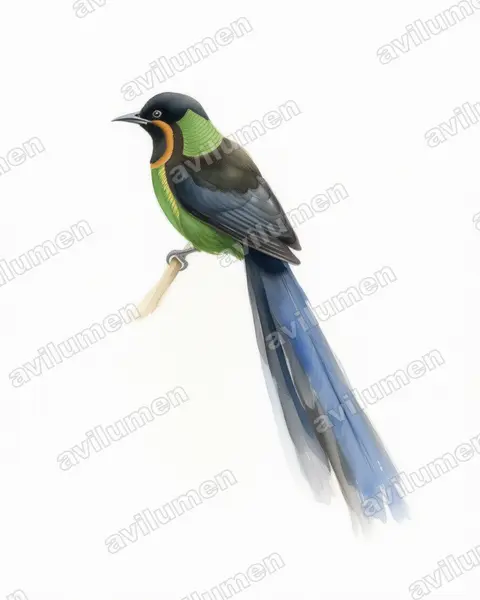
Watercolor 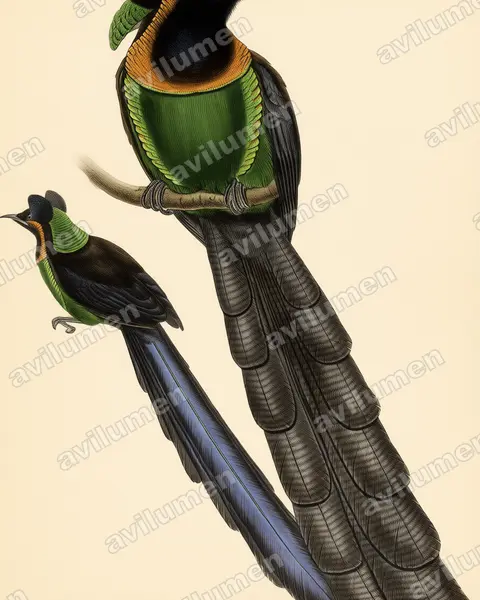
Vintage plate 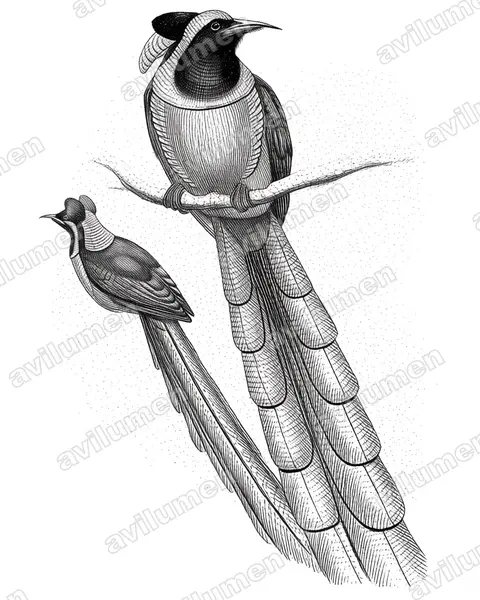
Ink 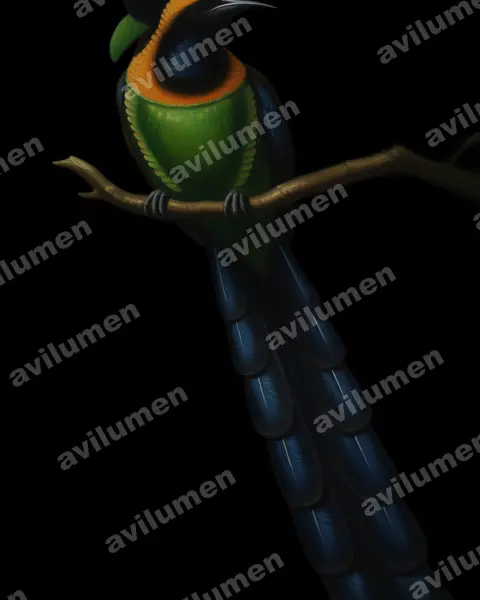
Oil 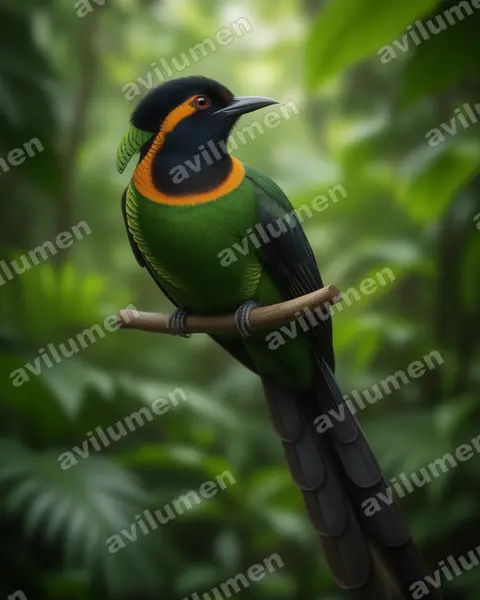
Realistic 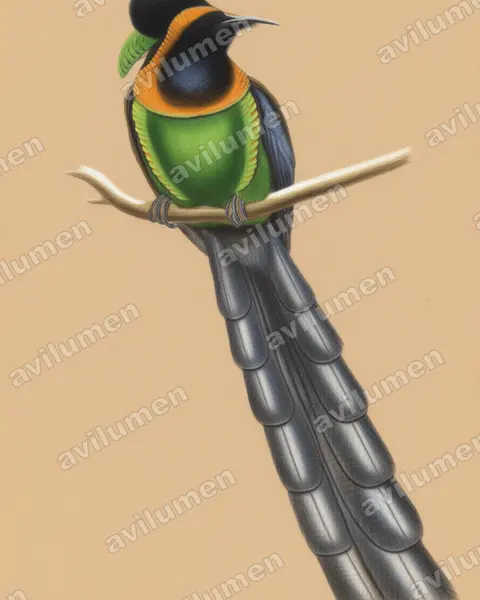
Colored pencil
Illustrations based on the photograph by John Gould / William Matthew Hart (Public domain), from Wikimedia Commons.
Digital editions
HD Digital Art Pack — Arfak astrapia
Digital download: 6 high-resolution illustrations of the Arfak astrapia (Astrapia nigra), print-ready. This is a digital file; no animal or physical item is included.
AI Avatar — Arfak astrapia
Generate an avatar fusing your face with the Arfak astrapia (Astrapia nigra). Delivered digitally in 8K, watermark-free. Digital product; no animals are sold or brokered.
Instant download. No live birds are sold.
Frequently asked questions
- Is Astrapia nigra (Arfak astrapia) endangered?
- The IUCN Red List places Astrapia nigra, commonly known as the Arfak astrapia, in the «Least concern» category. «Least concern» means it is not currently threatened.
- What family does Astrapia nigra (Arfak astrapia) belong to?
- Astrapia nigra (Arfak astrapia) belongs to the family Paradisaeidae, in the order Passeriformes.
- What colour is Astrapia nigra (Arfak astrapia)?
- The plumage of Astrapia nigra (Arfak astrapia) combines these colours: Black and Green.
More from the same family
 Least concern
Ribbon-tailed Astrapia
Astrapia mayeri
The ribbon-tailed astrapia, also known as Shaw Mayer's astrapia, is a species of bird-of-paradise.
from $1.99
 Least concern
Huon Astrapia
Astrapia rothschildi
The Huon astrapia, also known as Rothschild's astrapia, Huon bird-of-paradise, or Lord Rothschild's bird-of-paradise, is a species of bird-of-paradise belonging to the genus Astrapia. Like most of its congeners, A. rothschildi is a rather elusive member of its genus and family.
from $1.99
 Least concern
Splendid Astrapia
Astrapia splendidissima
The splendid astrapia is a species of bird in the family Paradisaeidae, native to the montane forests of New Guinea. Males are known for their iridescent plumage and elaborate courtship displays, including branch-hopping, tail-flicking, and frog-like calls; they may also display in leks.
from $1.99
 Least concern
Princess Stephanie's Astrapia
Astrapia stephaniae
Stephanie's astrapia, also known as Princess Stephanie's astrapia, is a species of bird-of-paradise of the family Paradisaeidae, native to the Bird's Tail Peninsula. This species was first described by Carl Hunstein in 1884.
from $1.99