Groove-billed Toucanet
Aulacorhynchus sulcatus
Avilumen editorial team ·

The groove-billed toucanet is a near-passerine bird in the toucan family Ramphastidae. It is found in Colombia and Venezuela.
The groove-billed toucanet (Aulacorhynchus sulcatus) is a near-passerine bird in the toucan family Ramphastidae. It is found in Colombia and Venezuela.
Taxonomy and systematics
The groove-billed toucanet was originally described in the genus Pteroglossus. The International Ornithological Committee (IOC), the South American Classification Committee of the American Ornithological Society, and the Clements taxonomy recognize these three subspecies:
The nominate A. s. sulcatus - (Swainson, 1820)
A. s. erythrognathus - Gould, 1874
A. s. calorhynchus - Gould, 1874
A. s. calorhynchus was formerly treated as a separate species, "yellow-billed toucanet", by most taxonomists but was merged into the groove-billed toucanet starting in 2012. BirdLife International's Handbook of the Birds of the World retains it as a species.
Subspecies A. s. erythrognathus might warrant consideration as a separate species because its voice is different from that of the other two subspecies.
Description
The groove-billed toucanet is 33 to 37 cm (13 to 15 in) long and weighs 130 to 200 g (4.6 to 7.1 oz). Its grooved culmen and mandible give it its English name. In the nominate subspecies and A. s. erythrognathus, most of the bill is wine-red to brown-red with a diagonal black stripe on the mandible. The nominate's bill also has a vertical white stripe at its base. In A. s. calorhynchus the bill is mostly yellow with a reduced amount of black, some orange-red at the base of the mandible, and a white stripe like the nominate's. All subspecies are overall mostly green, with the underparts being lighter and the undertail coverts yellower. The nominate subspecies has a white throat, some gold-bronze on the face, and bare blue skin around the brownish eye. A. s. erythrognathus has essentially the same plumage but with less gold-bronze on the face. A. s. calorhynchus also has similar plumage to the nominate but is larger than it and A. s. erythrognathus.
Distribution and habitat
The subspecies of groove-billed toucanet are found thus:
A. s. sulcatus, northern Venezuela between Falcón and Miranda states
A. s. erythrognathus, mountains of northeastern Venezuela
A. s. calorhynchus, Sierra Nevada de Santa Marta and Serranía del Perijá in northeastern Colombia and eastward to Lara in northwestern Venezuela
The species primarily inhabits humid montane forest but is also found in semi-open landscapes like secondary forest, forest edges and nearby isolated trees, and gardens. It shuns large open areas. In elevation it mostly ranges between 900 and 2,000 m (3,000 and 6,600 ft) but occurs as low as sea level and as high as about 2,400 m (7,900 ft).
Movement
The groove-billed toucanet is generally non-migratory but occasionally moves to lower parts of its elevational range in the rainy season.
Feeding
The groove-billed toucanet forages at all levels of its habitat, sometimes in groups. It has been observed following army ant swarms. Its diet is not known in detail but the species is omnivorous, eating fruit, invertebrates, eggs, and small vertebrates.
Breeding
Little is known about the groove-billed toucanet's breeding biology. Its season appears to be March to July in parts of its range but extends to August in northeastern Venezuela. In other parts of Venezuela it may nest as early as February and as late as October. It is believed to nest in tree cavities, either natural or those abandoned by woodpeckers. The nest, eggs, incubation period, and time to fledging are not known.
Vocalization
The groove-billed toucanet's song is "barking-growling notes or croaks...wik-wik- to waak-waak-", sometimes sung in duet. Male's voices are lower pitched than female's. A. s. erythrognathus' song sounds similar to those of the other subspecies but is apparently faster.
Status
The IUCN has assessed the groove-billed toucanet as being of Least Concern, though its population size is not known and is believed to be decreasing. No immediate threats have been identified. "Biological and further ecological data [are] required in case any of the subspecies should eventually need to be monitored."
Text adapted from Wikipedia · CC BY-SA 4.0
Where it lives
Taxonomy
- Order
- Piciformes
- Family
- Ramphastidae
- Genus
- Aulacorhynchus
- Conservation status
- Least concern
Listen to its call
No recording yet
Care guide
Toucan and Aracari Care Guide: Diet and Housing
How to care for toucans and aracaris: low-iron diet, iron storage disease (hemochromatosis), aviary setup, health, behavior and CITES legal status.
Read the guide →Illustration gallery
6 illustrations of Aulacorhynchus sulcatus (Groove-billed Toucanet) in different styles, true to its real plumage. Shown watermarked; the art pack includes the high-resolution originals, ready to print.
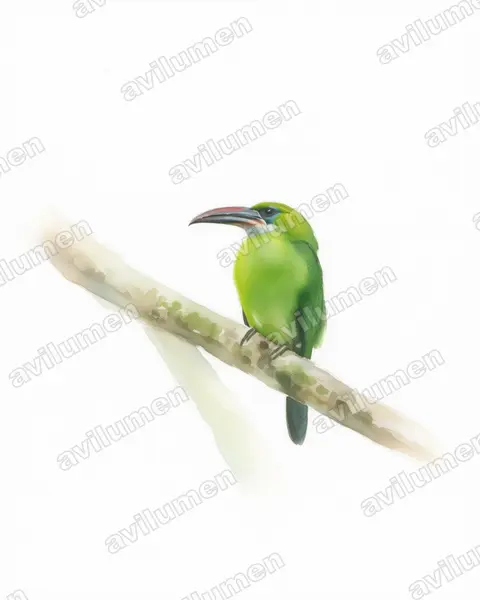
Watercolor 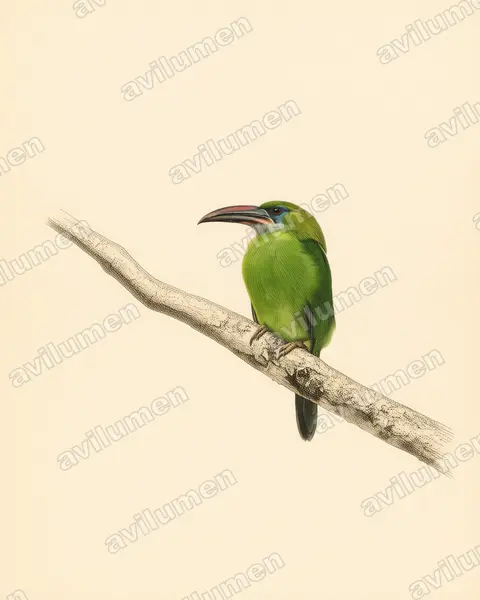
Vintage plate 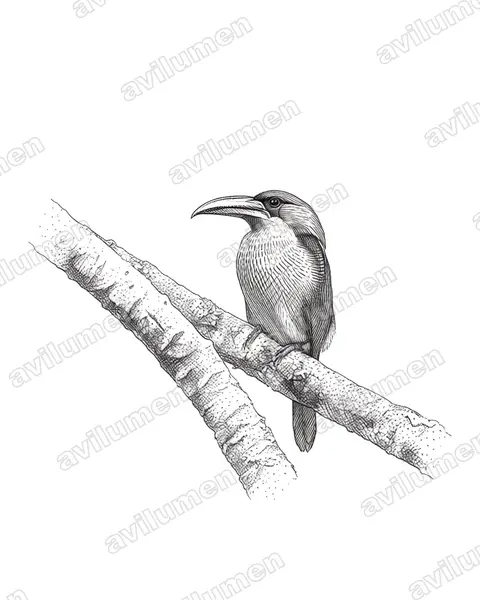
Ink 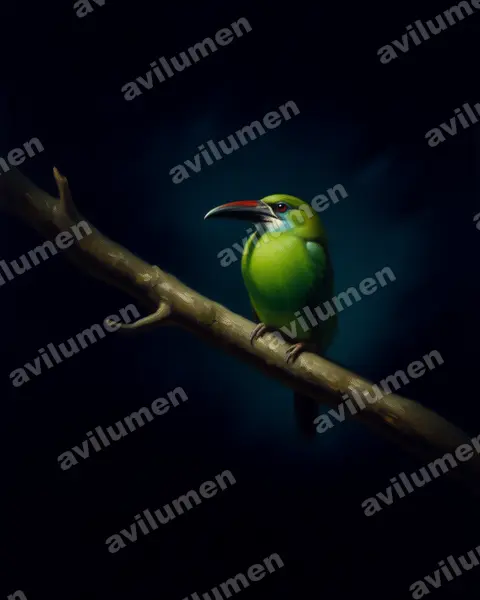
Oil 
Realistic 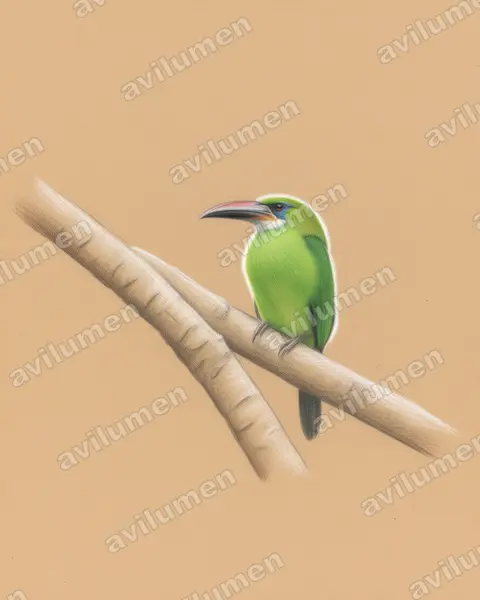
Colored pencil
Illustrations based on the photograph by Cristóbal Alvarado Minic (CC BY 2.0), from Wikimedia Commons.
Digital editions
HD Digital Art Pack — Groove-billed Toucanet
Digital download: 6 high-resolution illustrations of the Groove-billed Toucanet (Aulacorhynchus sulcatus), print-ready. This is a digital file; no animal or physical item is included.
AI Avatar — Groove-billed Toucanet
Generate an avatar fusing your face with the Groove-billed Toucanet (Aulacorhynchus sulcatus). Delivered digitally in 8K, watermark-free. Digital product; no animals are sold or brokered.
Instant download. No live birds are sold.
Frequently asked questions
- Is Aulacorhynchus sulcatus (Groove-billed Toucanet) endangered?
- The IUCN Red List places Aulacorhynchus sulcatus, commonly known as the Groove-billed Toucanet, in the «Least concern» category. «Least concern» means it is not currently threatened.
- Where does Aulacorhynchus sulcatus (Groove-billed Toucanet) live?
- Aulacorhynchus sulcatus (Groove-billed Toucanet) is found in South America.
- What family does Aulacorhynchus sulcatus (Groove-billed Toucanet) belong to?
- Aulacorhynchus sulcatus (Groove-billed Toucanet) belongs to the family Ramphastidae, in the order Piciformes.
- What colour is Aulacorhynchus sulcatus (Groove-billed Toucanet)?
- The plumage of Aulacorhynchus sulcatus (Groove-billed Toucanet) combines these colours: Green and Black.
More from the same family
 Least concern
Hooded Mountain Toucan
Andigena cucullata
The hooded mountain toucan is a species of bird in the toucan family Ramphastidae. It is found in Bolivia and Peru.
from $1.99
 Near threatened
Grey-breasted Mountain Toucan
Andigena hypoglauca
The grey-breasted mountain toucan is a least-concern species of bird in the toucan family, Ramphastidae. It is found in South American countries such as Colombia, Ecuador and Peru.
from $1.99
 Near threatened
Plate-billed Mountain Toucan
Andigena laminirostris
The plate-billed mountain toucan is a species of bird in the family Ramphastidae. It is native to the west slope of Ecuador and extreme southern Colombia, where it lives in the high-altitude humid mountain forests of the Andes.
from $1.99
 Least concern
Black-billed Mountain Toucan
Andigena nigrirostris
The black-billed mountain toucan is a species of bird in the toucan family Ramphastidae. It is found in Colombia, Ecuador, Peru, and Venezuela.
from $1.99