Little kingfisher
Ceyx pusillus
Avilumen editorial team ·

The little kingfisher is a species of kingfisher in the subfamily Alcedininae.
The little kingfisher (Ceyx pusillus) is a species of kingfisher in the subfamily Alcedininae.
Taxonomy
The first formal description of the little kingfisher was by the Dutch zoologist Coenraad Jacob Temminck in 1836 under the current binomial name Ceyx pusilla. The generic name Ceyx () derives from Ancient Greek: Κήϋξ, romanized: Kēüx, a mythological seabird that was drowned at sea and then found washed ashore by his wife Alcyone, after which both were metamorphosed into kingfishers. The specific epithet pusillus is the Latin for 'tiny' or 'very small'.
There are nine recognised subspecies of the little kingfisher (see box at right). The nominate subspecies Ceyx pusillus pusillus is found in Aru Island and Kai Island of Indonesia, southern New Guinea, the Torres Strait Islands, and possibly the tip of Cape York in Queensland. The subspecies C. p. ramsayi is found in coastal Northern Territory and western Cape York; it is a paler blue, with blue patches extending into the sides of the breast. Subspecies C. p. halli is found in coastal north-eastern Queensland from Endeavour River to Keppel Bay; it has small blue patches extending into the sides of the breast. The subspecies C. p. laetior is found in northern New Guinea; C. p. masauji in the Bismarck Archipelago; C. p. bougainvillei is found in the Solomon Islands and Bougainville; C. p. halmaherae is found in the northern Moluccas; C. p. richardsi is found in the western and central Solomon Islands; and C. p. aolae is found in Guadalcanal.
Description
The little kingfisher is 11.5 to 13 cm (4.5 to 5.1 in) long with a glossy, deep-blue back and head, and a snowy white breast. It has a heavy bill and a short tail. It has dark brown feet, with one toe to the rear and only two forward toes. This is one of the smallest kingfishers in the world; only the African dwarf kingfisher is smaller. The male weighs 10–15 g (0.35–0.53 oz) and the female 10–14 g (0.35–0.49 oz).
Distribution and habitat
The little kingfisher is found in open forest, woodland, swamps, and mangroves of Australia (northern Queensland and coastal Northern Territory), Indonesia, Papua New Guinea, and the Solomon Islands. It is generally uncommon and sedentary.
Breeding
The little kingfisher will make a small burrow on the bank of a river during the mating season (October to March in Queensland; February in Northern Territory; and January to April in Papua New Guinea). Sometimes the nest is formed in the rotting root of a mangrove or paperbark, or in a termite mound. A clutch of 4-5 glossy, rounded, white eggs, measuring 17 mm × 14 mm (0.67 in × 0.55 in), are laid in a chamber at the end of the burrow. Although incubation and fledging periods are unknown, both parents feed the young and continue to do so outside the nest for 9 days or more until the young are independent.
Feeding
The little kingfisher feeds on small fish, crustaceans, insect larvae and water-beetles. It perches quietly on a branch close to the water until it plunges into the water for prey, then returns swiftly and directly to the perch.
Voice
The little kingfisher makes a high-pitched, squeaky "tzeit-tzeit" in flight, which is usually not heard by observers unless very close.
Conservation status
Although the population trend is decreasing, the little kingfisher is classified as least concern on the IUCN Red List. However, certain subspecies may be adversely affected by mangrove clearance and the Guadalcanal subspecies (Ceyx pusillus aolae) has not been recorded for several decades.
Text adapted from Wikipedia · CC BY-SA 4.0
Plumage colours
Taxonomy
- Order
- Coraciiformes
- Family
- Alcedinidae
- Genus
- Ceyx
- Conservation status
- Least concern
Listen to its call
No recording yet
Illustration gallery
6 illustrations of Ceyx pusillus (Little kingfisher) in different styles, true to its real plumage. Shown watermarked; the art pack includes the high-resolution originals, ready to print.
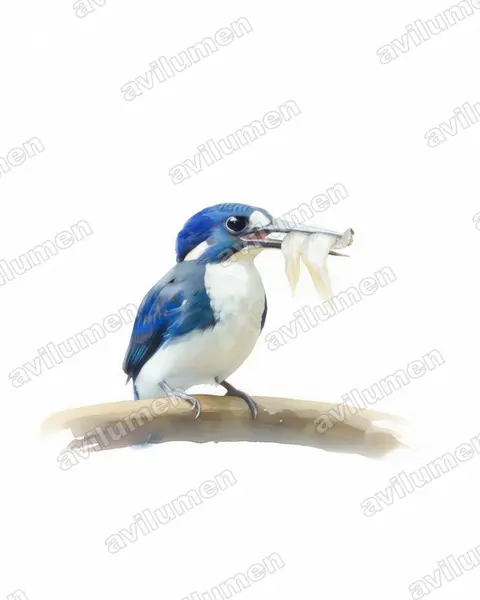
Watercolor 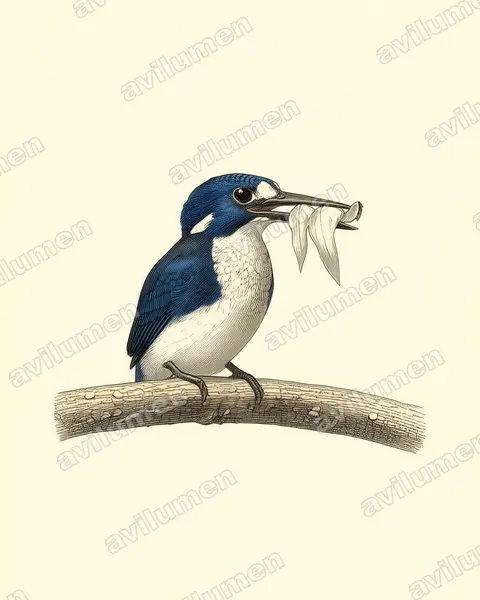
Vintage plate 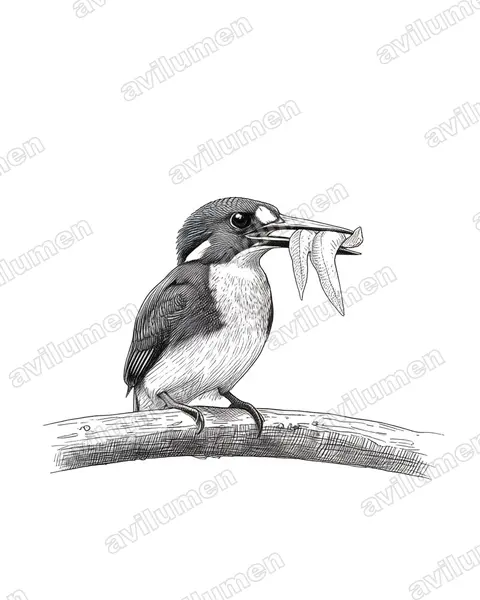
Ink 
Oil 
Realistic 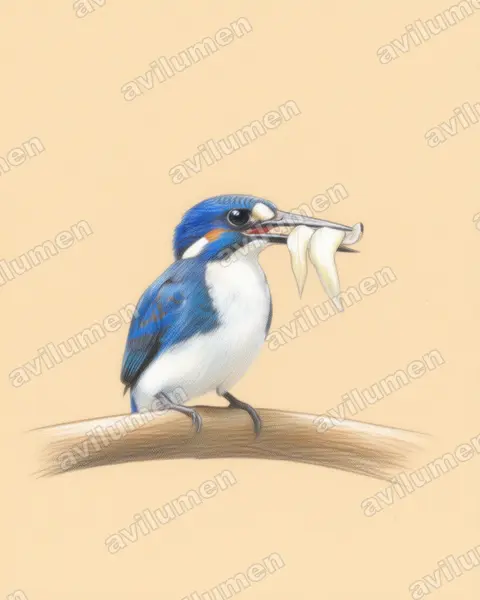
Colored pencil
Illustrations based on the photograph by JJ Harrison (https://www.jjharrison.com.au/) (CC BY-SA 3.0), from Wikimedia Commons.
Digital editions
HD Digital Art Pack — Little kingfisher
Digital download: 6 high-resolution illustrations of the Little kingfisher (Ceyx pusillus), print-ready. This is a digital file; no animal or physical item is included.
AI Avatar — Little kingfisher
Generate an avatar fusing your face with the Little kingfisher (Ceyx pusillus). Delivered digitally in 8K, watermark-free. Digital product; no animals are sold or brokered.
Instant download. No live birds are sold.
Frequently asked questions
- Is Ceyx pusillus (Little kingfisher) endangered?
- The IUCN Red List places Ceyx pusillus, commonly known as the Little kingfisher, in the «Least concern» category. «Least concern» means it is not currently threatened.
- What family does Ceyx pusillus (Little kingfisher) belong to?
- Ceyx pusillus (Little kingfisher) belongs to the family Alcedinidae, in the order Coraciiformes.
- What colour is Ceyx pusillus (Little kingfisher)?
- The plumage of Ceyx pusillus (Little kingfisher) combines these colours: Blue.
More from the same family
 Least concern
Moustached Kingfisher
Actenoides bougainvillei
The moustached kingfisher, also called Bougainville moustached kingfisher, is a species of bird in the family Alcedinidae. It is endemic to Bougainville Island in Papua New Guinea. An estimated 1,300–7,000 mature individuals are left.
from $1.99
 Near threatened
Rufous-collared Kingfisher
Actenoides concretus
The rufous-collared kingfisher is a species of bird in the family Alcedinidae. It is found in Brunei, Indonesia, Malaysia, Myanmar, and Thailand. Its natural habitats are subtropical or tropical moist lowland forest and subtropical or tropical moist montane forest. It is threatened by habitat loss.
from $1.99
 Least concern
Hombron's Kingfisher
Actenoides hombroni
The blue-capped kingfisher, also known as Hombron's kingfisher, is a species of bird in the family Alcedinidae endemic to the Philippines and found only on Mindanao. It is one of the most colorful kingfishers in the country having a dark blue cap and wings with rufous spots, a striped rufous belly, white chin and red bill.
from $1.99
 Least concern
Spotted Wood Kingfisher
Actenoides lindsayi
The spotted wood kingfisher or spotted kingfisher is a species of bird in the family Alcedinidae. It is endemic to the Philippines found on the islands of Luzon, Catanduanes, Marinduque, Negros and Panay where its natural habitat is tropical moist lowland forests.
from $1.99