Garden sunbird
Cinnyris jugularis
Avilumen editorial team ·

The garden sunbird, previously known as the olive-backed sunbird, is a species of passerine bird in the family Nectariniidae that is found in the Philippines except on the Palawan island group. It was formerly considered to be conspecific with seven other species: the ornate sunbird, Palawan sunbird, Sahul sunbird, Tukangbesi sunbird, Flores Sea sunbird, South Moluccan sunbird and the Mamberamo sunbird.
The garden sunbird (Cinnyris jugularis), previously known as the olive-backed sunbird, is a species of passerine bird in the family Nectariniidae that is found in the Philippines except on the Palawan island group. It was formerly considered to be conspecific with seven other species: the ornate sunbird, Palawan sunbird, Sahul sunbird, Tukangbesi sunbird, Flores Sea sunbird, South Moluccan sunbird and the Mamberamo sunbird.
It is a small, brightly coloured bird with olive-green plumage on the wings and back with a bright yellow chest. It has a long downward-curved bill it uses for taking nectar and capturing insects. It is primarily nectarivorous, but will take insects and spiders, particularly when feeding chicks.
Taxonomy
In 1760 the French zoologist Mathurin Jacques Brisson included a description of the garden sunbird in his Ornithologie based on a specimen collected in the Philippines. He used the French name Le petit grimpereau des Philippines and the Latin Certhia Philippensis Minor. Although Brisson coined Latin names, these do not conform to the binomial system and are not recognised by the International Commission on Zoological Nomenclature. When in 1766 the Swedish naturalist Carl Linnaeus updated his Systema Naturae for the twelfth edition, he added 240 species that had been previously described by Brisson. One of these was the garden sunbird. Linnaeus included a brief description, coined the binomial name Certhia jugularis and cited Brisson's work. The specific name jugularis is Medieval Latin for 'of the throat'. The garden sunbird is now one of 64 species placed in the genus Cinnyris that was introduced by the French naturalist Georges Cuvier in 1816.
The garden sunbird (under the name olive-backed sunbird) formerly included 21 subspecies and had a range that extended from Southeast Asia to Australia. Based on the difference in the male plumage and a genetic study comparing mitochondrial DNA sequences of some of the subspecies, the olive-backed sunbird was split into eight species. The seven new species are: ornate sunbird (Cinnyris ornatus), Palawan sunbird (Cinnyris aurora), Sahul sunbird (Cinnyris frenatus), Tukangbesi sunbird (Cinnyris infrenatus), Flores Sea sunbird (Cinnyris teysmanni), South Moluccan sunbird (Cinnyris clementiae) and Mamberamo sunbird (Cinnyris idenburgi).
Three subspecies are now recognised:
C. j. obscurior Ogilvie-Grant, 1894 – north Luzon and Babuyan Islands in northern Philippines
C. j. jugularis (Linnaeus, 1766) – central, south Luzon group, Mindoro, Visayas and Mindanao group (north to south Philippines)
C. j. woodi (Mearns, 1909) – Sulu Archipelago in southern Philippines
Description
The garden sunbird is 10–11.4 cm (3.9–4.5 in) in size; males weigh 6.7–11.9 g (0.24–0.42 oz) and females 6–10 g (0.21–0.35 oz). The male in its nominate (jugularis) form displays an olive hue on its upper body, featuring black wing feathers with green edges and a black tail adorned with white tips. The areas around its eyes (lores), neck, chin, throat, and breast are dark and iridescent, accompanied by yellow pectoral tufts. The lower portion of the bird is dark yellow, sometimes with a brown band encircling the gorget area. The iris is dark brown, while its bill and legs are black. Non-breeding males often have the glossy black coloration limited to the central throat stripe, which may represent juvenile birds transitioning to their adult plumage.
In contrast, the female exhibits an upper body of greenish olive, featuring a pale-yellowish stripe above the eyes, yellowish borders on its wing feathers, a tail with black and white markings, and a deep yellow color on the lower portion of its body, slightly lighter on the undertail feathers. Juvenile birds resemble the female but tend to be paler and browner in appearance.
Distribution and habitat
The garden sunbird is found on the Philippine islands except on the Palawan archipelago which is occupied by the similar Palawan sunbird. It inhabits forests, shrublands, grasslands and artificial habitats. The garden sunbird has adapted well to human environments and is common in fairly densely populated areas, where it builds nests in human settlements.
Behaviour and ecology
The female garden sunbird builds the nest using grass, cotton, moss, lichens, leaf fragments, vegetable fibers, and spider webs, lined with bark or feathers. The nest has the form of a hanging oval pouch with a sheltered side opening, often featuring a dangling "beard." She lays eggs in May and June.
Sunbirds feed largely on nectar, although they will also take insects, especially when feeding young. Most species can take nectar by hovering, but usually perch to feed most of the time.
Conservation
The garden sunbird has been classified as Least Concern on the IUCN Red List as it is common throughout its wide range.
Text adapted from Wikipedia · CC BY-SA 4.0
Taxonomy
- Order
- Passeriformes
- Family
- Nectariniidae
- Genus
- Cinnyris
- Conservation status
- Least concern
Listen to its call
No recording yet
Illustration gallery
6 illustrations of Cinnyris jugularis (Garden sunbird) in different styles, true to its real plumage. Shown watermarked; the art pack includes the high-resolution originals, ready to print.
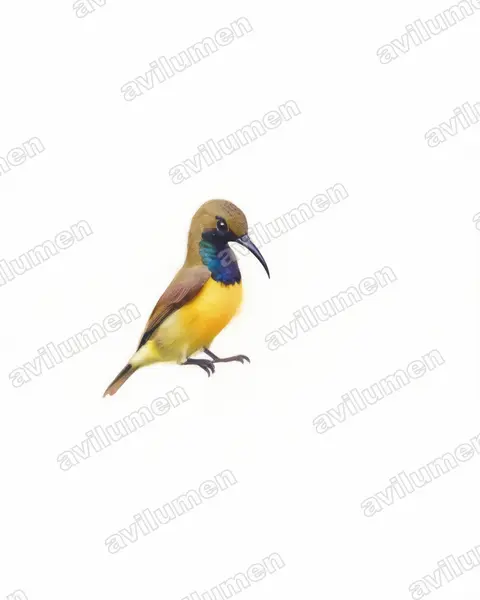
Watercolor 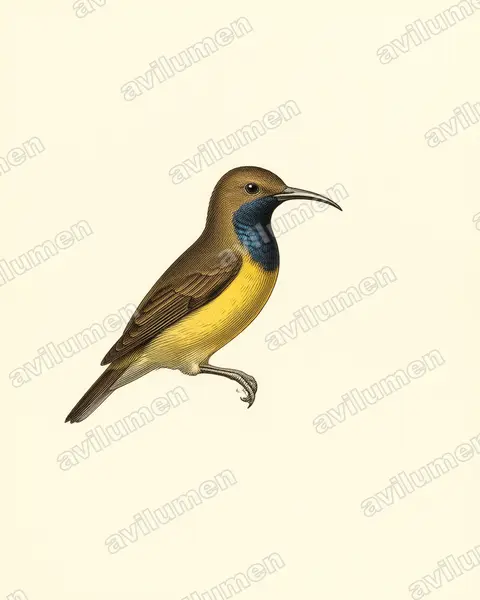
Vintage plate 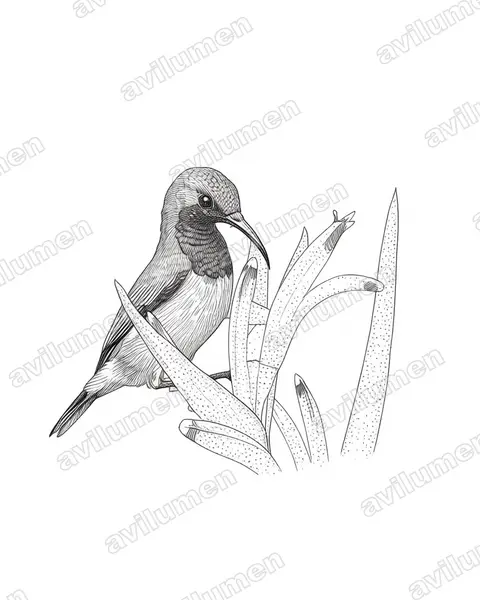
Ink 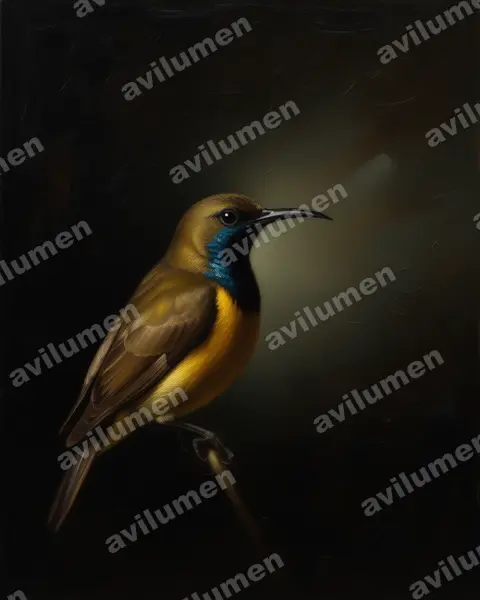
Oil 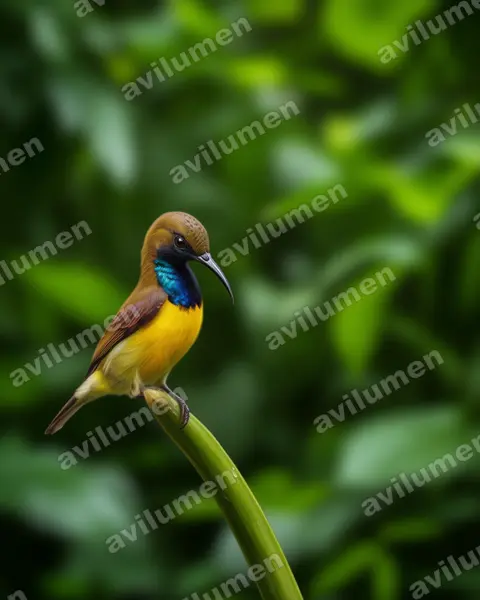
Realistic 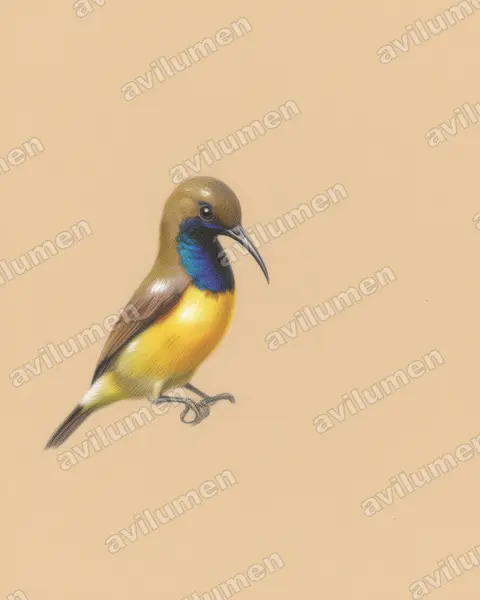
Colored pencil
Illustrations based on the photograph by Domzjuniorwildlife (CC BY-SA 4.0), from Wikimedia Commons.
Digital editions
HD Digital Art Pack — Garden sunbird
Digital download: 6 high-resolution illustrations of the Garden sunbird (Cinnyris jugularis), print-ready. This is a digital file; no animal or physical item is included.
AI Avatar — Garden sunbird
Generate an avatar fusing your face with the Garden sunbird (Cinnyris jugularis). Delivered digitally in 8K, watermark-free. Digital product; no animals are sold or brokered.
Instant download. No live birds are sold.
Frequently asked questions
- Is Cinnyris jugularis (Garden sunbird) endangered?
- The IUCN Red List places Cinnyris jugularis, commonly known as the Garden sunbird, in the «Least concern» category. «Least concern» means it is not currently threatened.
- What family does Cinnyris jugularis (Garden sunbird) belong to?
- Cinnyris jugularis (Garden sunbird) belongs to the family Nectariniidae, in the order Passeriformes.
- What colour is Cinnyris jugularis (Garden sunbird)?
- The plumage of Cinnyris jugularis (Garden sunbird) combines these colours: Green and Yellow.
More from the same family
 Least concern
Handsome Sunbird
Aethopyga bella
The handsome sunbird is a species of bird in the family Nectariniidae. It is endemic to the Philippines.
from $1.99
 Least concern
Apo Sunbird
Aethopyga boltoni
The Apo sunbird is a species of bird in the sunbird family Nectariniidae. It is endemic to the island of Mindanao in the Philippines. It is found in tropical moist montane forests at elevations ranging from 820 to 2,000 metres above sea level.
from $1.99
 Least concern
Fork-tailed Sunbird
Aethopyga christinae
The fork-tailed sunbird is a bird in the family Nectariniidae. The species was first described by Robert Swinhoe in 1869.
from $1.99
 Endangered
Elegant Sunbird
Aethopyga duyvenbodei
The elegant sunbird is a large, up to 12 cm long, Australasian sunbird in the genus Aethopyga. The male has an iridescent blue-green crown, shoulder patch and uppertail coverts, yellow bar across lower back, red ear coverts, olive back, yellow throat, red neck collar and yellow below. The female has a yellowish olive upperparts, scaly crown and yellow underparts.
from $1.99