Cameroon Sunbird
Cyanomitra oritis
Avilumen editorial team ·

The Cameroon sunbird is a species of bird in the family Nectariniidae. It is native to montane forests of Cameroon, Nigeria, and Equatorial Guinea, including the island of Bioko. It inhabits high-altitude forests and feeds primarily on nectar and insects. The species shows marked sexual dimorphism, with males displaying a metallic blue breast and duller females, and is known to make seasonal altitudinal movements.
The Cameroon sunbird (Cyanomitra oritis) is a species of bird in the family Nectariniidae. It is native to montane forests of Cameroon, Nigeria, and Equatorial Guinea, including the island of Bioko. It inhabits high-altitude forests and feeds primarily on nectar and insects. The species shows marked sexual dimorphism, with males displaying a metallic blue breast and duller females, and is known to make seasonal altitudinal movements. The species is classified as Least Concern by the International Union for Conservation of Nature (IUCN), although its population trend is decreasing due to habitat loss.
Behavior-Call/Vocalization, Breeding, Migration
The vocalization of the Cameroon sunbird consists of a 'sequence of rapid, well spaced whistles described as "tiu tiu tiwu tiwu tiu tiu.'" Breeding has been recorded that eggs are laid from March-April and then from November-December. They build pear-shaped nests that are made from grass, moss, rootlets lined with fibre, silk-cotton, and dry grass. Cameroon sunbirds are considered non-migratory but make altitude movements. On Mount Cameroon, individuals have been observed descending to lower elevations between June and September.
Sexual Dimorphism and Age-Based Differences
Males have an upper breast metallic steel-blue with violet reflections, with their hindneck and the rest of their body being olive-green. The bill is sharp, curved and black matching their legs. The eyes have a dark brown iris with a bright, pale blue eyering. Females differ from males, lacking pectoral tufts. Females appear olive-brown. Their underparts are yellow-tinged and duller than males. Females have a shorter, less curved bill. As juveniles, they appear duller above and below. The metallic areas are instead brown or grey with a bright yellow belly. The throat and breast are steel-blue rather than deep purplish-blue. Immatures have a shorter bill and appear darker olive. Head gloss is more greenish, with the metallic blue continuing from the hindneck farther down the breast.
Diet/Habitat
The Cameroon sunbird occurs in montane forests of Cameroon, Nigeria and Equatorial Guinea, including the island of Bioko. Montane forests are "high-altitude, biodiversity-rich cloud forests found above 1,600m on volcanic peaks, characterized by a dense, humid canopy" of many different species of trees. This bird primarily feeds on small insects and nectar. They forage individually or in pairs, and occasionally in large groups near flowering trees.
Conservation/Red List Evaluation
The Cameroon sunbird is not a concern according to the IUCN Red List evaluation. This species is classified under the Least Concern category. The global population is unquantified but is stable. The population trend has been noted as declining. Some species of sunbirds live between 2-8 years, Cameroon sunbirds have an average generation length of 2.7 years. Habitat loss caused by agricultural expansion, logging, and infrastructure development is considered the primary threat to the species.
Text adapted from Wikipedia · CC BY-SA 4.0
Taxonomy
- Order
- Passeriformes
- Family
- Nectariniidae
- Genus
- Cyanomitra
- Conservation status
- Least concern
Listen to its call
No recording yet
Illustration gallery
6 illustrations of Cyanomitra oritis (Cameroon Sunbird) in different styles, true to its real plumage. Shown watermarked; the art pack includes the high-resolution originals, ready to print.
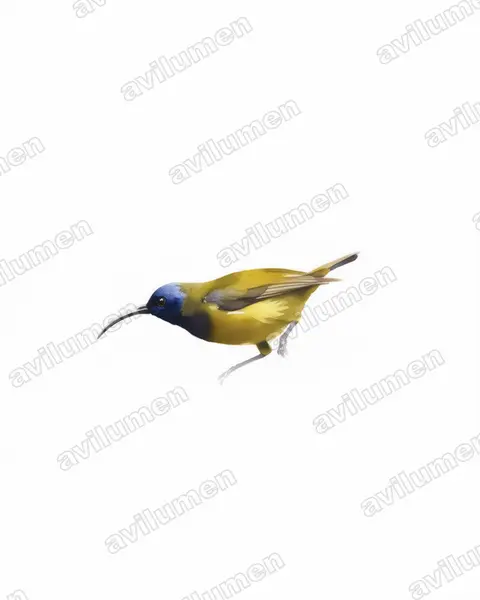
Watercolor 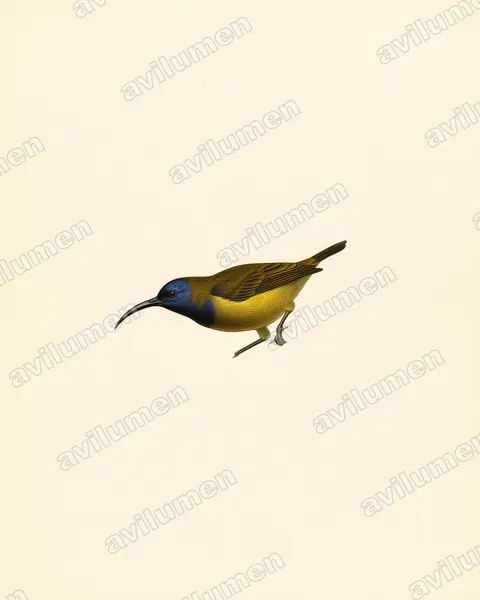
Vintage plate 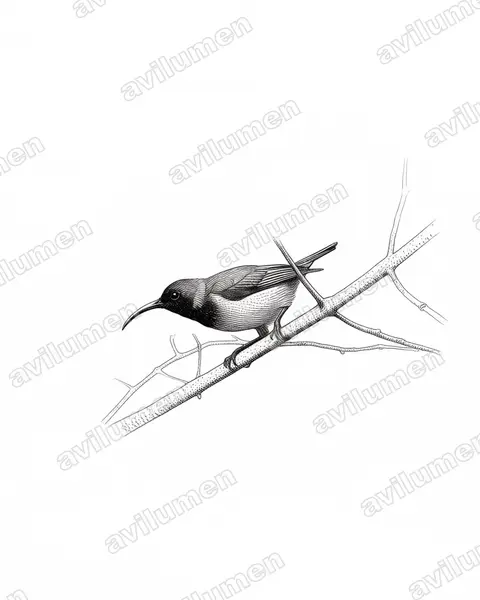
Ink 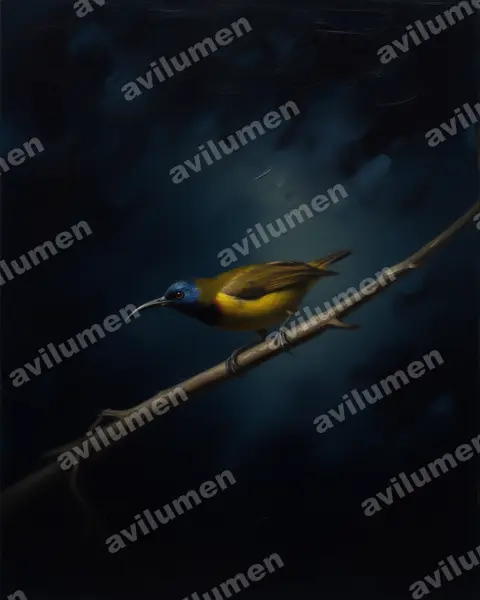
Oil 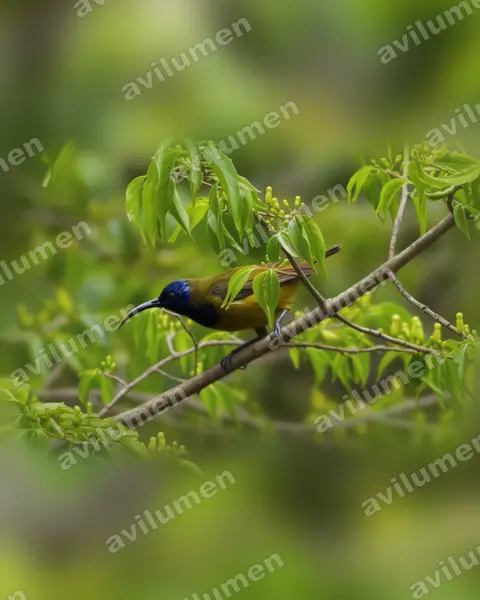
Realistic 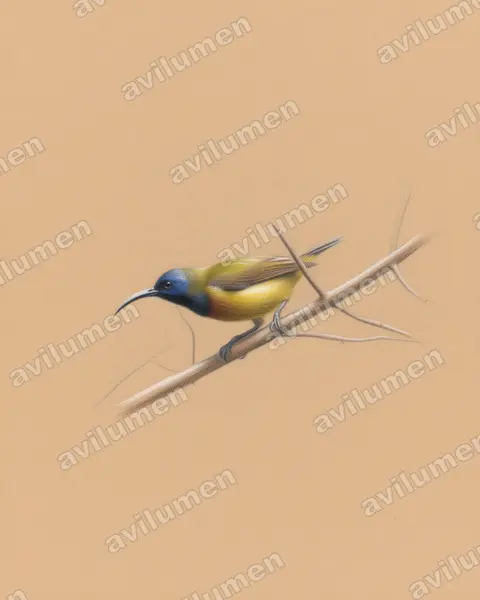
Colored pencil
Illustrations based on the photograph by Ron Knight from Seaford, East Sussex, United Kingdom (CC BY 2.0), from Wikimedia Commons.
Digital editions
HD Digital Art Pack — Cameroon Sunbird
Digital download: 6 high-resolution illustrations of the Cameroon Sunbird (Cyanomitra oritis), print-ready. This is a digital file; no animal or physical item is included.
AI Avatar — Cameroon Sunbird
Generate an avatar fusing your face with the Cameroon Sunbird (Cyanomitra oritis). Delivered digitally in 8K, watermark-free. Digital product; no animals are sold or brokered.
Instant download. No live birds are sold.
Frequently asked questions
- Is Cyanomitra oritis (Cameroon Sunbird) endangered?
- The IUCN Red List places Cyanomitra oritis, commonly known as the Cameroon Sunbird, in the «Least concern» category. «Least concern» means it is not currently threatened.
- Where does Cyanomitra oritis (Cameroon Sunbird) live?
- Cyanomitra oritis (Cameroon Sunbird) is found in Africa.
- What family does Cyanomitra oritis (Cameroon Sunbird) belong to?
- Cyanomitra oritis (Cameroon Sunbird) belongs to the family Nectariniidae, in the order Passeriformes.
- What colour is Cyanomitra oritis (Cameroon Sunbird)?
- The plumage of Cyanomitra oritis (Cameroon Sunbird) combines these colours: Blue.
More from the same family
 Least concern
Handsome Sunbird
Aethopyga bella
The handsome sunbird is a species of bird in the family Nectariniidae. It is endemic to the Philippines.
from $1.99
 Least concern
Apo Sunbird
Aethopyga boltoni
The Apo sunbird is a species of bird in the sunbird family Nectariniidae. It is endemic to the island of Mindanao in the Philippines. It is found in tropical moist montane forests at elevations ranging from 820 to 2,000 metres above sea level.
from $1.99
 Least concern
Fork-tailed Sunbird
Aethopyga christinae
The fork-tailed sunbird is a bird in the family Nectariniidae. The species was first described by Robert Swinhoe in 1869.
from $1.99
 Endangered
Elegant Sunbird
Aethopyga duyvenbodei
The elegant sunbird is a large, up to 12 cm long, Australasian sunbird in the genus Aethopyga. The male has an iridescent blue-green crown, shoulder patch and uppertail coverts, yellow bar across lower back, red ear coverts, olive back, yellow throat, red neck collar and yellow below. The female has a yellowish olive upperparts, scaly crown and yellow underparts.
from $1.99