Rufous-bellied Kookaburra
Dacelo gaudichaud
Avilumen editorial team ·

The rufous-bellied kookaburra, originally known as Gaudichaud's kookaburra after French botanist Charles Gaudichaud-Beaupré, is a species of kookaburra that is widely distributed through the forests of lowland New Guinea.
The rufous-bellied kookaburra (Dacelo gaudichaud), originally known as Gaudichaud's kookaburra after French botanist Charles Gaudichaud-Beaupré, is a species of kookaburra that is widely distributed through the forests of lowland New Guinea.
It has a black cap, blue-tinged wings, and a pale, rufous belly and tail feathers, but its white bill distinguishes it very clearly from other kookaburras with their black bills. Juveniles, however, have a dark-grey bill. Like the blue-winged kookaburra, the sexes can be distinguished by the colour of the tail feathers, blue in males and rufous in females and immature birds. Rufous-bellied kookaburras are smaller than other kookaburra species at around 143 g (5.0 oz) as against the laughing kookaburra's 335 g (11.8 oz) and about 28 cm (11.0 in) as against the laughing kookaburra's 46 cm (18.1 in). Despite this major size difference, the rufous-bellied kookaburra has been known to form (infertile) hybrids with all other kookaburra species, though available genetic studies suggest it is clearly the most distant of the four.
This kookaburra is unusual in that it occupies dense rainforests (as opposed to the open country preferred by other kookaburras) and does not live in cooperative breeding family groups, but singly, or when breeding, in pairs. Rufous-bellied kookaburras can be found in the middle story of the tropical rainforest, where they fly out directly and swiftly from their perch to seize large insects from trees. Despite their direct flight, rufous-bellied kookaburras are capable of very sharp twists and turns around the dense trees that form their habitat. They have been known also to hunt small vertebrates, but do so less frequently than the larger woodland kookaburras, and frequently are mobbed by smaller birds when they prey on their eggs or nestlings. Males are very aggressive in defending their territories, which average 2 to 2.5 ha (4.9 to 6.2 acres) in size, and sometimes fight intruders violently.
Like their larger relatives, rufous-bellied kookaburras breed in termite mounds. Breeding usually takes place from May to October, though the young do not disperse fully until February, and pairs have not been known to attempt a second brood in one year. Two white eggs are laid, though the actual incubation period is not known.
Text adapted from Wikipedia · CC BY-SA 4.0
Plumage colours
Taxonomy
- Order
- Coraciiformes
- Family
- Alcedinidae
- Genus
- Dacelo
- Conservation status
- Least concern
Listen to its call
No recording yet
Illustration gallery
6 illustrations of Dacelo gaudichaud (Rufous-bellied Kookaburra) in different styles, true to its real plumage. Shown watermarked; the art pack includes the high-resolution originals, ready to print.
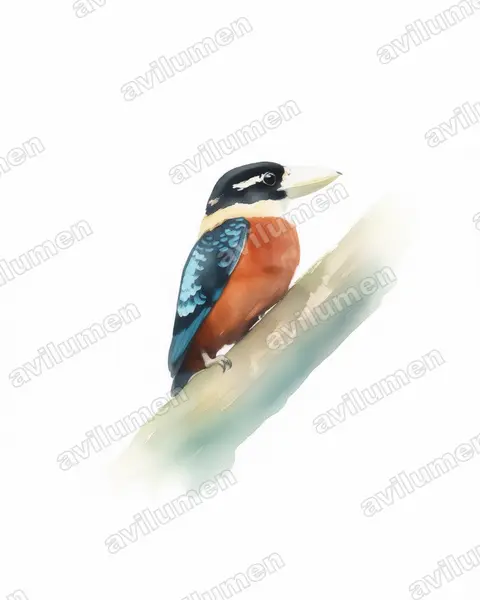
Watercolor 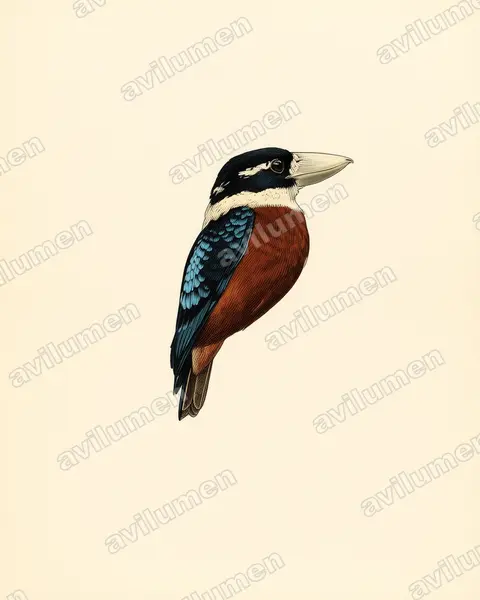
Vintage plate 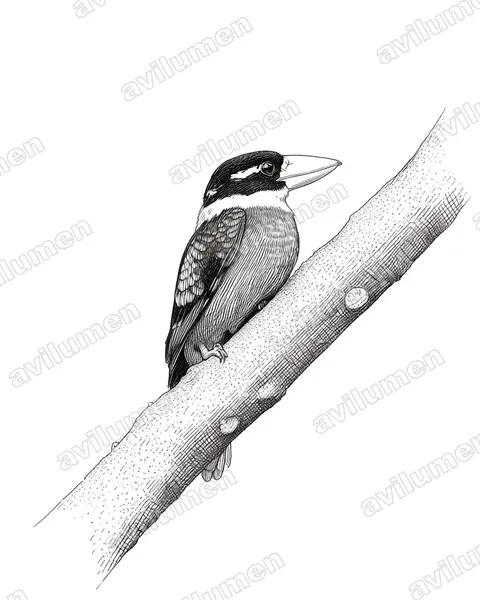
Ink 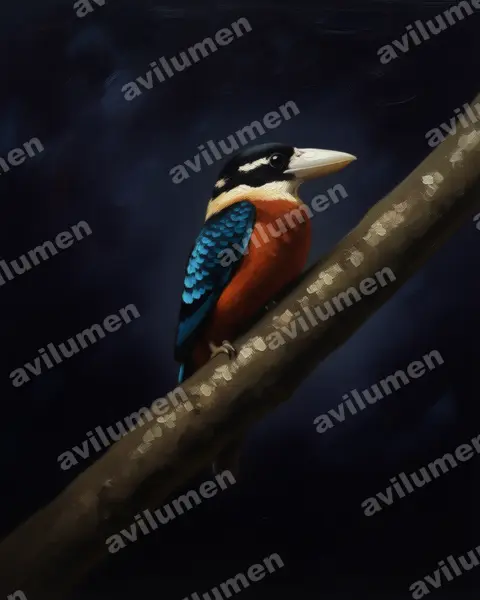
Oil 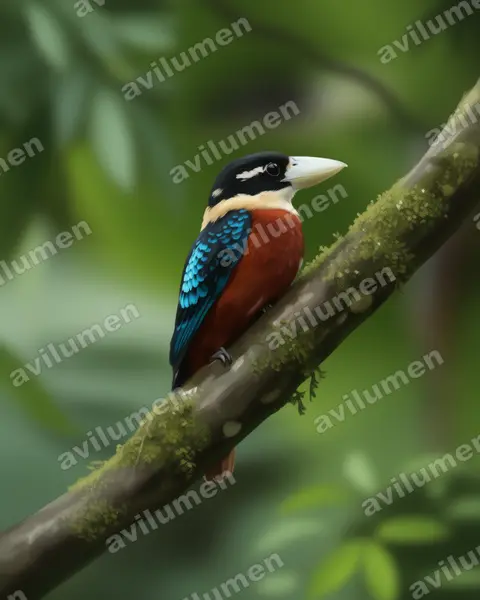
Realistic 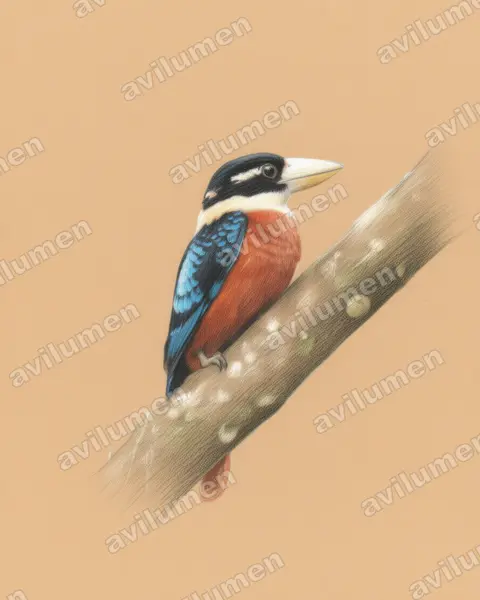
Colored pencil
Illustrations based on the photograph by Greg Miles from Australia (CC BY-SA 2.0), from Wikimedia Commons.
Digital editions
HD Digital Art Pack — Rufous-bellied Kookaburra
Digital download: 6 high-resolution illustrations of the Rufous-bellied Kookaburra (Dacelo gaudichaud), print-ready. This is a digital file; no animal or physical item is included.
AI Avatar — Rufous-bellied Kookaburra
Generate an avatar fusing your face with the Rufous-bellied Kookaburra (Dacelo gaudichaud). Delivered digitally in 8K, watermark-free. Digital product; no animals are sold or brokered.
Instant download. No live birds are sold.
Frequently asked questions
- Is Dacelo gaudichaud (Rufous-bellied Kookaburra) endangered?
- The IUCN Red List places Dacelo gaudichaud, commonly known as the Rufous-bellied Kookaburra, in the «Least concern» category. «Least concern» means it is not currently threatened.
- What family does Dacelo gaudichaud (Rufous-bellied Kookaburra) belong to?
- Dacelo gaudichaud (Rufous-bellied Kookaburra) belongs to the family Alcedinidae, in the order Coraciiformes.
- What colour is Dacelo gaudichaud (Rufous-bellied Kookaburra)?
- The plumage of Dacelo gaudichaud (Rufous-bellied Kookaburra) combines these colours: Blue.
More from the same family
 Least concern
Moustached Kingfisher
Actenoides bougainvillei
The moustached kingfisher, also called Bougainville moustached kingfisher, is a species of bird in the family Alcedinidae. It is endemic to Bougainville Island in Papua New Guinea. An estimated 1,300–7,000 mature individuals are left.
from $1.99
 Near threatened
Rufous-collared Kingfisher
Actenoides concretus
The rufous-collared kingfisher is a species of bird in the family Alcedinidae. It is found in Brunei, Indonesia, Malaysia, Myanmar, and Thailand. Its natural habitats are subtropical or tropical moist lowland forest and subtropical or tropical moist montane forest. It is threatened by habitat loss.
from $1.99
 Least concern
Hombron's Kingfisher
Actenoides hombroni
The blue-capped kingfisher, also known as Hombron's kingfisher, is a species of bird in the family Alcedinidae endemic to the Philippines and found only on Mindanao. It is one of the most colorful kingfishers in the country having a dark blue cap and wings with rufous spots, a striped rufous belly, white chin and red bill.
from $1.99
 Least concern
Spotted Wood Kingfisher
Actenoides lindsayi
The spotted wood kingfisher or spotted kingfisher is a species of bird in the family Alcedinidae. It is endemic to the Philippines found on the islands of Luzon, Catanduanes, Marinduque, Negros and Panay where its natural habitat is tropical moist lowland forests.
from $1.99