Philippine Trogon
Harpactes ardens
Avilumen editorial team ·

The Philippine trogon is a species of bird in the family Trogonidae. It is endemic to the Philippines found on regions of Luzon, Eastern Visayas, and Mindanao. It is the only species of trogon in the country. While not a threatened species, its population is declining due to habitat loss and hunting.
The Philippine trogon (Harpactes ardens) is a species of bird in the family Trogonidae. It is endemic to the Philippines found on regions of Luzon, Eastern Visayas, and Mindanao. It is the only species of trogon in the country. While not a threatened species, its population is declining due to habitat loss and hunting.
Description and taxonomy
Its Latin name ardens translates to burning, flaming, glowing, fiery which is likely in reference to its bright colors.
Subspecies
Five subspecies are recognised:
H. a. ardens – Found in Mindanao, Dinagat, and Basilan
H. a. linae – Found in Samar, Biliran, Leyte, and Bohol; has a larger throat patch and bill
H. a.. minor – Found in Polillo Islands; smaller with darker red colors
H. a. luzoniensis – Found in Luzon (except Northeast), Marinduque and Catanduanes; shorter bill and duller underparts with no maroon hues on crown
H. a. herberti – Found in Northeast Luzon; strong maroon hues on crown and a larger bill
Ecology and behavior
It is primarily an insectivore that feeds on grasshoppers, stick insects, praying mantises and other insects. It has also been recorded feeding on a small lizards and amphibians.
Breeding season is from March to June. Nest in tree holes above 5 meters from the forest floor. Its clutch size is 3 eggs. Interestingly, only males have been observed incubating but it is presumed that the females also participate.
Habitat and conservation status
It is found in tropical moist lowland forest and the lower reaches of tropical moist mountain forest up to 2,000 meters above sea level but is most common under 600 meters above sea level.
The International Union for Conservation of Nature has assessed this bird as a Least-concern species as it has a large range and is still locally common in some areas. However, despite not being a threatened species, the population is believed to be on the decline. This species' main threat is habitat loss with wholesale clearance of forest habitats as a result of logging, agricultural conversion and mining activities occurring within the range.
Occurs in a many protected areas in Bataan National Park, Bulusan Volcano Natural Park, Angat Watershed Forest Reserve, Northern Sierra Madre Natural Park on Luzon, Pasonanca Natural Park, Mount Kitanglad, Mount Apo on Mindanao; Rajah Sikatuna Protected Landscape in Bohol; and Samar Island Natural Park in Samar. While all of these areas are protected by law, deforestation, mining, hunting and habitat loss still continue in some of these protected areas.
Relationship with humans
Among Philippine endemics, this bird is relatively well known by the public as it is often featured in stamps, murals, artworks, stuffed toys, brands and viral news articles.
Primarily due to its plumage and colors, the bird has been associated with the mythical Ibong Adarna from Filipino epic poem of the same name. However, there is no actual and historical basis for this and based on the descriptions of the mythical bird, it is more akin to the mythical Phoenix or Sarimanok rather than any actual bird. Also, unlike the Ibong Adarna's musical lullaby-like call in the epic, the Philippine trogon's voice is often compared to a laughing horse's neighing This bird is often featured on viral news articles and posts which directly link it to the Ibong Adarna, while the state news outlet Philippine News Agency has erroneously referred to this bird as "critically endangered".
The Philippine trogon has been featured twice on Philippine stamps in 1969 and 1992 respectively.
Despite its attractive plumage, this species is rarely kept in captivity as they do not survive, partly due to their specialized insectivorous diet. There are no records of Philippine trogons in zoos.
Text adapted from Wikipedia · CC BY-SA 4.0
Where it lives
Taxonomy
- Order
- Trogoniformes
- Family
- Trogonidae
- Genus
- Harpactes
- Conservation status
- Least concern
Listen to its call
No recording yet
Illustration gallery
6 illustrations of Harpactes ardens (Philippine Trogon) in different styles, true to its real plumage. Shown watermarked; the art pack includes the high-resolution originals, ready to print.

Watercolor 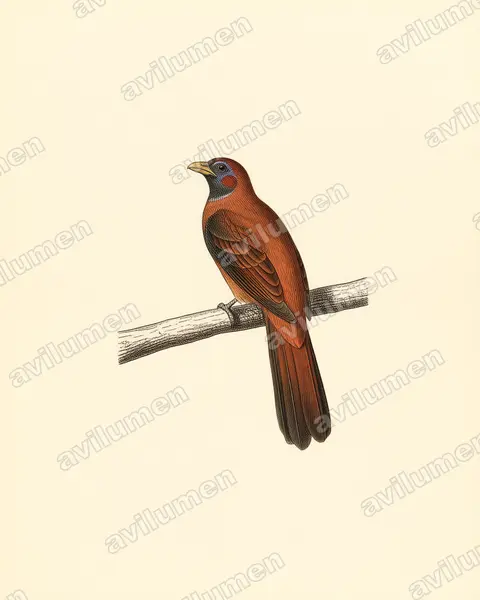
Vintage plate 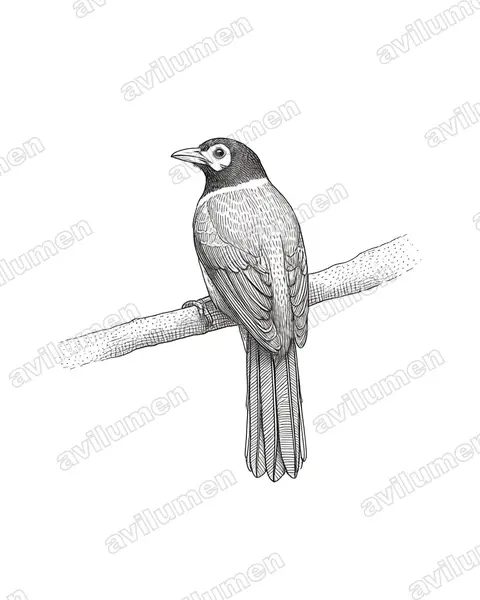
Ink 
Oil 
Realistic 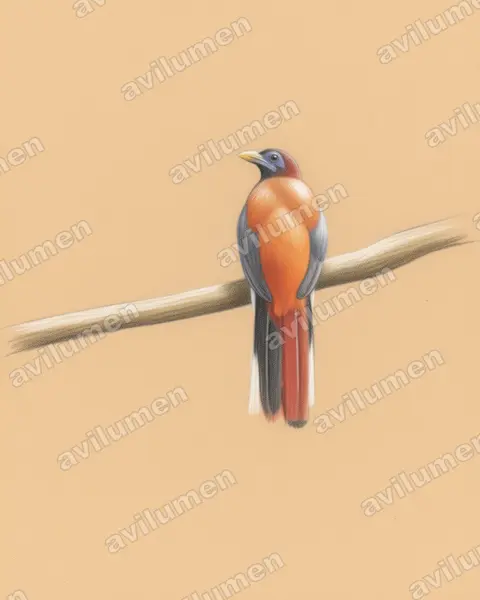
Colored pencil
Illustrations based on the photograph by Noel Reynolds (CC BY 2.0), from Wikimedia Commons.
Digital editions
HD Digital Art Pack — Philippine Trogon
Digital download: 6 high-resolution illustrations of the Philippine Trogon (Harpactes ardens), print-ready. This is a digital file; no animal or physical item is included.
AI Avatar — Philippine Trogon
Generate an avatar fusing your face with the Philippine Trogon (Harpactes ardens). Delivered digitally in 8K, watermark-free. Digital product; no animals are sold or brokered.
Instant download. No live birds are sold.
Frequently asked questions
- Is Harpactes ardens (Philippine Trogon) endangered?
- The IUCN Red List places Harpactes ardens, commonly known as the Philippine Trogon, in the «Least concern» category. «Least concern» means it is not currently threatened.
- Where does Harpactes ardens (Philippine Trogon) live?
- Harpactes ardens (Philippine Trogon) is found in Philippines.
- What family does Harpactes ardens (Philippine Trogon) belong to?
- Harpactes ardens (Philippine Trogon) belongs to the family Trogonidae, in the order Trogoniformes.
- What colour is Harpactes ardens (Philippine Trogon)?
- The plumage of Harpactes ardens (Philippine Trogon) combines these colours: Green and Red.
More from the same family
 Least concern
Sumatran Trogon
Apalharpactes mackloti
The Sumatran trogon is a species of bird in the family Trogonidae. It was formerly considered conspecific with the Javan trogon under the common name blue-tailed trogon.
from $1.99
 Vulnerable
Javan trogon
Apalharpactes reinwardtii
The Javan trogon is a bird species in the family Trogonidae endemic to western Java, Indonesia. It was previously grouped with the Sumatran trogon as a single species, known as the blue-tailed trogon. However, differences in size, weight, and plumage have led to their classification as separate species.
from $1.99
 Least concern
Bare-cheeked Trogon
Apaloderma aequatoriale
The bare-cheeked trogon is a species of bird in the family Trogonidae found in the rainforests of western central Africa.
from $1.99
 Least concern
Narina Trogon
Apaloderma narina
The Narina trogon is a largely green and red, medium-sized bird in the family Trogonidae. It is native to forests and woodlands of the Afrotropics. Though it is the most widespread and diverse in habitat choice of the three Apaloderma species, its numbers are locally depleted due to deforestation. Some populations are sedentary while others undertake regular movements.
from $1.99