Blue pitta
Hydrornis cyaneus
Avilumen editorial team ·

The blue pitta is a species of bird in the family Pittidae found in the northeastern Indian subcontinent, southern China, and Indochina. It typically lives in moist forests but can also inhabit dry forest. It is an unobtrusive, solitary bird which feeds by foraging on the ground for insects and other small invertebrates.
The blue pitta (Hydrornis cyaneus) is a species of bird in the family Pittidae found in the northeastern Indian subcontinent, southern China, and Indochina. It typically lives in moist forests but can also inhabit dry forest. It is an unobtrusive, solitary bird which feeds by foraging on the ground for insects and other small invertebrates.
Description
Pittas are medium-sized, stocky passerine birds with long legs and short tails. The blue pitta grows to a length of about 23 cm (9 in). It has a yellow forehead and crown and a bright orange nape. A bold black stripe passes through the eye and there is a less well-defined, short stripe on the chin. The male has a blue back and tail and a pale bluish breast, speckled with black. The female has a grey back and a pale grey breast, speckled with black. The bill is dark grey and the legs are pale pink. The call is a long, drawn-out "pleoow-whit" or "choocoo-whip", ending suddenly.
Distribution and habitat
There are three subspecies: H. c. cyaneus occurs in northeastern India and eastern Bangladesh, Myanmar, northern Laos, Vietnam, southern Thailand and southern China; H. c. aurantiacus occurs in eastern Thailand and southwestern Cambodia; H. c. willoughbyi occurs in central Laos and southern Vietnam. The bird's altitudinal range is from sea level up to about 2,000 m (6,600 ft). It is a forest bird, typical habitat being lowland and montane moist evergreen forest with bamboos, often near streams and in ravines, but it also occurs in drier tropical forests.
Ecology
Like other members of their genus, blue pittas are shy, secretive birds and usually occur singly, even juveniles foraging alone except when being visited by their parents; they will however respond to recordings of their call. They are diurnal, which enables them to see their often cryptic prey, but they often forage in darker areas of the forest. They search through plant litter on the forest floor for insects (especially beetles) and their larvae, spiders, snails, worms and grubs, flicking away leaves and probing the ground with their beaks. Breeding takes place in May and June in India and Myanmar, and between June and October in Thailand. The nest is a large, bulky dome-shaped structure with a side entrance, hidden amongst tangled plant growth.
Status
The blue pitta has a very wide range and although scarce in India and China, is common in suitable habitat over much of its range, being particularly abundant on the Bolaven Plateau in Laos. It is present in some protected areas, and the International Union for Conservation of Nature has assessed its conservation status as being of "least concern".
Text adapted from Wikipedia · CC BY-SA 4.0
Plumage colours
Taxonomy
- Order
- Passeriformes
- Family
- Pittidae
- Genus
- Hydrornis
- Conservation status
- Least concern
Listen to its call
No recording yet
Illustration gallery
6 illustrations of Hydrornis cyaneus (Blue pitta) in different styles, true to its real plumage. Shown watermarked; the art pack includes the high-resolution originals, ready to print.
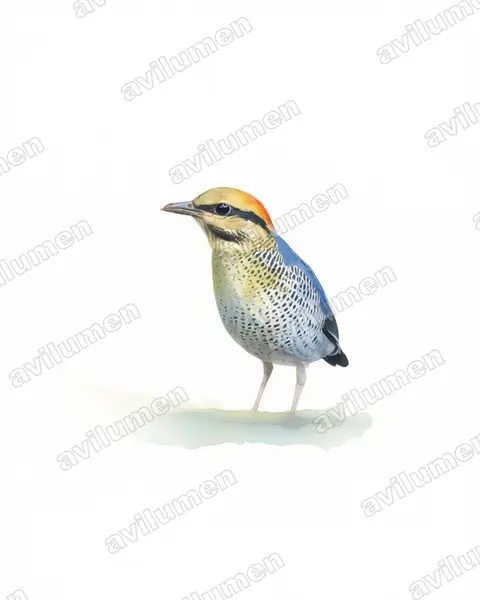
Watercolor 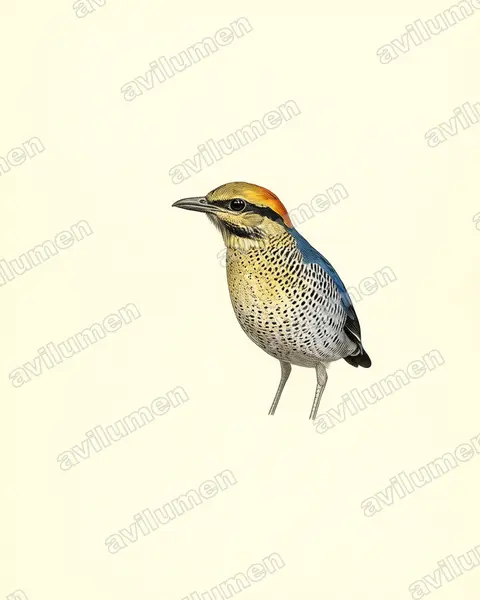
Vintage plate 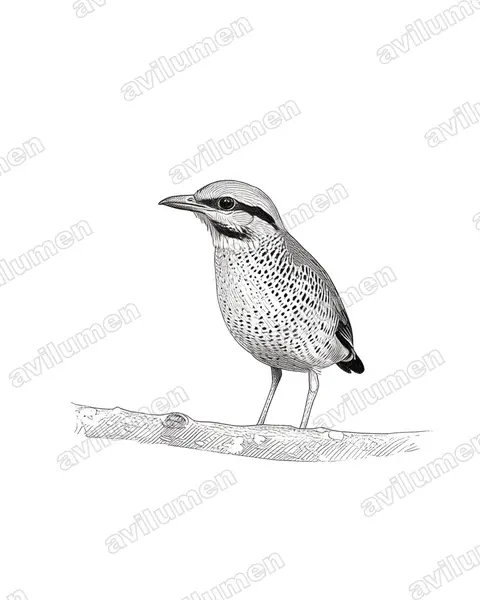
Ink 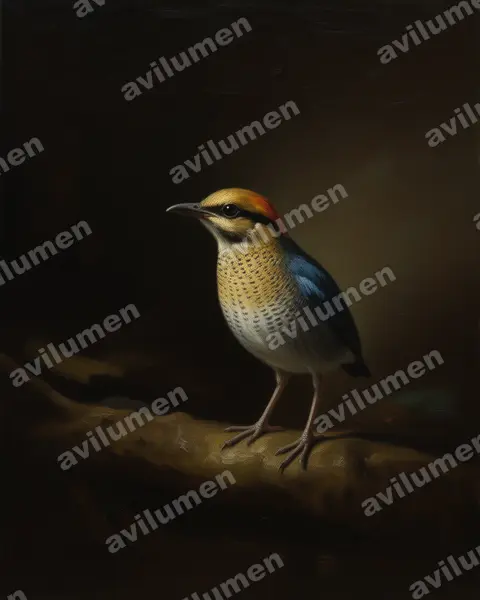
Oil 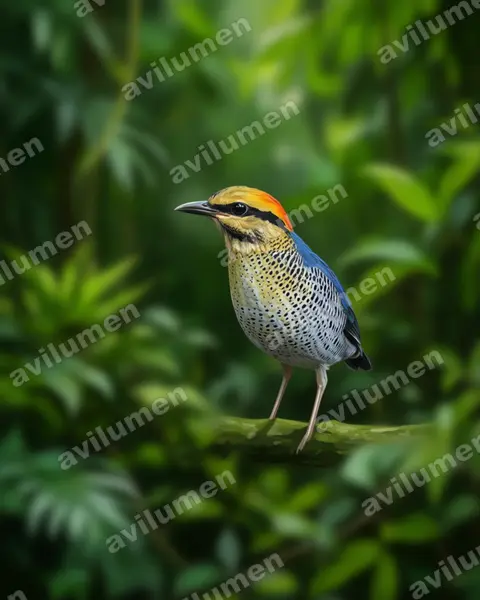
Realistic 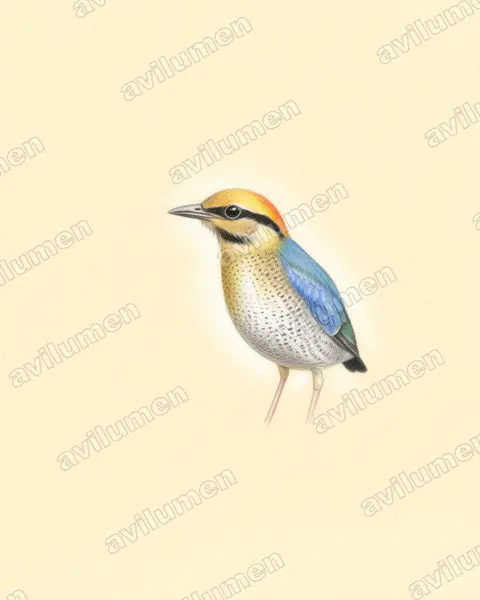
Colored pencil
Illustrations based on the photograph by JJ Harrison (https://tiny.jjharrison.com.au/t/hs1ud3eNEZn0LSRD) (CC BY 3.0), from Wikimedia Commons.
Digital editions
HD Digital Art Pack — Blue pitta
Digital download: 6 high-resolution illustrations of the Blue pitta (Hydrornis cyaneus), print-ready. This is a digital file; no animal or physical item is included.
AI Avatar — Blue pitta
Generate an avatar fusing your face with the Blue pitta (Hydrornis cyaneus). Delivered digitally in 8K, watermark-free. Digital product; no animals are sold or brokered.
Instant download. No live birds are sold.
Frequently asked questions
- Is Hydrornis cyaneus (Blue pitta) endangered?
- The IUCN Red List places Hydrornis cyaneus, commonly known as the Blue pitta, in the «Least concern» category. «Least concern» means it is not currently threatened.
- What family does Hydrornis cyaneus (Blue pitta) belong to?
- Hydrornis cyaneus (Blue pitta) belongs to the family Pittidae, in the order Passeriformes.
- What colour is Hydrornis cyaneus (Blue pitta)?
- The plumage of Hydrornis cyaneus (Blue pitta) combines these colours: Blue.
More from the same family
 Least concern
Blue-banded Pitta
Erythropitta arquata
The blue-banded pitta is a species of bird in the family Pittidae. It is native to lowlands of the Borneo montane rain forests.
from $1.99
 Endangered
Sangihe pitta
Erythropitta caeruleitorques
The Sulawesi pitta is a species of pitta. It was considered a subspecies of the red-bellied pitta. It is endemic to Indonesia where it occurs in Sulawesi, Manterawu, and Togian Islands. Its natural habitat is subtropical or tropical moist lowland forest. It is threatened by habitat loss.
from $1.99
 Least concern
Sulawesi pitta
Erythropitta celebensis
The Sulawesi pitta is a species of pitta. It was considered a subspecies of the red-bellied pitta. It is endemic to Indonesia where it occurs in Sulawesi, Manterawu, and Togian Islands. Its natural habitat is subtropical or tropical moist lowland forest. It is threatened by habitat loss.
from $1.99
 Near threatened
Sula pitta
Erythropitta dohertyi
The Sula pitta is a species of the pitta. It was considered a subspecies of the red-bellied pitta. It is endemic to Indonesia where it occurs in the Sula and Banggai Islands. Its natural habitat is subtropical or tropical moist lowland forests. It is threatened by habitat loss.
from $1.99