Malachite Sunbird
Nectarinia famosa
Avilumen editorial team ·

The malachite sunbird is a small nectarivorous bird found from the highlands of Ethiopia southwards to South Africa. They pollinate many flowering plants, particularly those with long corolla tubes, in the Fynbos.
The malachite sunbird (Nectarinia famosa) is a small nectarivorous bird found from the highlands of Ethiopia southwards to South Africa. They pollinate many flowering plants, particularly those with long corolla tubes, in the Fynbos.
Taxonomy
The malachite sunbird was formally described in 1766 by the Swedish naturalist Carl Linnaeus in the twelfth edition of his Systema Naturae under the binomial name Certhia famosa. Linnaeus specified the type locality as the Cape of Good Hope in South Africa. He based his account on "Le grimpereau à longue queue du Cap de Bonne Espérance" that had been described and illustrated in 1760 by French zoologist Mathurin Jacques Brisson. The specific epithet is from Latin famosus meaning "renowned" (from fama meaning "fame" or "repute").
The sunbirds are a group of small Old World passerine birds, and are placed within the family Nectariniidae, which is found across Africa, the Middle East and into South-east Asia. Also called green sugarbird.
The malachite sunbird has two subspecies. The nominate N. f. famosa occurs mainly in South Africa, Lesotho and western Eswatini, although its range just extends into southern Namibia and Zimbabwe. N. f. cupreonitens breeds in the highlands from Ethiopia south to northern Mozambique.
Description
The breeding male malachite sunbird, which has very long central tail feathers, is 25 cm long, and the shorter-tailed female 15 cm. The adult male is metallic green when breeding, with blackish-green wings with small yellow pectoral patches. In non-breeding (eclipse) plumage, the male's upperparts are brown apart from the green wings and tail, the latter retaining the elongated feathers. The underparts in eclipse plumage are yellow, flecked with green.
The female has brown upperparts and dull yellow underparts with some indistinct streaking on the breast. Her tail is square-ended. The juvenile resembles the female.
Habitat
This large sunbird is found in hilly fynbos (including Protea stands as well as areas with aloes) and cool montane and coastal scrub, up to 2,800m altitude in South Africa. It also occurs in parks and gardens (often nesting within those located in the Highveld). It is resident, but may move downhill in winter.
This species, like most sunbirds, feeds mainly on nectar, although it will also take insects, especially when feeding young. This sunbird may hunt in a similar manner to a flycatcher, hawking for insect prey from a perch.
Most sunbird species can take nectar by hovering like a hummingbird, but usually perch to feed most of the time. As a fairly large sunbird, the malachite sunbird is no exception. They have long thin down-curved bills and brush-tipped tubular tongues, both adaptations to nectar feeding. Some plant species from which malachite sunbirds feed include many Aloe species, such as Aloe broomii, Aloe ferox and Aloe arborescens, and Protea species, such as Protea roupelliae as well as various other bird-pollinated plants such as Leonotis and Strelitzia. It has been suggested that their behaviour of guarding flowering plants may have led to the selection and evolution of long-tubed flowers that would otherwise tend to be robbed (nectar taken but not pollinated) by short-billed sunbird species.
Breeding and behaviour
This species is monogamous. The oval nest is usually suspended, as with most sunbirds, or constructed inside a bush. The female incubates one to three dark-blotched, greenish eggs for two weeks. The chicks are fed by both parents until fledging time, and the chicks will for a time return to the nest to roost. The malachite sunbird is often double-brooded, and may be parasitised by Klaas's cuckoo or red-chested cuckoo. It is territorial and aggressive when nesting, but highly gregarious when not breeding, forming flocks of over 1,000 birds.
The call is a loud tseep-tseep, and the male malachite sunbird has a twittering song, often accompanied by pointing its head upward and displaying his yellow pectoral tufts with his wings half open. Males also have an elaborate display flight. It was found that male birds display their pectoral tufts almost continuously throughout the night, whilst asleep, and one hypothesis is that these function as eyespots to deter nocturnal predators.
Text adapted from Wikipedia · CC BY-SA 4.0
Taxonomy
- Order
- Passeriformes
- Family
- Nectariniidae
- Genus
- Nectarinia
- Conservation status
- Least concern
Listen to its call
No recording yet
Illustration gallery
6 illustrations of Nectarinia famosa (Malachite Sunbird) in different styles, true to its real plumage. Shown watermarked; the art pack includes the high-resolution originals, ready to print.
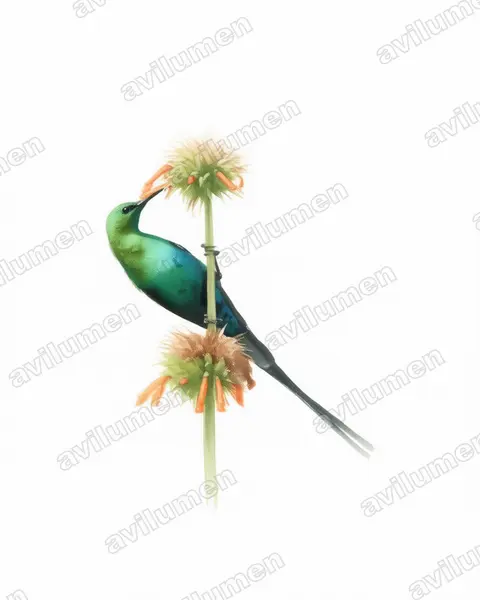
Watercolor 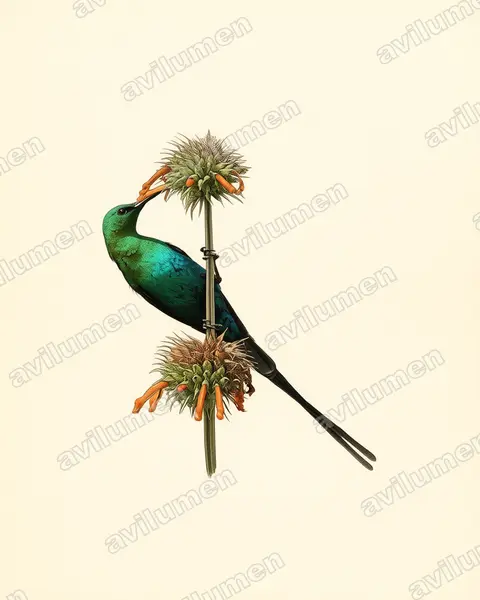
Vintage plate 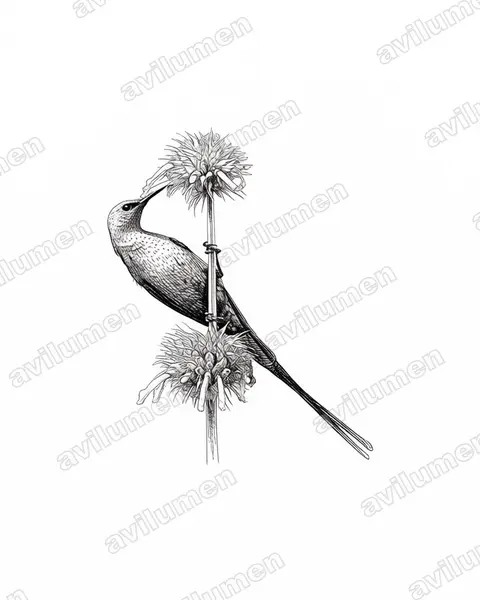
Ink 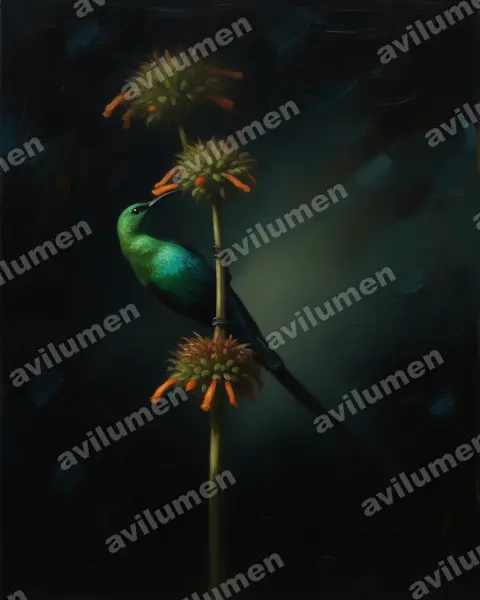
Oil 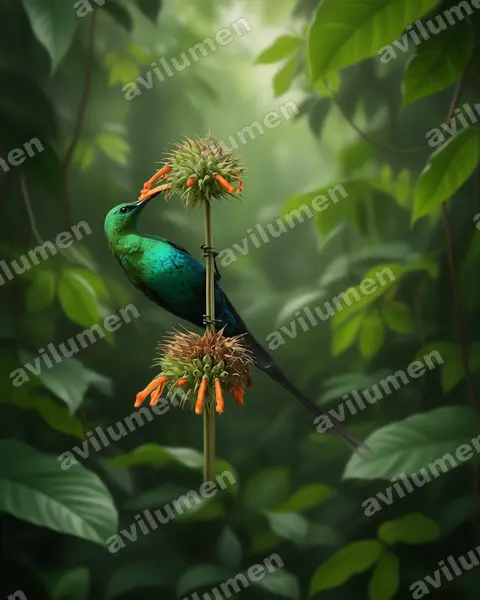
Realistic 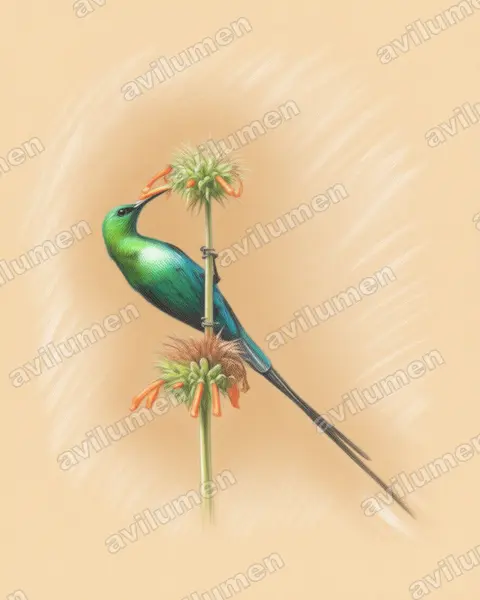
Colored pencil
Illustrations based on the photograph by Steve Garvie from Dunfermline, Fife, Scotland (CC BY 2.0), from Wikimedia Commons.
Digital editions
HD Digital Art Pack — Malachite Sunbird
Digital download: 6 high-resolution illustrations of the Malachite Sunbird (Nectarinia famosa), print-ready. This is a digital file; no animal or physical item is included.
AI Avatar — Malachite Sunbird
Generate an avatar fusing your face with the Malachite Sunbird (Nectarinia famosa). Delivered digitally in 8K, watermark-free. Digital product; no animals are sold or brokered.
Instant download. No live birds are sold.
Frequently asked questions
- Is Nectarinia famosa (Malachite Sunbird) endangered?
- The IUCN Red List places Nectarinia famosa, commonly known as the Malachite Sunbird, in the «Least concern» category. «Least concern» means it is not currently threatened.
- Where does Nectarinia famosa (Malachite Sunbird) live?
- Nectarinia famosa (Malachite Sunbird) is found in Africa.
- What family does Nectarinia famosa (Malachite Sunbird) belong to?
- Nectarinia famosa (Malachite Sunbird) belongs to the family Nectariniidae, in the order Passeriformes.
- What colour is Nectarinia famosa (Malachite Sunbird)?
- The plumage of Nectarinia famosa (Malachite Sunbird) combines these colours: Green.
More from the same family
 Least concern
Handsome Sunbird
Aethopyga bella
The handsome sunbird is a species of bird in the family Nectariniidae. It is endemic to the Philippines.
from $1.99
 Least concern
Apo Sunbird
Aethopyga boltoni
The Apo sunbird is a species of bird in the sunbird family Nectariniidae. It is endemic to the island of Mindanao in the Philippines. It is found in tropical moist montane forests at elevations ranging from 820 to 2,000 metres above sea level.
from $1.99
 Least concern
Fork-tailed Sunbird
Aethopyga christinae
The fork-tailed sunbird is a bird in the family Nectariniidae. The species was first described by Robert Swinhoe in 1869.
from $1.99
 Endangered
Elegant Sunbird
Aethopyga duyvenbodei
The elegant sunbird is a large, up to 12 cm long, Australasian sunbird in the genus Aethopyga. The male has an iridescent blue-green crown, shoulder patch and uppertail coverts, yellow bar across lower back, red ear coverts, olive back, yellow throat, red neck collar and yellow below. The female has a yellowish olive upperparts, scaly crown and yellow underparts.
from $1.99