Hispaniolan Trogon
Priotelus roseigaster
Avilumen editorial team ·

The Hispaniolan trogon is a species of bird in the family Trogonidae. It is endemic to Hispaniola in the Caribbean. It is one of the only two trogon species found in the Caribbean. It is the national bird of Haiti.
The Hispaniolan trogon (Priotelus roseigaster, also known as cacos) is a species of bird in the family Trogonidae. It
is endemic to Hispaniola in the Caribbean. It is one of the only two trogon species found in the Caribbean.
It is the national bird of Haiti.
Identification
Trogons are brightly coloured birds with long, strongly graduated tails, small feet, and short, thick bills. The Hispaniolan trogon has metallic green upper parts, a gray throat and breast, and a red belly and is separated from the closely related Cuban trogon by the more typical tail of this species. The underside of the tail is dark, but each rectrix is broadly tipped with white. Males and females look similar, but the females' wing coverts and secondaries lack the narrow white bars.
The male average measurements for wing, tail, culem from base and tarsus are 135.2, 154, 17.3, and 16.8 mm respectively. The female averages are 136.6, 154, 16.5, and 16.4 mm respectively.
Vocalizations
The song is rather slow and can be heard from quite a distance. It has a low rattle.
Habitat
Its natural habitats are subtropical or tropical moist montane forests and heavily degraded forest. It is threatened by habitat loss. It is mostly confined to a few remaining protected areas.
It inhabits rain, dry, pine and broadleaved deciduous forests. Several early records included mangrove swamps west of Miragoane but whether these were visitors or a resident population is unknown.
It requires large, old decayed trees with holes for nesting. It primarily occurs at elevations of 500–3,000 m, but there appears to be some altitudinal migration with birds observed at lower elevations in winter.
In Haiti, it is restricted to the Massif de la Hotte and Chaîne de la Selle, due to extensive habitat loss. It is still quite common in the Dominican Republic, especially in the relatively undisturbed Sierra de Baoruco, although there has been a moderately rapid population reduction, owing to deforestation.
Diet
It is known to mainly eat insects, though it also takes small vertebrates such as anoles and fruits, especially those of the West Indian sumac (Brunellia comocladifolia).
Behaviour
Its foraging behaviour is presumed to be similar to that of other species of trogon: most food is taken in aerial sallies to fruit or to surrounding vegetation. The species primarily forages in the midstory of humid deciduous and pine forests. A study of mixed-species flocks on Hispaniola recorded two encounters with the Hispaniolan trogon, both of which were associated with mixed flocks.
Reproduction
Its breeding season is thought to be March to July. The nest is a cavity in a tree, including cavities of the Hispaniolan woodpecker (Melanerpes striatus). The only known clutches are of two eggs; eggs are pale green and unmarked. Egg measurements ranged from 27.9 by 23.5 mm to 31.4 by 23.9 mm. The lengths of the incubation period and nestling periods are unknown. Generation length is estimated at 7.3 years.
Population and conservation
The Hispaniolan trogon is a forest-dependent species and is vulnerable to habitat loss or degradation.
The IUCN Red List conservation status of the Hispaniolan trogon is assessed as Least Concern; however, its population is continuing to decline throughout its small range, owing to forest degradation and fragmentation. Forest loss and fragmentation owing to shifting agriculture are causing a decline, particularly in moist forest areas. Dry forests have been considerably altered by charcoal production, and pine forests have been reduced as a consequence of indiscriminate logging and clear-cutting. In particular, recent habitat destruction along highways has caused a drastic decline of the population in the Cordillera Central, but it is occasionally seen on abandoned coffee farms and old cocoa groves in the Cordillera Septentrional. The species is also subject to hunting. However, as the range is relatively wide and not yet severely fragmented, the species is classified as Least Concern.
Some populations are afforded protection by national parks, such as in the Sierra de Baoruco. Proposed conservation actions include monitoring the population regularly, effectively protecting national parks that hold populations of the species, encouraging forms of agriculture which do not require forest clearance, discouraging charcoal production in native forests, and raising awareness of the uniqueness of the species, as well as discourage hunting.
Text adapted from Wikipedia · CC BY-SA 4.0
Plumage colours
Distribution

Taxonomy
- Order
- Trogoniformes
- Family
- Trogonidae
- Genus
- Priotelus
- Conservation status
- Not evaluated
Listen to its call
No recording yet
Illustration gallery
6 illustrations of Priotelus roseigaster (Hispaniolan Trogon) in different styles, true to its real plumage. Shown watermarked; the art pack includes the high-resolution originals, ready to print.
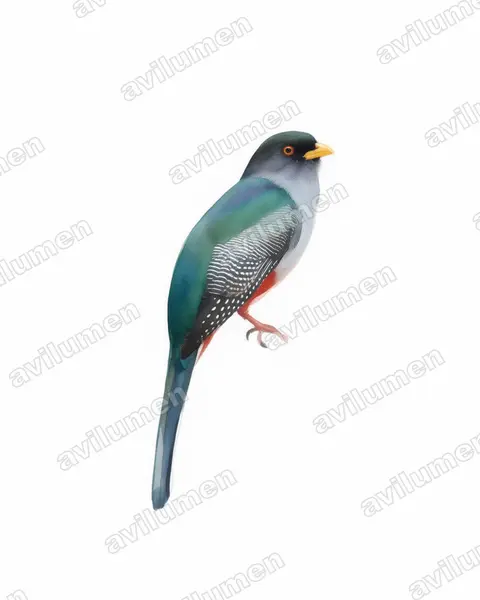
Watercolor 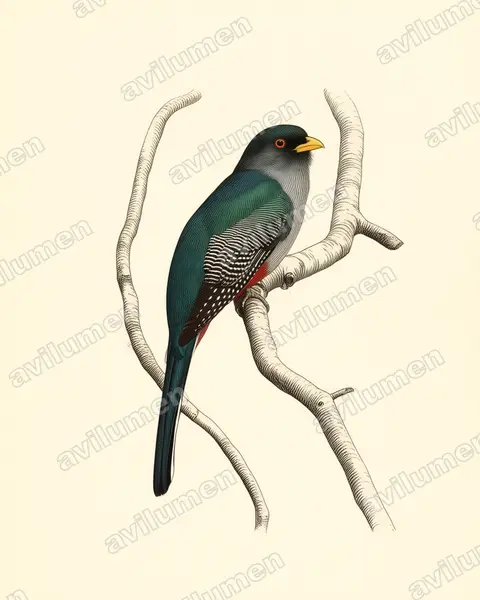
Vintage plate 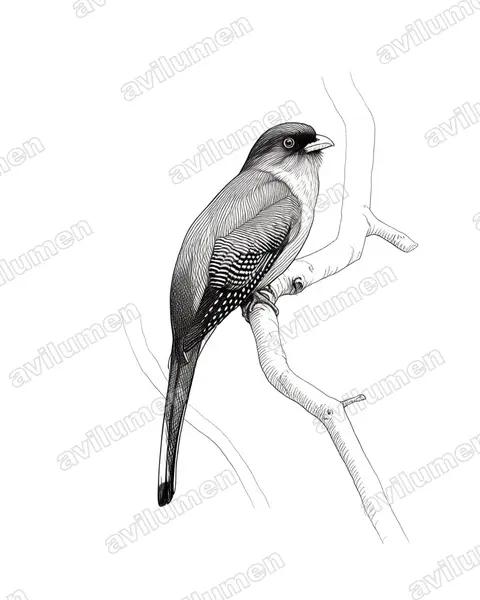
Ink 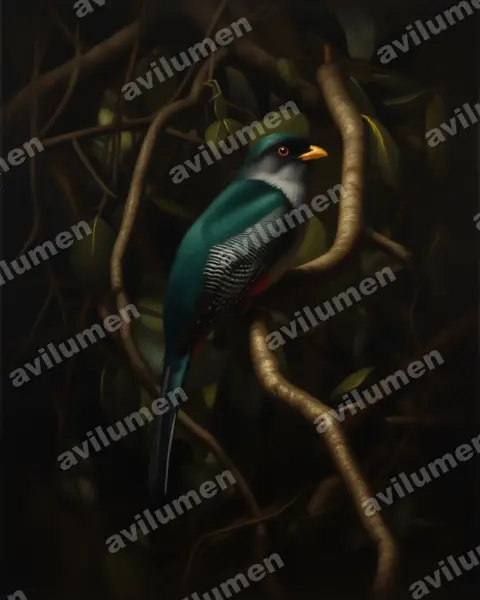
Oil 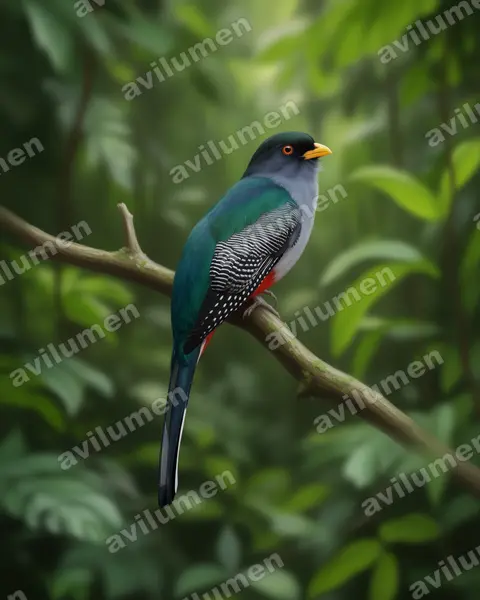
Realistic 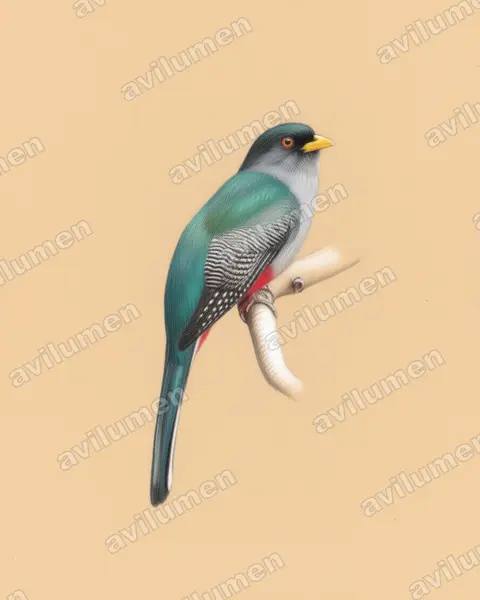
Colored pencil
Illustrations based on the photograph by Ron Knight from Seaford, East Sussex, United Kingdom (CC BY 2.0), from Wikimedia Commons.
Digital editions
HD Digital Art Pack — Hispaniolan Trogon
Digital download: 6 high-resolution illustrations of the Hispaniolan Trogon (Priotelus roseigaster), print-ready. This is a digital file; no animal or physical item is included.
AI Avatar — Hispaniolan Trogon
Generate an avatar fusing your face with the Hispaniolan Trogon (Priotelus roseigaster). Delivered digitally in 8K, watermark-free. Digital product; no animals are sold or brokered.
Instant download. No live birds are sold.
Frequently asked questions
- Is Priotelus roseigaster (Hispaniolan Trogon) endangered?
- The IUCN Red List places Priotelus roseigaster, commonly known as the Hispaniolan Trogon, in the «Not evaluated» category. «Not evaluated» means the IUCN has not yet assessed this species.
- What family does Priotelus roseigaster (Hispaniolan Trogon) belong to?
- Priotelus roseigaster (Hispaniolan Trogon) belongs to the family Trogonidae, in the order Trogoniformes.
- What colour is Priotelus roseigaster (Hispaniolan Trogon)?
- The plumage of Priotelus roseigaster (Hispaniolan Trogon) combines these colours: Multicoloured.
More from the same family
 Least concern
Sumatran Trogon
Apalharpactes mackloti
The Sumatran trogon is a species of bird in the family Trogonidae. It was formerly considered conspecific with the Javan trogon under the common name blue-tailed trogon.
from $1.99
 Vulnerable
Javan trogon
Apalharpactes reinwardtii
The Javan trogon is a bird species in the family Trogonidae endemic to western Java, Indonesia. It was previously grouped with the Sumatran trogon as a single species, known as the blue-tailed trogon. However, differences in size, weight, and plumage have led to their classification as separate species.
from $1.99
 Least concern
Bare-cheeked Trogon
Apaloderma aequatoriale
The bare-cheeked trogon is a species of bird in the family Trogonidae found in the rainforests of western central Africa.
from $1.99
 Least concern
Narina Trogon
Apaloderma narina
The Narina trogon is a largely green and red, medium-sized bird in the family Trogonidae. It is native to forests and woodlands of the Afrotropics. Though it is the most widespread and diverse in habitat choice of the three Apaloderma species, its numbers are locally depleted due to deforestation. Some populations are sedentary while others undertake regular movements.
from $1.99