Newton's parakeet
Psittacula exsul
Avilumen editorial team ·

Newton's parakeet, also known as the Rodrigues parakeet or Rodrigues ring-necked parakeet, is an extinct species of parrot that was endemic to the Mascarene island of Rodrigues in the western Indian Ocean. Several of its features diverged from related species, indicating long-term isolation on Rodrigues and subsequent adaptation. The rose-ringed parakeet of the same genus is a close relative and probable ancestor.
Newton's parakeet (Psittacula exsul), also known as the Rodrigues parakeet or Rodrigues ring-necked parakeet, is an extinct species of parrot that was endemic to the Mascarene island of Rodrigues in the western Indian Ocean. Several of its features diverged from related species, indicating long-term isolation on Rodrigues and subsequent adaptation. The rose-ringed parakeet of the same genus is a close relative and probable ancestor. Newton's parakeet may itself have been ancestral to the endemic parakeets of nearby Mauritius and Réunion.
Around 40 centimetres (16 in) long, Newton's parakeet was roughly the size of a rose-ringed parakeet. Its plumage was mostly greyish or slate blue in colour, which is unusual in Psittacula, a genus containing mostly green species. The male had stronger colours than the female and possessed a reddish instead of black beak, but details of a mature male's appearance are uncertain; only one male specimen is known, and it is believed to be immature. Mature males might have possessed red patches on the wing like the related Alexandrine parakeet. Both sexes had a black collar running from the chin to the nape, but this was clearer in the male. The legs were grey and the iris yellow. Some 17th-century accounts indicate that some members of the species were green, which would suggest that both blue and green colour morphs occurred, but no definitive explanation exists for these reports. Little is known about its behaviour in life, but it may have fed on the nuts of the bois d'olive tree, along with leaves. It was very tame and was able to mimic speech.
Newton's parakeet was first written about by the French Huguenot François Leguat in 1708 and was only mentioned a few times by other writers afterwards. The specific name "exsul" is a reference to Leguat, who was exiled from France. Only two life drawings exist, both of a single specimen held in captivity in the 1770s. The species was scientifically described in 1872, with a female specimen as the holotype. A male, the last specimen recorded, was collected in 1875, and these two specimens are the only ones that exist today. The bird became scarce due to deforestation and perhaps hunting, but it was thought to have been finally wiped out by a series of cyclones and storms that hit Rodrigues in the late 19th century. Speculation about the possible survival of the species, though unfounded, lasted as late as 1967.
Taxonomy
Newton's parakeet was first recorded by François Leguat in his 1708 memoir A New Voyage to the East Indies. Leguat was the leader of a group of nine French Huguenot refugees who colonised Rodrigues between 1691 and 1693 after they were marooned there. Subsequent accounts were by Julien Tafforet, who was marooned on the island in 1726, in his Relation de l'Île Rodrigue, and then by the French mathematician Alexandre Pingré, who travelled to Rodrigues to view the 1761 transit of Venus.
In 1871, George Jenner, the British magistrate of Rodrigues, collected a female specimen; it was preserved in alcohol and given to Edward Newton, a British colonial administrator in Mauritius, who sent it to his brother, the ornithologist Alfred Newton. A. Newton scientifically described the species in 1872 and gave it the scientific name Palaeornis exsul. "Exsul" ("exiled") refers to Leguat, in that he was exiled from France when he gave the first description of the bird. Newton had tried to find a more descriptive name, perhaps based on colouration, but found it difficult. He refrained from publishing a figure of the female in his original description, though the journal Ibis had offered him the space. He instead wanted to wait until a male specimen could be procured since he imagined it would be more attractive. The female, which is the holotype specimen of the species, is housed in the Cambridge University Museum as specimen UMZC 18/Psi/67/h/1.
A. Newton requested further specimens, especially males, but in 1875 he finally published a plate of the female, lamenting that no male specimens could be found. Tafforet's 1726 account had been rediscovered the previous year, and A. Newton noted that it confirmed his assumption that the male would turn out be much more colourful than the female. Newton's collector, the English naturalist Henry H. Slater, had seen a live Newton's parakeet the year before, but was not carrying a gun at the time. On 14 August 1875, William Vandorous shot a male specimen. It may have been the same specimen Slater had observed. It was subsequently sent to E. Newton by William J. Caldwell. This is the paratype of the species, numbered UMZC 18/Psi/67/h/2 and housed in the Cambridge Museum.
In 1876, the Newton brothers noted that they had expected the male would be adorned with a red patch on the wing, but that the absence of this indicated it was immature. They still found it more beautiful than the female. These two specimens are the only preserved individuals of the species. The mandible and sternum were extracted from the female specimen, and subfossil remains have since been found in the Plaine Corail caverns on Rodrigues. The American ornithologist James L. Peters used the name Psittacula exsul for Newton's parakeet in his 1937 checklist of birds, replacing the genus name Palaeornis with Psittacula, wherein he also classified other extant parakeets of Asia and Africa.
Evolution
Based on morphological features, the Alexandrine parakeet (Psittacula eupatria) has been proposed as the founder population for all Psittacula species on Indian Ocean islands, with new populations settling during the species' southwards colonisation from its native South Asia. Features of that species gradually disappear in species further away from its range. Subfossil remains of Newton's parakeet show that it differed from other Mascarene Psittacula species in some osteological features, but also had similarities, such as a reduced sternum, which suggests a close relationship. Skeletal features indicate an especially close relationship with the Alexandrine parakeet and the rose-ringed parakeet (Psittacula krameri), but the many derived features of Newton's parakeet indicates it had long been isolated on Rodrigues.
Many endemic Mascarene birds, including the dodo, are descended from South Asian ancestors, and the British palaeontologist Julian Hume has proposed that this may also be the case for all parrots there. Sea levels were lower during the Pleistocene, so it was possible for species to colonise some of these less isolated islands. Although most extinct parrot species of the Mascarenes are poorly known, subfossil remains show that they shared common features such as enlarged heads and jaws, reduced pectoral bones, and robust leg bones. Hume has suggested that they all have a common origin in the radiation of the tribe Psittaculini, members of which are known as Psittaculines, basing this theory on morphological features and the fact that parrots from that group have managed to colonise many isolated islands in the Indian Ocean. The Psittaculini could have invaded the area several times, as many of the species were so specialised that they may have evolved significantly on hotspot islands before the Mascarenes emerged from the sea. Other members of the genus Psittacula from the Mascarenes include the extant echo parakeet (Psittacula eques echo) of Mauritius, as well as its extinct Réunion subspecies (Psittacula eques eques), and the Mascarene grey parakeet (Psittacula bensoni) of both Mauritius and Réunion.
A 2011 genetic study of parrot phylogeny was unable to include Newton's parakeet, as no viable DNA could be extracted. A 2015 genetic study by the British geneticist Hazel Jackson and colleagues included viable DNA from the toe-pad of the female Newton's parakeet specimen. It was found to group within a clade of rose-ringed parakeet subspecies (from Asia and Africa), which it had diverged from 3.82 million years ago. Furthermore, Newton's parakeet appeared to be ancestral to the parakeets of Mauritius and Réunion. The cladogram accompanying the study is shown below:
In 2018, the American ornithologist Kaiya L. Provost and colleagues found the Mascarene parrot (Mascarinus marscarinus) and Tanygnathus species to group within Psittacula, making that genus paraphyletic (an unnatural grouping), and stated this argued for breaking up the latter genus. To solve the issue, the German ornithologist Michael P. Braun and colleagues proposed in 2019 that Psittacula should be split into multiple genera. They placed Newton's parakeet in the new genus Alexandrinus, along with its closest relatives, the echo parakeet and the rose-ringed parakeet.
A 2022 genetic study by the Brazilian ornithologist Alexandre P. Selvatti and colleagues confirmed the earlier studies in regard to the relationship between Psittacula, the Mascarene parrot, and Tanygnathus. They suggested that Psittaculinae originated in the Australo–Pacific region (then part of the supercontinent Gondwana), and that the ancestral population of the Psittacula–Mascarinus lineage were the first psittaculines in Africa by the late Miocene (8–5 million years ago), and colonised the Mascarenes from there.
Description
Newton's parakeet was about 40 cm (16 in) long – roughly the size of the rose-ringed parakeet. The wing of the male specimen was 198 mm (7.8 in), the tail 206 mm (8.1 in), the culmen 25 mm (0.98 in), and the tarsus was 22 mm (0.87 in). The wing of the female specimen was 191 mm (7.5 in), the tail 210 mm (8.3 in), the culmen 24 mm (0.94 in), and the tarsus was 22 mm (0.87 in). The male specimen was greyish blue (also described as "slatey blue") tinged with green, and darker above. The head was bluer, with a dark line running from the eye to the cere. It had a broad black collar running from the chin to the nape, where it became gradually narrower. The underside of the tail was greyish, the upper beak was dark reddish brown, and the mandible was black. The legs were grey and the iris yellow. The female was similar but had a greyer head and a black beak. The black collar was not so prominent as that of the male and did not extend to the back of the neck.
The general appearance of Newton's parakeet was similar to the extant Psittacula species, including the black collar, but the bluish grey colouration set it apart from other members of its genus, which are mostly green. It differed from its Mascarene relatives in some skeletal details, including in that the internal margin of the mandibular symphysis (where the two halves of the lower jaw connected) was oval instead of square-shaped when seen from above, and in that the upper end of the humerus (upper arm bone) was less expanded than in the Mascarene grey parakeet and the echo parakeet.
Possible colour variation
The French naturalist Philibert Commerson received a live specimen on Mauritius in the 1770s and described it as "greyish blue". French artist Paul Philippe Sanguin de Jossigny made two illustrations of this specimen, the only known depictions of Newton's parakeet in life, unpublished until 2007. Though both existing specimens are blue, some early accounts from Rodrigues have caused confusion over the colouration of the plumage. One of these is Leguat's following statement:
There are abundance of green and blew Parrets, they are of a midling and equal bigness; when they are young, their Flesh is as good as young Pigeons.
If the green parrots Leguat referred to were not the Rodrigues parrot (Necropsittacus rodericanus), they might perhaps have been a green colour morph of Newton's parakeet, as Hume has suggested. As A. Newton observed in his original description, some feathers of the female specimen display both blue and green tinges, depending on the light. This may explain some of the discrepancies. According to Fuller, the green parrots mentioned could also instead have been storm-blown members of Psittacula species from other islands, that survived on Rodrigues for a short time.
The two existing specimens were originally preserved in alcohol, but though this can discolour specimens, it is not probable that it could turn green to blue. Hume and the Dutch orhinthologist Hein van Grouw have also suggested that due to an inheritable mutation, some Newton's parakeets may have lacked psittacin, a pigment that together with eumelanin produces green colouration in parrot feathers. Complete lack of psittacin produces blue colouration, whereas reduced psittacin can produce a colour between green and blue called parblue, which corresponds to the colour of the two preserved Newton's parakeet specimens. The reason why only parblue specimens are known today may be due to collecting bias, as unusually coloured specimens are more likely to be collected than those of normal colour.
Tafforet also described what appears to be green Newton's parakeets, but the issue of colouration was further complicated by the mention of red plumage:
Text adapted from Wikipedia · CC BY-SA 4.0
Plumage colours
Distribution

Taxonomy
- Order
- Psittaciformes
- Family
- Psittaculidae
- Genus
- Psittacula
- Conservation status
- Extinct
Listen to its call
No recording yet
Care guide
Budgie, Conure and Parakeet Care Guide
How to care for budgies, conures, parrotlets, ringnecks and other parakeets: diet, cage setup, health, behavior, breeding and legal status for owners.
Read the guide →Illustration gallery
6 illustrations of Psittacula exsul (Newton's parakeet) in different styles, true to its real plumage. Shown watermarked; the art pack includes the high-resolution originals, ready to print.
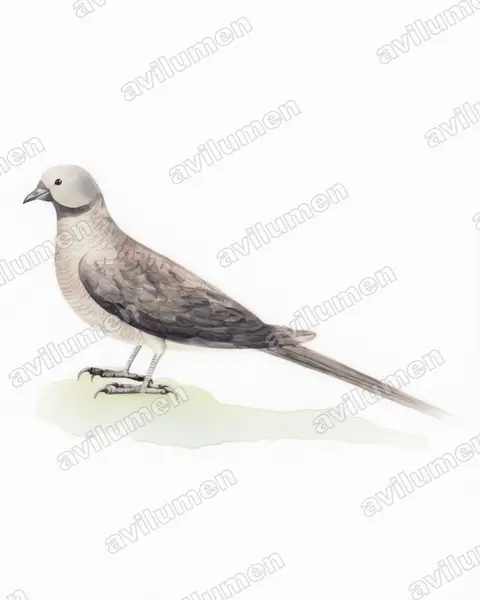
Watercolor 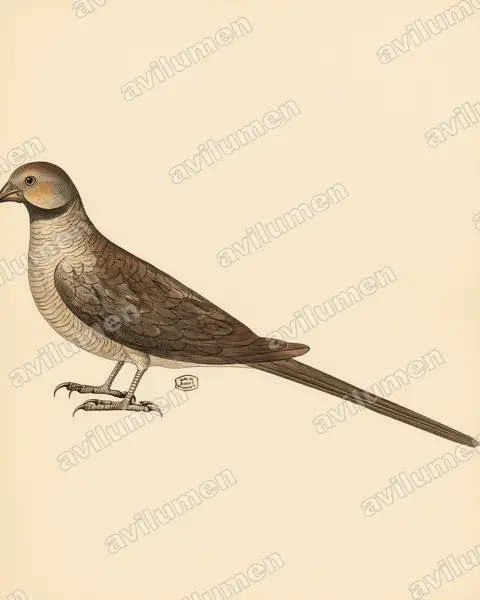
Vintage plate 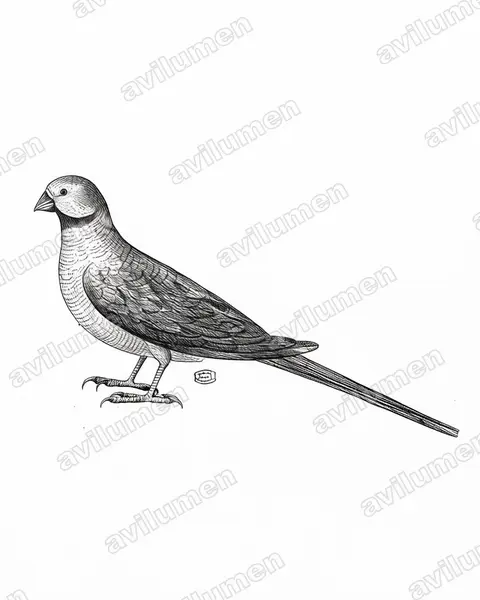
Ink 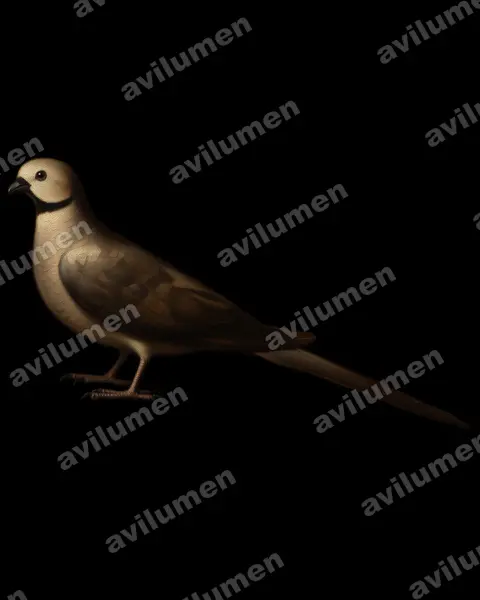
Oil 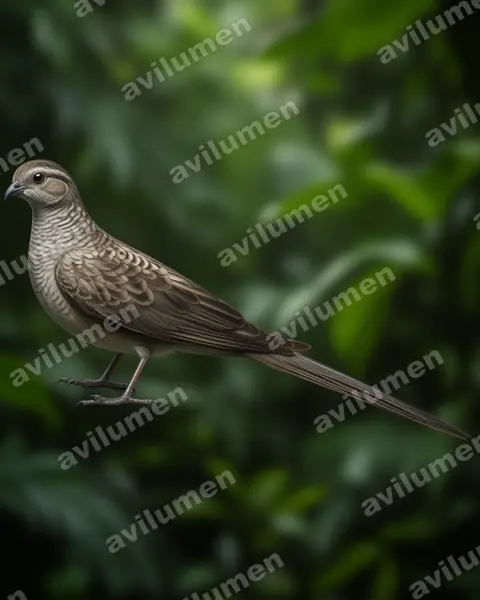
Realistic 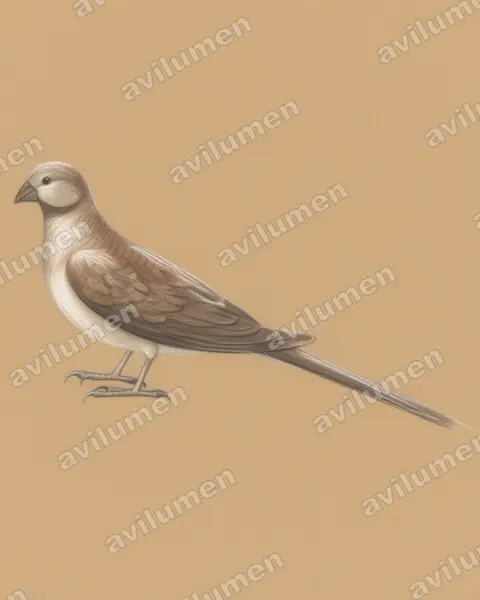
Colored pencil
Illustrations based on the photograph by Jossigny (Public domain), from Wikimedia Commons.
Digital editions
HD Digital Art Pack — Newton's parakeet
Digital download: 6 high-resolution illustrations of the Newton's parakeet (Psittacula exsul), print-ready. This is a digital file; no animal or physical item is included.
AI Avatar — Newton's parakeet
Generate an avatar fusing your face with the Newton's parakeet (Psittacula exsul). Delivered digitally in 8K, watermark-free. Digital product; no animals are sold or brokered.
Instant download. No live birds are sold.
Frequently asked questions
- Is Psittacula exsul (Newton's parakeet) endangered?
- The IUCN Red List places Psittacula exsul, commonly known as the Newton's parakeet, in the «Extinct» category. «Extinct» means no individual is known to remain alive.
- What family does Psittacula exsul (Newton's parakeet) belong to?
- Psittacula exsul (Newton's parakeet) belongs to the family Psittaculidae, in the order Psittaciformes.
- What colour is Psittacula exsul (Newton's parakeet)?
- The plumage of Psittacula exsul (Newton's parakeet) combines these colours: Green.
More from the same family
 Least concern
Grey-headed Lovebird
Agapornis canus
The gray-headed lovebird or Madagascar lovebird is a small species of parrot of the lovebird genus. It is a mainly green parrot. The species is sexually dimorphic and only the adult male has grey on its upper body. They are native on the island of Madagascar and are the only lovebird species which are not native on the African continent. They are the smallest of the lovebird species.
from $1.99
 Near threatened
Fischer's Lovebird
Agapornis fischeri
Fischer's lovebird is a small parrot species of the genus Agapornis. They were originally discovered in the late 19th century. They are named after the 19th century German explorer of East Africa Gustav Fischer.
from $1.99
 Near threatened
Lilian's Lovebird
Agapornis lilianae
Lilian's lovebird, also known as the Nyasa lovebird, is a small African parrot species of the lovebird genus. It is mainly green and has orange on its upper chest and head. It is 13 cm (5 inches) long and is the smallest parrot on mainland Africa. In captivity, it is uncommon and difficult to breed.
from $1.99
 Extinct
Agapornis longipes
Agapornis longipes
Agapornis longipes is an extinct species of lovebird that lived in what is now Gauteng, South Africa during the Early Pleistocene epoch, about 2.5–1.38 million years ago. The fossilized remains of this bird were first discovered in the Kromdraai fossil site and reported in 1969 by T.N. Pocock, though the species would not be named until decades later in 2024.
from $4.99