Many-banded Aracari
Pteroglossus pluricinctus
Avilumen editorial team ·

The many-banded aracari or many-banded araçari is a near-passerine bird in the toucan family Ramphastidae. It is found in Brazil, Colombia, Ecuador, Peru, and Venezuela.
The many-banded aracari or many-banded araçari (Pteroglossus pluricinctus) is a near-passerine bird in the toucan family Ramphastidae. It is found in Brazil, Colombia, Ecuador, Peru, and Venezuela.
Taxonomy and systematics
The many-banded aracari is monotypic.
Description
The many-banded aracari is 43 to 46 cm (17 to 18 in) long including the 11 to 12.5 cm (4.3 to 4.9 in) bill. It weighs 215 to 302 g (7.6 to 11 oz). Males' and females' bills are alike in color; the female's is shorter. The bill has an orange-yellow line at its base. Its maxilla is orange-yellow with a wide black stripe on the culmen and a black base. Its mandible is black. Adult males have a mostly black head, throat, and neck but for bare blue-green to green skin around the eye and a chestnut patch behind it. Their back is dark green and their rump is red. Their underparts are yellow with two bands, the upper one black and the lower one black and red. Their thighs are a mix of chestnut, green, and yellow. Adult females have little or no chestnut behind the eye and their black breast band is usually wider than the male's. Immatures are overall duller than adults, especially the yellow. Their bill is gray, brown, horn, and black without the yellow basal line. Their thighs are green.
Distribution and habitat
The many-banded aracari is found from northeastern Colombia and northwestern and southeastern Venezuela south through eastern Ecuador to northeastern Peru and east into northwestern Brazil north of the Amazon River and east to Roraima state. It primarily inhabits terra firme forest and to a lesser degree várzea and gallery forests. It mostly ranges up to 750 m (2,500 ft) of elevation but occurs as high as 1,000 m (3,300 ft).
Movement
The many-banded aracari is believed to be a year-round resident throughout its range.
Feeding
The many-banded aracari forages singly, in pairs, or in small groups. It is primarily frugivorous and also includes insects, small birds and bird eggs, and lizards in its diet. It plays a role in seed dispersal of fruits with a dispersion range of hundreds of meters. It is likely to regurgitate seeds as opposed to excreting them.
Breeding
The many-banded aracari's breeding season is thought to be between November and March in Colombia and Ecuador and from March to October in the rest of its range. Nothing else is known about its breeding biology.
Vocalization
The many-banded aracari's calls are variously described as "seeent", "seeet", "see-yeet", "kyseek", and "kyeek".
Status
The IUCN has assessed the many-banded aracari as being of Least Concern. It has a very large range but its population size is not known and is believed to be decreasing. It is described as "fairly common" from Colombia to Peru but is not well known elsewhere. It occurs in several protected areas. " Lack of information on its biology and population ecology would be serious handicaps if [the] species comes to need any protective action."
Text adapted from Wikipedia · CC BY-SA 4.0
Where it lives
Plumage colours
Distribution

Taxonomy
- Order
- Piciformes
- Family
- Ramphastidae
- Genus
- Pteroglossus
- Conservation status
- Least concern
Listen to its call
No recording yet
Care guide
Toucan and Aracari Care Guide: Diet and Housing
How to care for toucans and aracaris: low-iron diet, iron storage disease (hemochromatosis), aviary setup, health, behavior and CITES legal status.
Read the guide →Illustration gallery
6 illustrations of Pteroglossus pluricinctus (Many-banded Aracari) in different styles, true to its real plumage. Shown watermarked; the art pack includes the high-resolution originals, ready to print.
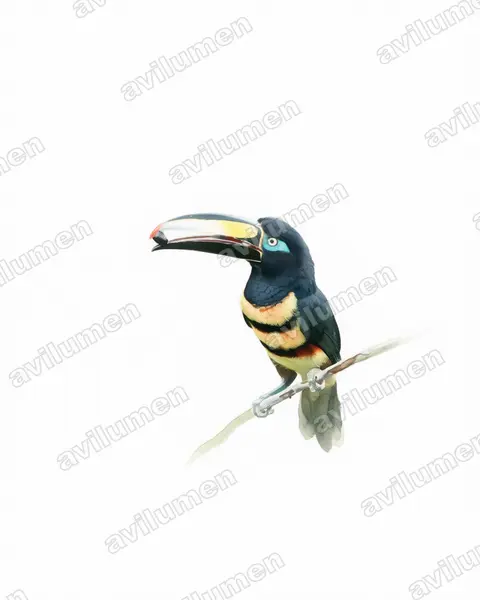
Watercolor 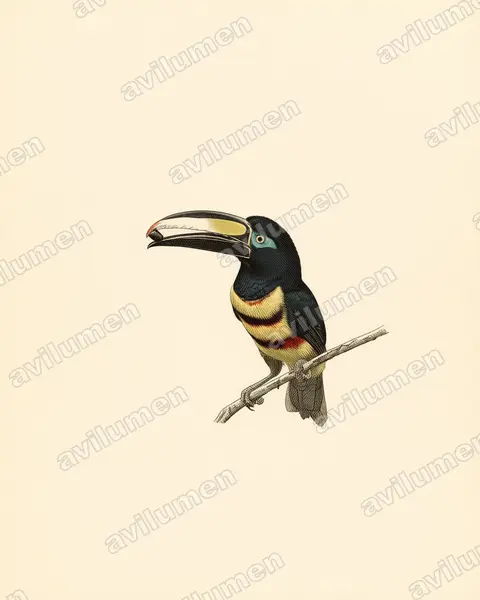
Vintage plate 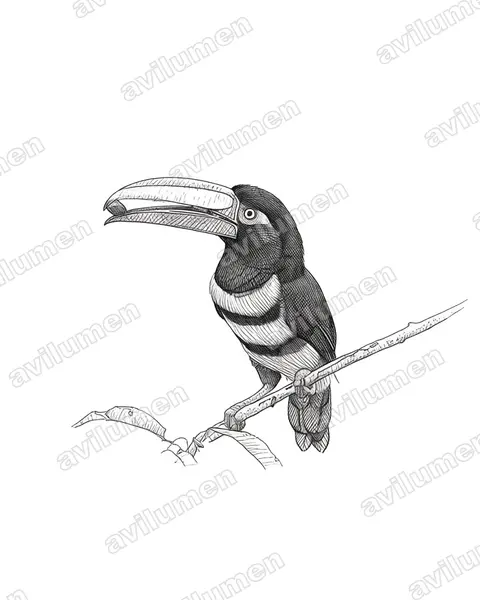
Ink 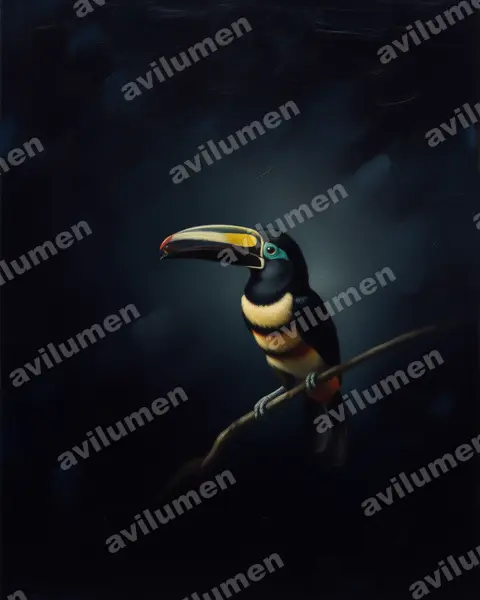
Oil 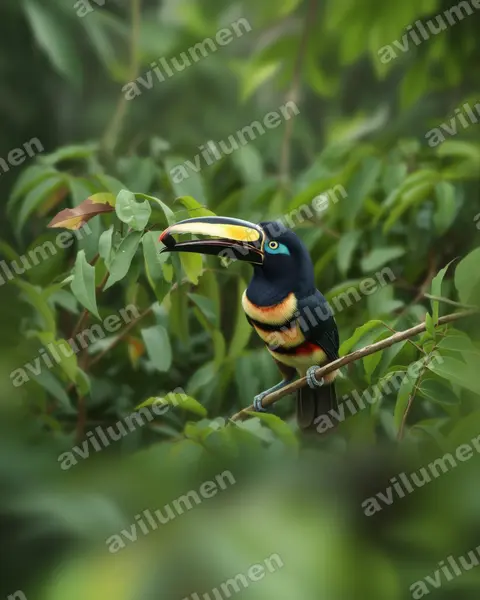
Realistic 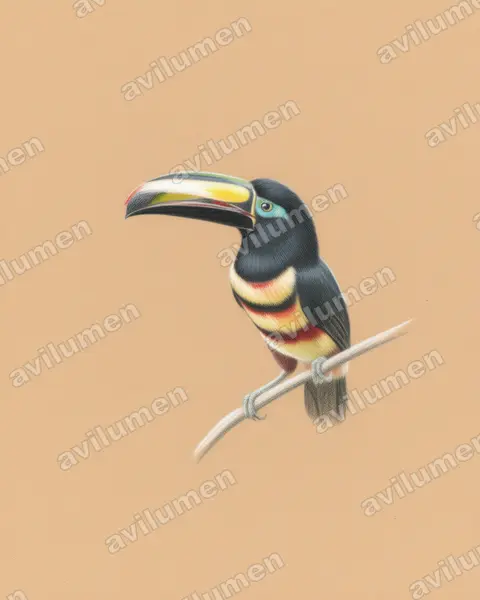
Colored pencil
Illustrations based on the photograph by Patty McGann (CC BY 2.0), from Wikimedia Commons.
Digital editions
HD Digital Art Pack — Many-banded Aracari
Digital download: 6 high-resolution illustrations of the Many-banded Aracari (Pteroglossus pluricinctus), print-ready. This is a digital file; no animal or physical item is included.
AI Avatar — Many-banded Aracari
Generate an avatar fusing your face with the Many-banded Aracari (Pteroglossus pluricinctus). Delivered digitally in 8K, watermark-free. Digital product; no animals are sold or brokered.
Instant download. No live birds are sold.
Frequently asked questions
- Is Pteroglossus pluricinctus (Many-banded Aracari) endangered?
- The IUCN Red List places Pteroglossus pluricinctus, commonly known as the Many-banded Aracari, in the «Least concern» category. «Least concern» means it is not currently threatened.
- Where does Pteroglossus pluricinctus (Many-banded Aracari) live?
- Pteroglossus pluricinctus (Many-banded Aracari) is found in Brazil and South America.
- What family does Pteroglossus pluricinctus (Many-banded Aracari) belong to?
- Pteroglossus pluricinctus (Many-banded Aracari) belongs to the family Ramphastidae, in the order Piciformes.
- What colour is Pteroglossus pluricinctus (Many-banded Aracari)?
- The plumage of Pteroglossus pluricinctus (Many-banded Aracari) combines these colours: Multicoloured.
More from the same family
 Least concern
Hooded Mountain Toucan
Andigena cucullata
The hooded mountain toucan is a species of bird in the toucan family Ramphastidae. It is found in Bolivia and Peru.
from $1.99
 Near threatened
Grey-breasted Mountain Toucan
Andigena hypoglauca
The grey-breasted mountain toucan is a least-concern species of bird in the toucan family, Ramphastidae. It is found in South American countries such as Colombia, Ecuador and Peru.
from $1.99
 Near threatened
Plate-billed Mountain Toucan
Andigena laminirostris
The plate-billed mountain toucan is a species of bird in the family Ramphastidae. It is native to the west slope of Ecuador and extreme southern Colombia, where it lives in the high-altitude humid mountain forests of the Andes.
from $1.99
 Least concern
Black-billed Mountain Toucan
Andigena nigrirostris
The black-billed mountain toucan is a species of bird in the toucan family Ramphastidae. It is found in Colombia, Ecuador, Peru, and Venezuela.
from $1.99