Shining sunbeam
Aglaeactis cupripennis
Avilumen editorial team ·

The shining sunbeam is a species of hummingbird in the "brilliants", tribe Heliantheini in subfamily Lesbiinae. It is found in Colombia, Ecuador, and Peru.
The shining sunbeam (Aglaeactis cupripennis) is a species of hummingbird in the "brilliants", tribe Heliantheini in subfamily Lesbiinae. It is found in Colombia, Ecuador, and Peru.
Taxonomy and systematics
As of 2022, the shining sunbeam had two recognized subspecies, the nominate A. c. cupripennis and A. c. caumatonota. In the past the species had been subdivided into as many as six subspecies. In addition, what is now the purple-backed sunbeam (A. aliciae) has also been treated as a subspecies of shining sunbeam.
Description
The shining sunbeam is 12 to 13 cm (4.7 to 5.1 in) long. Males weigh 7.6 to 8.1 g (0.27 to 0.29 oz) and females 6.9 to 7.5 g (0.24 to 0.26 oz). Both sexes have a short, straight, black bill. Unique among sunbeams, neither sex has any white plumage. Males of the nominate subspecies have a dark brown crown and upper back; their lower back and rump are lilac-gold becoming silvery green on the uppertail coverts. Their tail feathers are dark brown to rufous, usually with bronzy edges. Their throat is rufous dotted with dusky gray, the breast a patchy buff, and the belly reddish brown. From north to south, the male's underparts become brighter, the crown darker, and the tail redder. Females are similar to the males but the gold and green of the lower back and rump are duller or absent. A. c. caumatonota differs from the nominate with an iridescent amethyst rump and purplish amethyst uppertail coverts.
Distribution and habitat
The nominate subspecies of shining sunbeam is found in all three Andean ranges of Colombia and south from there through Ecuador to Peru's departments of La Libertad and Huánuco. A. c. caumatonota is found in Peru from the nominate's range south to the departments of Lima and Cuzco.
The species inhabits sub-páramo to páramo, landscapes characterized by grasslands with scattered shrubs and trees. It also inhabits cloudforest and semi-arid ridges with a few trees. In elevation it ranges from 2,500 to 4,300 m (8,200 to 14,100 ft).
Movement
In Colombia at least, the shining sunbeam makes seasonal elevational movements.
Feeding
The shining sunbeam forages for nectar at all levels from the ground to treetops. It feeds at a wide variety of bromeliads, vines, and trees including Embothrium, Puya, and Fuchsia, and males defend patches of flowering plants. The species also feeds on small arthropods by hawking.
Breeding
The shining sunbeam's breeding seasons differ throughout its range, from March to September in Colombia, between February and April in Ecuador, and in (and possibly between) November and April in Peru. It builds a compact cup nest of moss and cobweb lined with soft plant fibers and sometimes decorated on the outside with bark or lichen. It is placed on a branch or epiphyte, usually 4 to 10 m (10 to 30 ft) above ground but sometimes as high as 15 m (50 ft). The female alone incubates the clutch of two white eggs for 16 to 18 days; fledging occurs 24 to 27 days after hatch.
Vocalization
The shining sunbeam's song is "high-pitched chirping notes, 'tsip...chew...chew...tseep.....tsip..chew...'". Its calls include "single upslurred 'suweet' notes and single high-pitched 'see' notes."
Status
The IUCN has assessed the shining sunbeam as being of Least Concern. It has a large range, and though its population size is not known it is believed to be stable. It is generally fairly common, occurs in a wide range of habitats, and is found in several protected areas.
Text adapted from Wikipedia · CC BY-SA 4.0
Where it lives
Distribution

Taxonomy
- Order
- Apodiformes
- Family
- Trochilidae
- Genus
- Aglaeactis
- Conservation status
- Least concern
Listen to its call
No recording yet
Illustration gallery
6 illustrations of Aglaeactis cupripennis (Shining sunbeam) in different styles, true to its real plumage. Shown watermarked; the art pack includes the high-resolution originals, ready to print.
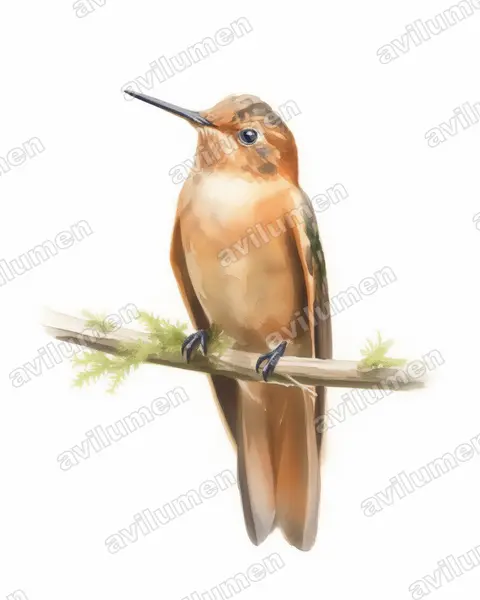
Watercolor 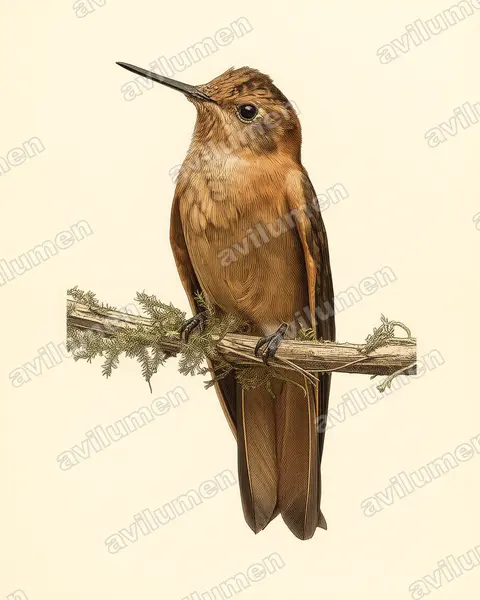
Vintage plate 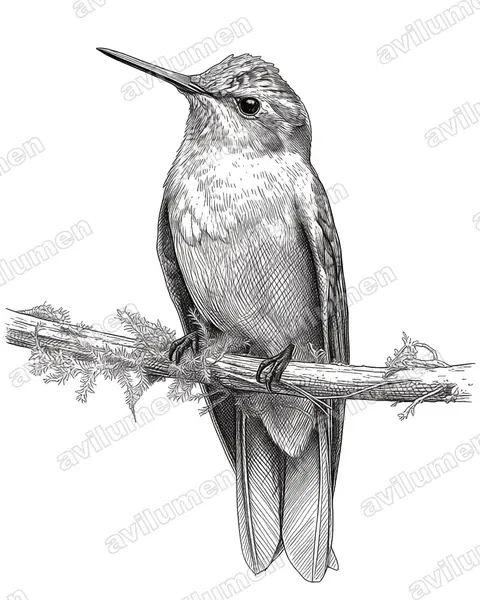
Ink 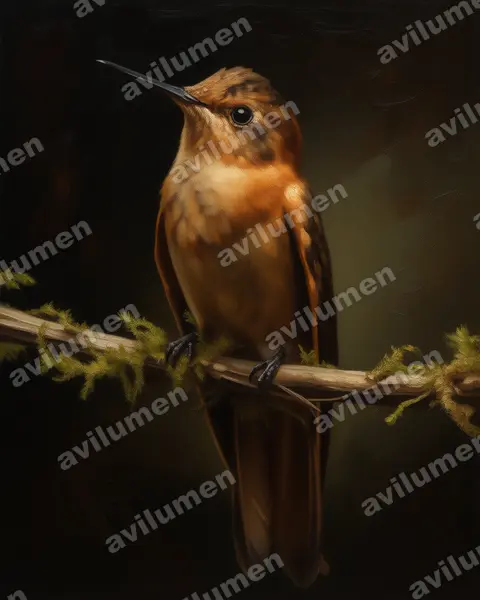
Oil 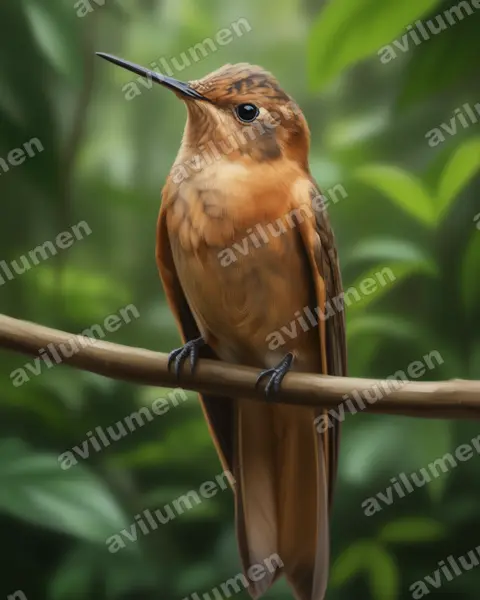
Realistic 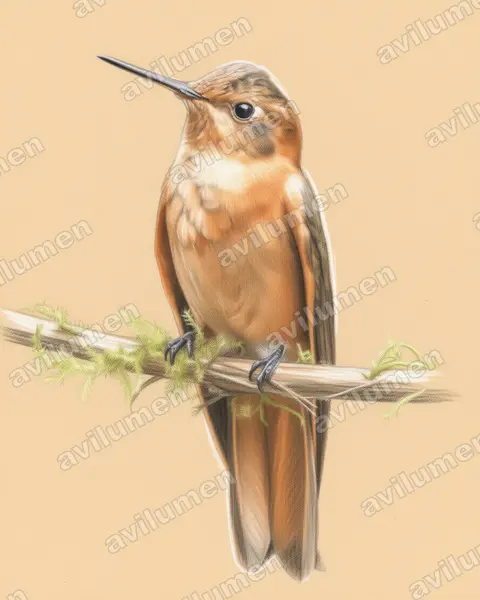
Colored pencil
Illustrations based on the photograph by Charles J. Sharp (CC BY-SA 4.0), from Wikimedia Commons.
Digital editions
HD Digital Art Pack — Shining sunbeam
Digital download: 6 high-resolution illustrations of the Shining sunbeam (Aglaeactis cupripennis), print-ready. This is a digital file; no animal or physical item is included.
AI Avatar — Shining sunbeam
Generate an avatar fusing your face with the Shining sunbeam (Aglaeactis cupripennis). Delivered digitally in 8K, watermark-free. Digital product; no animals are sold or brokered.
Instant download. No live birds are sold.
Frequently asked questions
- Is Aglaeactis cupripennis (Shining sunbeam) endangered?
- The IUCN Red List places Aglaeactis cupripennis, commonly known as the Shining sunbeam, in the «Least concern» category. «Least concern» means it is not currently threatened.
- Where does Aglaeactis cupripennis (Shining sunbeam) live?
- Aglaeactis cupripennis (Shining sunbeam) is found in South America.
- What family does Aglaeactis cupripennis (Shining sunbeam) belong to?
- Aglaeactis cupripennis (Shining sunbeam) belongs to the family Trochilidae, in the order Apodiformes.
- What colour is Aglaeactis cupripennis (Shining sunbeam)?
- The plumage of Aglaeactis cupripennis (Shining sunbeam) combines these colours: Green and Blue.
More from the same family
 Least concern
Emerald-chinned Hummingbird
Abeillia abeillei
The emerald-chinned hummingbird is a species of hummingbird in the "emeralds", tribe Trochilini of subfamily Trochilinae.
from $1.99
 Least concern
Speckled hummingbird
Adelomyia melanogenys
The speckled hummingbird is a species of hummingbird. It is the only member of the genus Adelomyia. It inhabits Neotropical montane cloud forests at elevations of 1,000–2,500 meters and is confined to the Andes of Argentina, Bolivia, Peru, Ecuador, Colombia and Venezuela; as well as to some isolated montane forests in western Ecuador and Venezuela.
from $1.99
 Vulnerable
Purple-backed sunbeam
Aglaeactis aliciae
The purple-backed sunbeam is a bird species in the family Trochilidae. It is found only in Peru.
from $1.99
 Near threatened
White-tufted sunbeam
Aglaeactis castelnaudii
The white-tufted sunbeam is a species of hummingbird in the family Trochilidae. It is found only in Peru. Its natural habitats are subtropical or tropical moist montane forest and subtropical or tropical high-altitude shrubland.
from $1.99