White-tufted sunbeam
Aglaeactis castelnaudii
Avilumen editorial team ·

The white-tufted sunbeam is a species of hummingbird in the family Trochilidae. It is found only in Peru. Its natural habitats are subtropical or tropical moist montane forest and subtropical or tropical high-altitude shrubland.
The white-tufted sunbeam (Aglaeactis castelnaudii) is a species of hummingbird in the family Trochilidae.
It is found only in Peru.
Its natural habitats are subtropical or tropical moist montane forest and subtropical or tropical high-altitude shrubland.
Description
An adult white-tufted sunbeam is approximately 12 cm in height and weighs 7- 8.5 g. The bill is straight and black and there is a notable patch of white feathers directly under the chin on the breast. The rest of the body is described as tawny and darkly-colored. There are iridescent feathers on the back of the bird that are most noticeable in flight and while hovering. Males and females of the species exhibit subtle sexual dimorphism.
Males are fuscous-black on their upper backs with a magenta reflection on their rump and lower back. Their tails are forked. The belly, side, and neck of a male are dull brown. The throat and pectoral band are blackish in color. True to their name, there is a white feather tuft on the central breast. Females are very similar to males, but have a less iridescent back and a smaller tail fork.
Juvenile white-tufted sunbeams have a more uniform, brown exterior with no iridescent feathers.
Habitat and range
The white-tufted sunbeam has a small and fragmented range, estimated at a maximum of 832 km2 (approximately 321 sq mi), cumulatively. This number was calculated using the remaining tree area in their range. The species has been observed to have a range that is not restricted to a specific number of locations (i.e. the range is fragmented). These hummingbirds reside in two main areas located in Central and Southern-Central Peru. They prefer drier parts of evergreen montane forests, intermontane valleys, and open shrub. White-tufted sunbeams can often be seen perching precariously at the very top of trees; except for where their range overlaps with Shining Sunbeams (Aglaeactis cupripennis). In these areas, they are often hidden away on lower branches and within dense vegetation.
Vocalization
Like many hummingbirds, the white-tufted sunbeam has a very soft and inconspicuous call. Vocalizations include a repeated tzit call and, during chases, a twittering series of titi-tsreet-tsreet-tsreet sounds. The latter is used during hostile situations only. The white-tufted sunbeam can also emit a thin, high-pitched seeeuuu noise.
Diet
Staples of this hummingbird's diet include flower nectar and insects. Some of the flowering plants utilized by this species include members of the following genera:
Barnadesia
Berberis
Brachyotum
Centropogon
Labiatae
Lupinus
Salpichroa
Siphocamplos
The white-tufted sunbeam is known for always clinging to flowers while it feeds and for catching insects in midair.
Conservation status
This hummingbird's divided range meets the criterion of the IUCN (International Union for Conservation) Red List, and is therefore evaluated as near threatened. Despite a general agreement among researchers that this species has a declining population and fragmented range, it is not defined as vulnerable by the IUCN because the range is not considered severely fragmented.
While the hummingbird's exact population size is unknown, white-tufted sunbeams have been described as "common but patchily distributed." The suspected cause of population decline is ongoing habitat loss due to deforestation.
Text adapted from Wikipedia · CC BY-SA 4.0
Where it lives
Plumage colours
Distribution

Taxonomy
- Order
- Apodiformes
- Family
- Trochilidae
- Genus
- Aglaeactis
- Conservation status
- Near threatened
Listen to its call
No recording yet
Illustration gallery
6 illustrations of Aglaeactis castelnaudii (White-tufted sunbeam) in different styles, true to its real plumage. Shown watermarked; the art pack includes the high-resolution originals, ready to print.
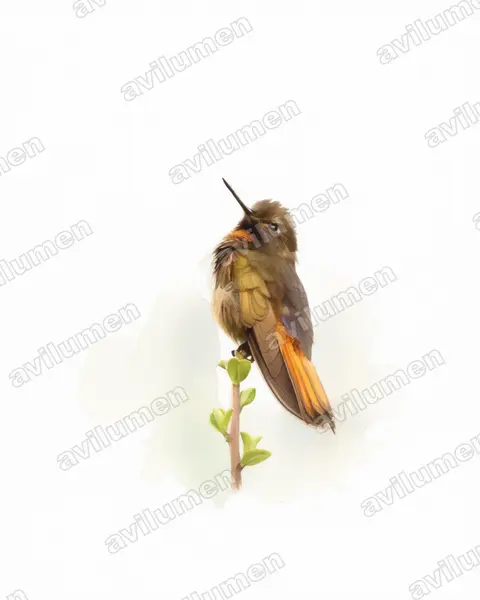
Watercolor 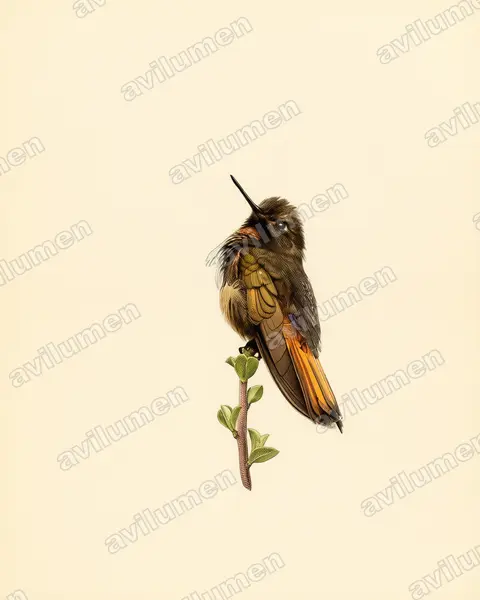
Vintage plate 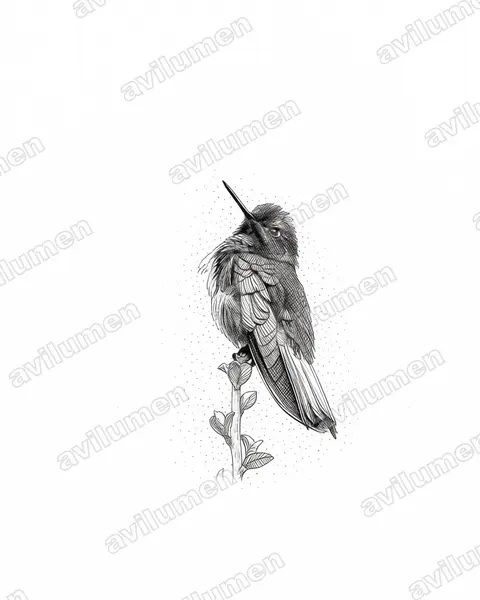
Ink 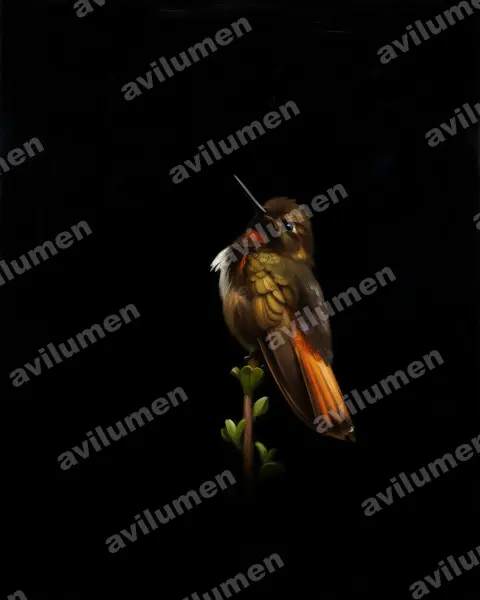
Oil 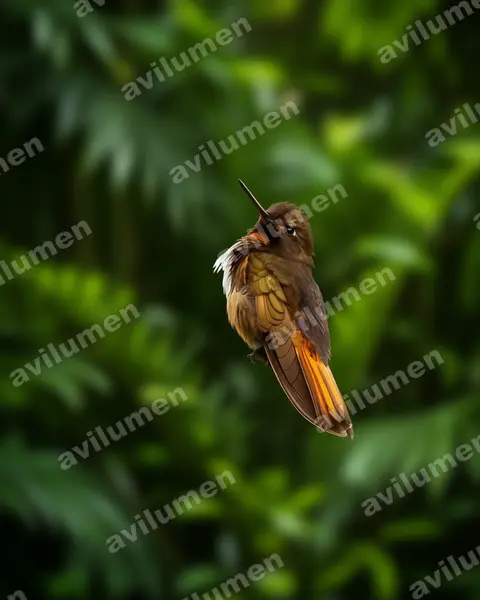
Realistic 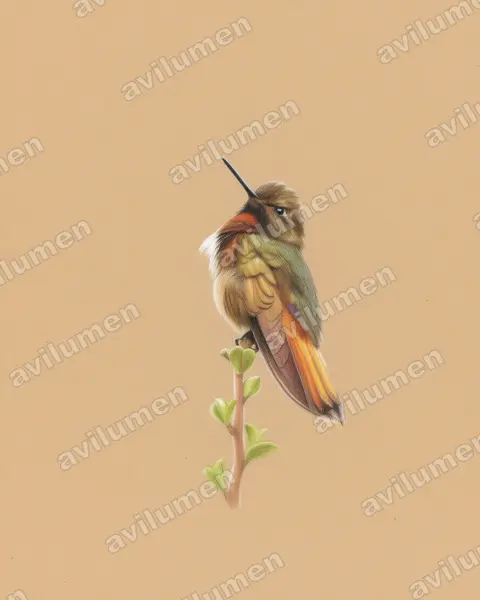
Colored pencil
Illustrations based on the photograph by thibaudaronson (CC BY-SA 4.0), from Wikimedia Commons.
Digital editions
HD Digital Art Pack — White-tufted sunbeam
Digital download: 6 high-resolution illustrations of the White-tufted sunbeam (Aglaeactis castelnaudii), print-ready. This is a digital file; no animal or physical item is included.
AI Avatar — White-tufted sunbeam
Generate an avatar fusing your face with the White-tufted sunbeam (Aglaeactis castelnaudii). Delivered digitally in 8K, watermark-free. Digital product; no animals are sold or brokered.
Instant download. No live birds are sold.
Frequently asked questions
- Is Aglaeactis castelnaudii (White-tufted sunbeam) endangered?
- The IUCN Red List places Aglaeactis castelnaudii, commonly known as the White-tufted sunbeam, in the «Near threatened» category. «Near threatened» means it is not threatened yet, but is close to becoming so.
- Where does Aglaeactis castelnaudii (White-tufted sunbeam) live?
- Aglaeactis castelnaudii (White-tufted sunbeam) is found in Peru and South America.
- What family does Aglaeactis castelnaudii (White-tufted sunbeam) belong to?
- Aglaeactis castelnaudii (White-tufted sunbeam) belongs to the family Trochilidae, in the order Apodiformes.
- What colour is Aglaeactis castelnaudii (White-tufted sunbeam)?
- The plumage of Aglaeactis castelnaudii (White-tufted sunbeam) combines these colours: Multicoloured.
More from the same family
 Least concern
Emerald-chinned Hummingbird
Abeillia abeillei
The emerald-chinned hummingbird is a species of hummingbird in the "emeralds", tribe Trochilini of subfamily Trochilinae.
from $1.99
 Least concern
Speckled hummingbird
Adelomyia melanogenys
The speckled hummingbird is a species of hummingbird. It is the only member of the genus Adelomyia. It inhabits Neotropical montane cloud forests at elevations of 1,000–2,500 meters and is confined to the Andes of Argentina, Bolivia, Peru, Ecuador, Colombia and Venezuela; as well as to some isolated montane forests in western Ecuador and Venezuela.
from $1.99
 Vulnerable
Purple-backed sunbeam
Aglaeactis aliciae
The purple-backed sunbeam is a bird species in the family Trochilidae. It is found only in Peru.
from $1.99
 Least concern
Shining sunbeam
Aglaeactis cupripennis
The shining sunbeam is a species of hummingbird in the "brilliants", tribe Heliantheini in subfamily Lesbiinae. It is found in Colombia, Ecuador, and Peru.
from $1.99