Speckled hummingbird
Adelomyia melanogenys
Avilumen editorial team ·

The speckled hummingbird is a species of hummingbird. It is the only member of the genus Adelomyia. It inhabits Neotropical montane cloud forests at elevations of 1,000–2,500 meters and is confined to the Andes of Argentina, Bolivia, Peru, Ecuador, Colombia and Venezuela; as well as to some isolated montane forests in western Ecuador and Venezuela.
The speckled hummingbird (Adelomyia melanogenys) is a species of hummingbird. It is the only member of the genus Adelomyia. It inhabits Neotropical montane cloud forests at elevations of 1,000–2,500 meters and is confined to the Andes of Argentina, Bolivia, Peru, Ecuador, Colombia and Venezuela; as well as to some isolated montane forests in western Ecuador and Venezuela. In Ecuador, it ranges across both the eastern and western slopes of the Andes and occupies a broad altitudinal range from subtropical forests (1400 m) to cloud forests (3000 m). In addition, one isolated population inhabits the Chongón Colonche cordillera in the coastal evergreen montane forest (600 m) located ca. 130 km away from the Andes.
Description
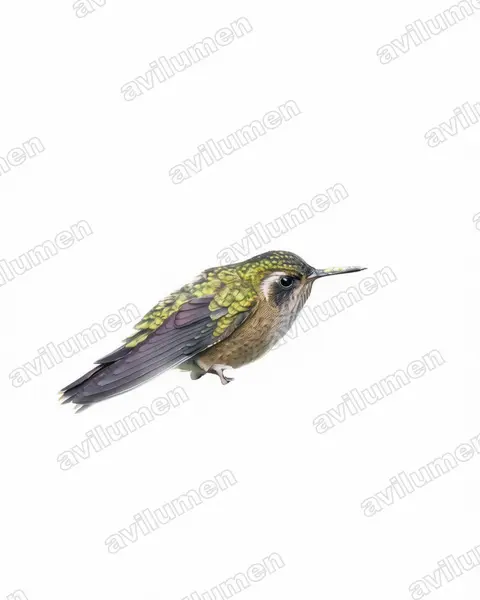
The speckled hummingbird is a monomorphic species, making females and males indistinguishable. Adults measure approximately 8 cm, or 3 inches, in length (from bill to tip of tail). The upper plumage is a glossy green/bronze. The underside is pale, with green and bronze specks. It has a black cheek patch below its eye with a white stripe above.
Systematics
While the speckled hummingbird is the only species in its genus, evidence suggests that populations on either side of the Andes mountains are genetically distinct, especially due to its broad geographic and ecological distribution. Relationships with other hummingbirds are uncertain and is still in need of further studies.
Based on plumage coloration and biogeography, eight subspecies have been described, and known as Adelomyia melanogenys melanogenys, inornata, connectens, maculata, aenosticta, chlorospila, debellardiana and cervina. A recent study of this genus, based on molecular, morphological and ecological data recovered six monophyletic clades which show distributional limits at well-defined geographic barriers, not corresponding with the currently recognized limits of subspecies. Sequence divergence ranged between 5.8% and 8.2% between phylogroups separated by >4000 km and <50 km distances respectively, this gives support to the idea that geographic isolation may be influential at very different scales. Morphological traits are more related to environmental heterogeneity than to geographic barriers and isolation.
Behavior
The speckled hummingbird is a solitary species. They neither live nor migrate in flocks and there is no pair bond for this species, making them a mainly sedentary species. Nevertheless, individuals may disperse to lower altitudes as the breeding periods finish.
Breeding
Males do not participate in any part of nest building or brooding of the young, and disengage with female partners after copulation. Though, both males and females may be promiscuous, having multiple partners.
Female speckled hummingbirds incubate and feed nestlings. A clutch consists of two white eggs; measurements consist of 12.4 mm × 8.7 mm and 12.6 mm × 8.6 mm. The incubation period lasts approximately 17–20 days. The species broods for shorter durations than most hummingbirds during incubation. Speckled hummingbirds often travel several kilometers to avoid competition, making visits to the nest less frequent. After the young hatch, the adult continues brooding hatchlings for 7–8 days. After brooding and until the young have fledged, the adult will no longer enter the nest and instead perch nearby, potentially watching for predators. This behavior is curious, as perching outside a nest may alert predators of its location. Nests can be found all year round, and consist of a bulky cup shaped of moss and cobweb, lined with plant fibre. The construction of nests have been observed on moss-covered trunks or on rocky ridges, at the entrance of caves, at a height of 1–3 m.
Diet and feeding
The species does not gather with others to feed, even on flowering trees. Speckled hummingbirds feed on the nectar of flowers, often near the ground, either from short-tubed flowers or holes at the base of long-tubed flowers. Like other hummingbird species, it is likely that the speckled hummingbird will also feed on insects, for additional nutrients. The species may also collect small insects that are caught on or in the nest.
Conservation status
Not globally threatened (Least Concern). A very common hummingbird of moderate elevations in the Andes. Particularly abundant in the Andes above of Cali, Colombia, with densities of at least 10–12 pairs/km².
Text adapted from Wikipedia · CC BY-SA 4.0
Where it lives
Distribution

Taxonomy
- Order
- Apodiformes
- Family
- Trochilidae
- Genus
- Adelomyia
- Conservation status
- Least concern
Listen to its call
No recording yet
Illustration gallery
6 illustrations of Adelomyia melanogenys (Speckled hummingbird) in different styles, true to its real plumage. Shown watermarked; the art pack includes the high-resolution originals, ready to print.
Watercolor 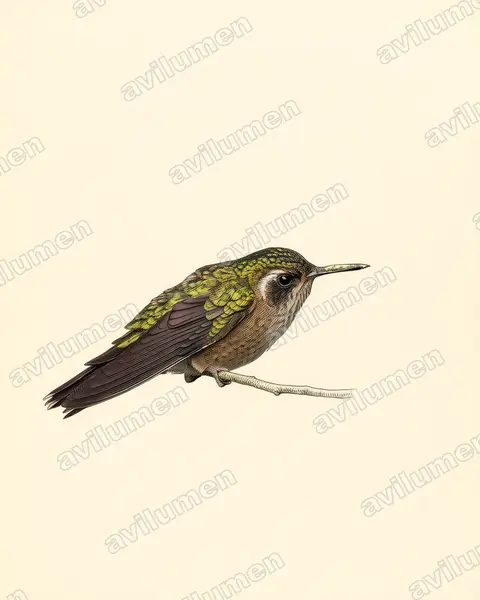
Vintage plate 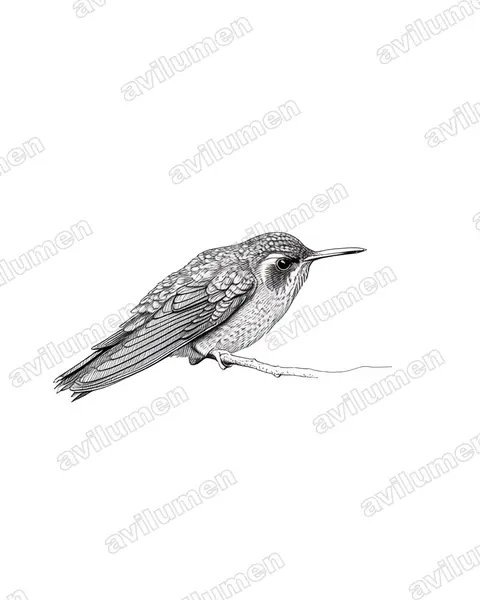
Ink 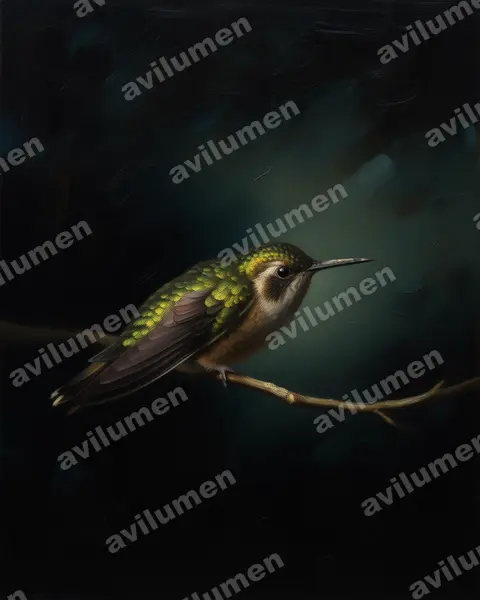
Oil 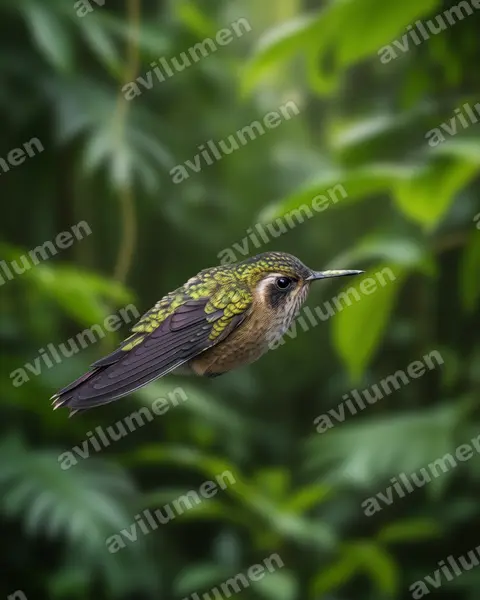
Realistic 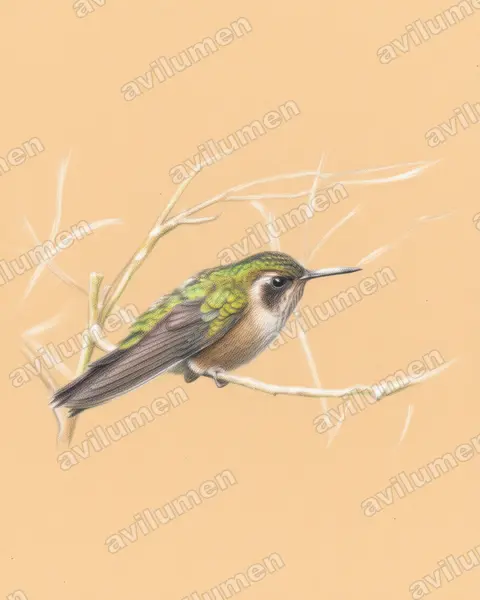
Colored pencil
Illustrations based on the photograph by Charles J. Sharp (CC BY-SA 4.0), from Wikimedia Commons.
Digital editions
HD Digital Art Pack — Speckled hummingbird
Digital download: 6 high-resolution illustrations of the Speckled hummingbird (Adelomyia melanogenys), print-ready. This is a digital file; no animal or physical item is included.
AI Avatar — Speckled hummingbird
Generate an avatar fusing your face with the Speckled hummingbird (Adelomyia melanogenys). Delivered digitally in 8K, watermark-free. Digital product; no animals are sold or brokered.
Instant download. No live birds are sold.
Frequently asked questions
- Is Adelomyia melanogenys (Speckled hummingbird) endangered?
- The IUCN Red List places Adelomyia melanogenys, commonly known as the Speckled hummingbird, in the «Least concern» category. «Least concern» means it is not currently threatened.
- Where does Adelomyia melanogenys (Speckled hummingbird) live?
- Adelomyia melanogenys (Speckled hummingbird) is found in South America.
- What family does Adelomyia melanogenys (Speckled hummingbird) belong to?
- Adelomyia melanogenys (Speckled hummingbird) belongs to the family Trochilidae, in the order Apodiformes.
- What colour is Adelomyia melanogenys (Speckled hummingbird)?
- The plumage of Adelomyia melanogenys (Speckled hummingbird) combines these colours: Green and Brown.
More from the same family
 Least concern
Emerald-chinned Hummingbird
Abeillia abeillei
The emerald-chinned hummingbird is a species of hummingbird in the "emeralds", tribe Trochilini of subfamily Trochilinae.
from $1.99
 Vulnerable
Purple-backed sunbeam
Aglaeactis aliciae
The purple-backed sunbeam is a bird species in the family Trochilidae. It is found only in Peru.
from $1.99
 Near threatened
White-tufted sunbeam
Aglaeactis castelnaudii
The white-tufted sunbeam is a species of hummingbird in the family Trochilidae. It is found only in Peru. Its natural habitats are subtropical or tropical moist montane forest and subtropical or tropical high-altitude shrubland.
from $1.99
 Least concern
Shining sunbeam
Aglaeactis cupripennis
The shining sunbeam is a species of hummingbird in the "brilliants", tribe Heliantheini in subfamily Lesbiinae. It is found in Colombia, Ecuador, and Peru.
from $1.99