Azure-crowned hummingbird
Amazilia cyanocephala
Avilumen editorial team ·

The azure-crowned hummingbird is a species of hummingbird in the "emeralds", tribe Trochilini of subfamily Trochilinae. It is found in Belize, El Salvador, Guatemala, Honduras, Mexico, and Nicaragua.
The azure-crowned hummingbird (Saucerottia cyanocephala) is a species of hummingbird in the "emeralds", tribe Trochilini of subfamily Trochilinae. It is found in Belize, El Salvador, Guatemala, Honduras, Mexico, and Nicaragua.
Taxonomy and systematics
The azure-crowned hummingbird was originally described as Ornismya cyanocephalus and later moved into genus Amazilia. A molecular phylogenetic study published in 2014 found that Amazilia was polyphyletic. In the revised classification to create monophyletic genera, the azure-crowned hummingbird was moved by most taxonomic systems to the resurrected genus Saucerottia. However, BirdLife International's Handbook of the Birds of the World retains it in Amazilia.
The azure-crowned hummingbird has two subspecies, the nominate S. c. cyanocephala (Lesson, 1829) and S. c. chlorostephana (Howell, 1965).
Description
The azure-crowned hummingbird is 10 to 11.5 cm (3.9 to 4.5 in) long. Males weigh an average of about 5.8 g (0.20 oz) and females average about 5.4 g (0.19 oz). The bills of both sexes of both subspecies have a black maxilla and a dull pink mandible with a black outer third. Within a subspecies the sexes are almost alike. Adult males of the nominate subspecies have a bright metallic blue crown and females a duller blue to greenish blue crown. Both sexes have metallic bronze nape and back. They have greenish bronze to bronze green rump, uppertail coverts, and tail. Their face is mostly bluish green. Their underparts from chin to vent are white with metallic bronze green sides to the breast and duller bronze green flanks. Immatures are similar to the adults but duller, and with grayish buff tips to the uppertail coverts, whitish tips on the outer tail feathers, and a buff wash to the underparts. Subspecies S. c. chlorostephana is somewhat smaller than the nominate. Its plumage is essentially the same as that of the nominate but with a glittering green instead of metallic blue crown.
Distribution and habitat
The nominate subspecies of azure-crowned hummingbird is found from the Mexican state of Tamaulipas south through Belize, Guatemala, and El Salvador into north central Nicaragua. It inhabits the edges of humid evergreen forest, oak and pine-oak forest, scrublands, and secondary forest. In elevation it ranges between 600 and 2,400 m (2,000 and 7,900 ft). Subspecies S. c. chlorostephana's range is disjunct, on the Mosquito Coast of eastern Honduras and northeastern Nicaragua. This subspecies primarily inhabits pine savanna at low elevation.
Movement
The azure-crowned hummingbird is mostly sedentary but might make some local seasonal movements.
Feeding
The azure-crowned hummingbird forages for nectar from the understory to the forest canopy, but details of its diet are lacking. It forages both by trap-lining and defending feeding territories. In the pine savanna it has been noted hovering at clusters of needles and bark crevices, but it is not known if it was hunting arthropods or visiting the flowers of epiphytes.
Breeding
The azure-crowned hummingbird's breeding season varies geographically but overall appears to span at least from February to July. It makes a cup nest that apparently varies in materials depending on what is locally available. It is usually placed in a branch fork or "saddled" over a branch, but in urban areas some have been noted on utility wires.
Vocalization
One vocalization of the azure-crowned hummingbird is "a low, fairly hard, buzzy dzzzrt" that is given in flight and perched; when perched it might be "repeated steadily". It also makes a "fairly mellow, strong chipping [that] at times run into a trill or rattle." The vocalizations of isolated subspecies S. c. chlorostephana might be different but have not been separately described.
Status
The IUCN has assessed the azure-crowned hummingbird as being of Least Concern. It has a large range and an estimated population of at least 500,000 mature individuals, though the latter is believed to be decreasing. No immeditate threats have been identified. "Human activity probably has little short term effect on Azure-crowned Hummingbird".
Text adapted from Wikipedia · CC BY-SA 4.0
Distribution

Taxonomy
- Order
- Apodiformes
- Family
- Trochilidae
- Genus
- Amazilia
- Conservation status
- Least concern
Listen to its call
No recording yet
Illustration gallery
6 illustrations of Amazilia cyanocephala (Azure-crowned hummingbird) in different styles, true to its real plumage. Shown watermarked; the art pack includes the high-resolution originals, ready to print.
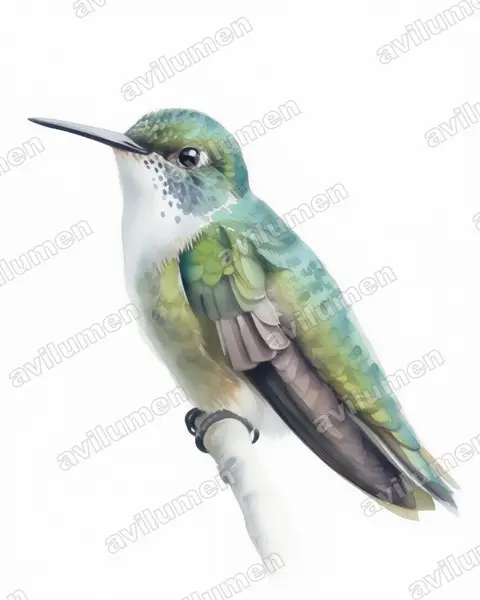
Watercolor 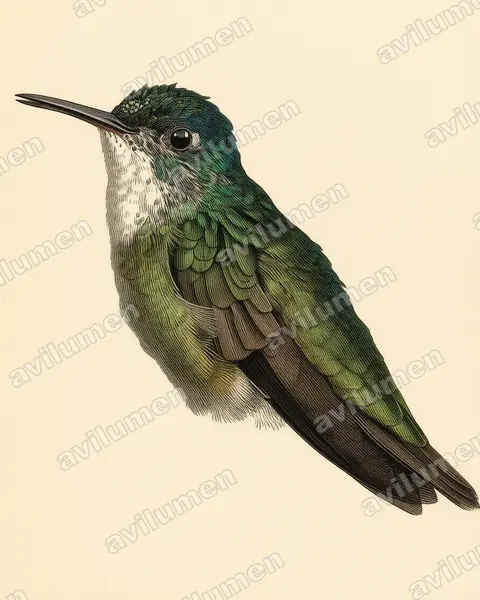
Vintage plate 
Ink 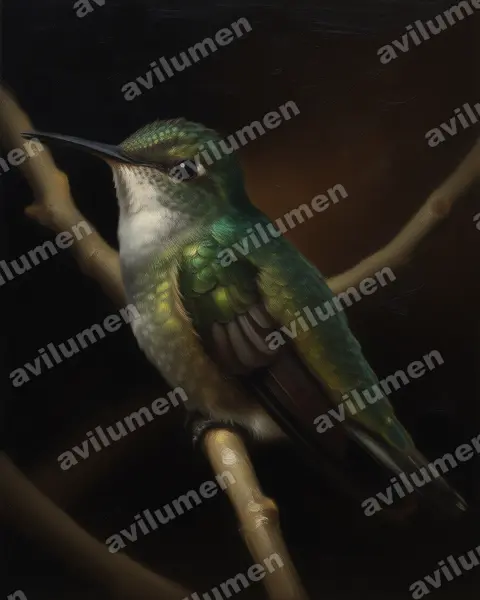
Oil 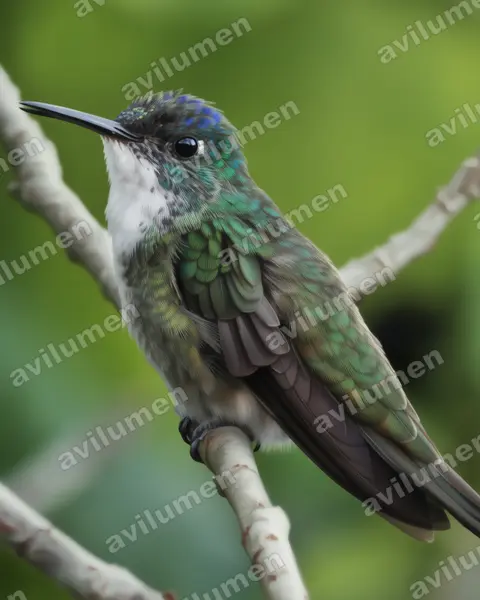
Realistic 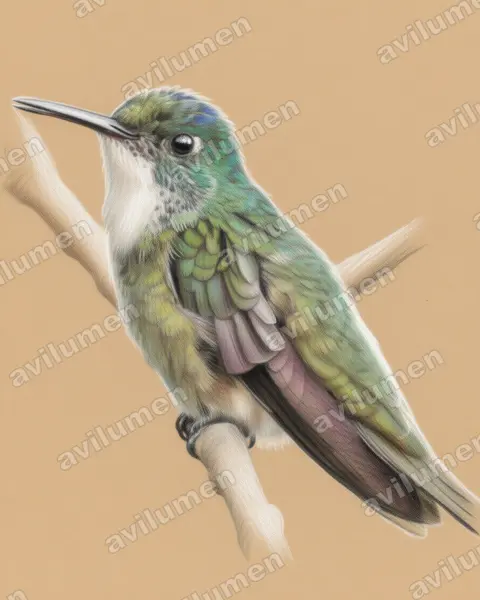
Colored pencil
Illustrations based on the photograph by Joseph C Boone (CC BY-SA 4.0), from Wikimedia Commons.
Digital editions
HD Digital Art Pack — Azure-crowned hummingbird
Digital download: 6 high-resolution illustrations of the Azure-crowned hummingbird (Amazilia cyanocephala), print-ready. This is a digital file; no animal or physical item is included.
AI Avatar — Azure-crowned hummingbird
Generate an avatar fusing your face with the Azure-crowned hummingbird (Amazilia cyanocephala). Delivered digitally in 8K, watermark-free. Digital product; no animals are sold or brokered.
Instant download. No live birds are sold.
Frequently asked questions
- Is Amazilia cyanocephala (Azure-crowned hummingbird) endangered?
- The IUCN Red List places Amazilia cyanocephala, commonly known as the Azure-crowned hummingbird, in the «Least concern» category. «Least concern» means it is not currently threatened.
- What family does Amazilia cyanocephala (Azure-crowned hummingbird) belong to?
- Amazilia cyanocephala (Azure-crowned hummingbird) belongs to the family Trochilidae, in the order Apodiformes.
- What colour is Amazilia cyanocephala (Azure-crowned hummingbird)?
- The plumage of Amazilia cyanocephala (Azure-crowned hummingbird) combines these colours: Blue and Green.
More from the same family
 Least concern
Emerald-chinned Hummingbird
Abeillia abeillei
The emerald-chinned hummingbird is a species of hummingbird in the "emeralds", tribe Trochilini of subfamily Trochilinae.
from $1.99
 Least concern
Speckled hummingbird
Adelomyia melanogenys
The speckled hummingbird is a species of hummingbird. It is the only member of the genus Adelomyia. It inhabits Neotropical montane cloud forests at elevations of 1,000–2,500 meters and is confined to the Andes of Argentina, Bolivia, Peru, Ecuador, Colombia and Venezuela; as well as to some isolated montane forests in western Ecuador and Venezuela.
from $1.99
 Vulnerable
Purple-backed sunbeam
Aglaeactis aliciae
The purple-backed sunbeam is a bird species in the family Trochilidae. It is found only in Peru.
from $1.99
 Near threatened
White-tufted sunbeam
Aglaeactis castelnaudii
The white-tufted sunbeam is a species of hummingbird in the family Trochilidae. It is found only in Peru. Its natural habitats are subtropical or tropical moist montane forest and subtropical or tropical high-altitude shrubland.
from $1.99