White-crowned hornbill
Berenicornis comatus
Avilumen editorial team ·

The white-crowned hornbill, also known as the long-crested hornbill or white-crested hornbill, is a species of hornbill.
The white-crowned hornbill (Berenicornis comatus), also known as the long-crested hornbill or white-crested hornbill (leading to easy confusion with the African white-crested hornbill), is a species of hornbill.
Taxonomy
It is monotypic within the genus Berenicornis, although rarely the white-crested hornbill is also included in this genus, and the white-crowned hornbill is sometimes placed in genus Aceros instead.
Description
Berenicornis comatus is a large hornbill, reaching a length of 83–102 cm (33–40 in) and a weight of 1.3–1.5 kg (2.9–3.3 lb). Females are smaller than males. The plumage is black and white. The head, neck, breast and tail are white, while the remaining plumage is black. It has white crown feathers erected in a crest (hence the common name). Between the eye and the bill and on the throat there is bare dark blue skin. The bill is mainly black, with a yellowish base. Like most hornbills, it has a blackish casque on the top of its bill. The female has a black neck and underparts.
Diet
These birds are territorial and feed on various fruits, lizards, arthropods and larvae.
Distribution
This species is found in the Malay Peninsula, Sumatra and Borneo.
Habitat
This bird inhabits rainforests at low and medium altitudes, usually at an elevation below 900 meters. It may also be found on fruit, oil-palm and rubber plantations. It is threatened by habitat destruction.
Behavior
The female lays two white eggs in a tree hole, then seals herself in by blocking the entrance to the nest with droppings, debris and mud. The male, and other adults and young forming a cooperative group, feed the breeding female and the chicks through a narrow hole. The female breaks the "wall" and leaves the nest when the chicks are able to fly.
Threats
The forest habitat that this bird depends on has been heavily declining in recent years. Due to this, the white-crowned hornbill was uplisted from near threatened to endangered on the IUCN Red List in 2018.
Text adapted from Wikipedia · CC BY-SA 4.0
Taxonomy
- Order
- Bucerotiformes
- Family
- Bucerotidae
- Genus
- Berenicornis
- Conservation status
- Endangered
Listen to its call
No recording yet
Illustration gallery
6 illustrations of Berenicornis comatus (White-crowned hornbill) in different styles, true to its real plumage. Shown watermarked; the art pack includes the high-resolution originals, ready to print.
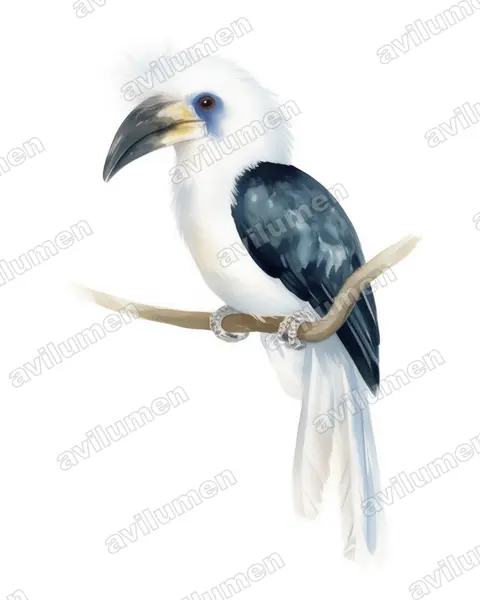
Watercolor 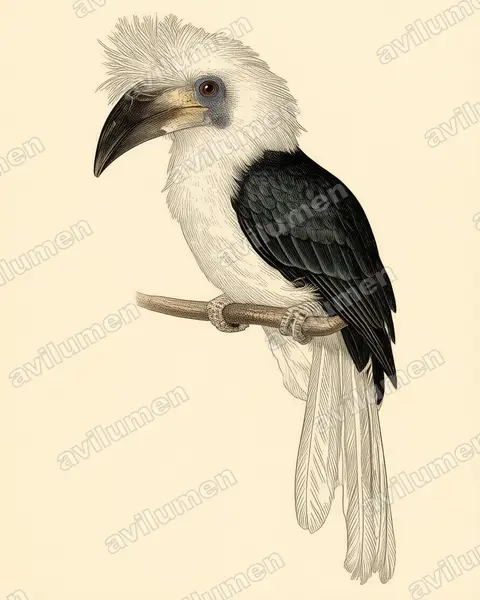
Vintage plate 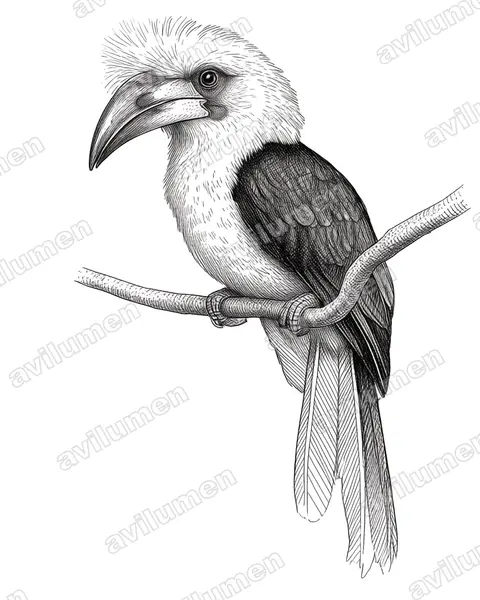
Ink 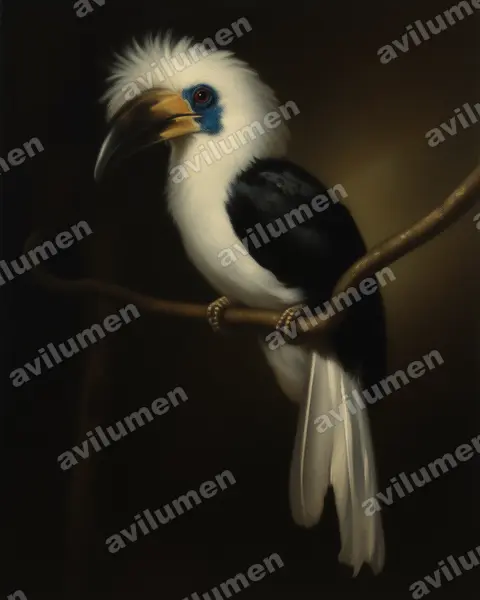
Oil 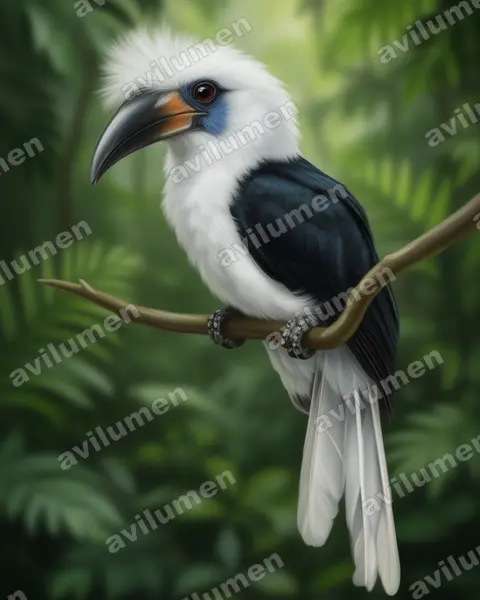
Realistic 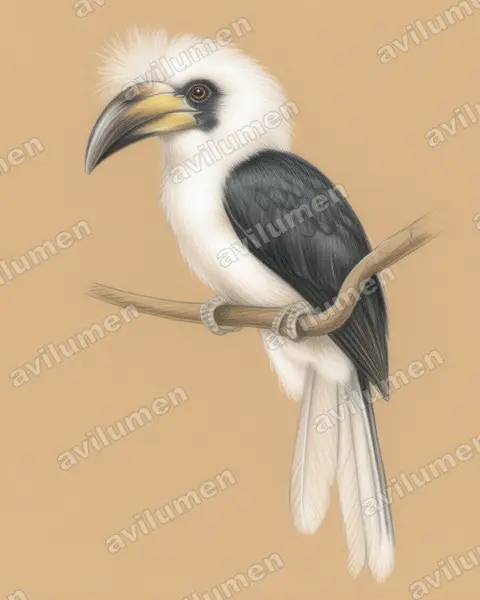
Colored pencil
Illustrations based on the photograph by Hectonichus (CC BY-SA 3.0), from Wikimedia Commons.
Digital editions
HD Digital Art Pack — White-crowned hornbill
Digital download: 6 high-resolution illustrations of the White-crowned hornbill (Berenicornis comatus), print-ready. This is a digital file; no animal or physical item is included.
AI Avatar — White-crowned hornbill
Generate an avatar fusing your face with the White-crowned hornbill (Berenicornis comatus). Delivered digitally in 8K, watermark-free. Digital product; no animals are sold or brokered.
Instant download. No live birds are sold.
Frequently asked questions
- Is Berenicornis comatus (White-crowned hornbill) endangered?
- The IUCN Red List places Berenicornis comatus, commonly known as the White-crowned hornbill, in the «Endangered» category. «Endangered» means it faces a very high risk of disappearing in the wild.
- What family does Berenicornis comatus (White-crowned hornbill) belong to?
- Berenicornis comatus (White-crowned hornbill) belongs to the family Bucerotidae, in the order Bucerotiformes.
- What colour is Berenicornis comatus (White-crowned hornbill)?
- The plumage of Berenicornis comatus (White-crowned hornbill) combines these colours: White and Black.
More from the same family
 Vulnerable
Rufous-necked Hornbill
Aceros nipalensis
The rufous-necked hornbill is a species of hornbill in Bhutan, northeastern India, especially in Arunachal Pradesh, Indian subcontinent and Southeast Asia. It is locally extinct in Nepal due to hunting and significant loss of habitat. There are less than 10,000 adults left in the wild. With a length of about 117 cm (46 in), it is among the largest Bucerotine hornbills.
from $1.99
 Near threatened
Austen's Brown Hornbill
Anorrhinus austeni
Austen's brown hornbill, also known as the white-throated brown hornbill or brown hornbill, is a medium-sized species of hornbill found in forests from northeastern India to Vietnam and northern Thailand. It is rare throughout its range and is threatened by habitat loss and fragmentation.
from $1.99
 Near threatened
Bushy-crested Hornbill
Anorrhinus galeritus
The bushy-crested hornbill is a bird in the hornbill family. It is found in Brunei, Indonesia, Malaysia, Myanmar, and Thailand. Its natural habitat is subtropical or tropical moist lowland forests.
from $1.99
 Near threatened
Austen's Brwon Hornbill
Anorrhinus tickelli
Tickell's brown hornbill, also known as the rusty-cheeked hornbill, is a species of hornbill found in forests in Burma and adjacent western Thailand. Austen's brown hornbill is sometimes considered as a subspecies of Tickell's brown hornbill.
from $1.99