Costa's hummingbird
Calypte costae
Avilumen editorial team ·

Costa's hummingbird is a species of hummingbird in the family Trochilidae. It breeds in the arid, semi-arid and Mediterranean climate zones of the Southwestern United States and northwestern Mexico, mainly in Southern California and the Baja California Peninsula.
Costa's hummingbird (Calypte costae) is a species of hummingbird in the family Trochilidae. It breeds in the arid, semi-arid and Mediterranean climate zones of the Southwestern United States and northwestern Mexico, mainly in Southern California and the Baja California Peninsula. Like many hummingbirds in the region, it can be found on the Pacific coast, often visiting backyard hummingbird feeders and gardens with flowering plants, as well as in more wild ecosystems, such as the conifer and oak forests, chaparral, and high desert habitats found further inland. When not in the US, the species often winters in western Mexico.
Taxonomy
Costa's hummingbird was formally described by the French ornithologist Jules Bourcier in 1839, and given the binomial name Ornismya costae; Bourcier chose the specific epithet to honour French nobleman (and fellow ornithologist) Louis Marie Pantaleon Costa, Marquis de Beauregard (1806–1864). The type locality is Magdalena Bay, on the Pacific west coast, of the Mexican state of Baja California Sur. Costa's hummingbird is presently placed in the genus Calypte, introduced in 1856 by John Gould. The species is monotypic, with no subspecies being currently recognised.
Hybridization
Hybrids of C. costae and Anna's (C. anna), black-chinned (Archilochus alexandri), and broad-tailed hummingbirds (Selasphorus platycercus) are all known to have occurred.
Description
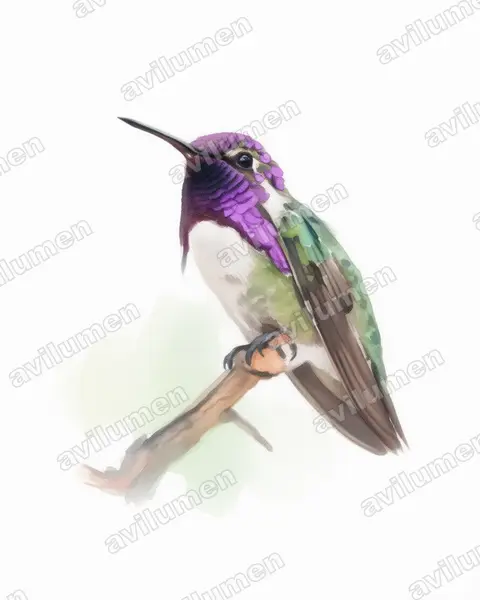
This species is small, as a mature adult grows to only 3–3.5 in (7.6–8.9 cm) in length, with a wingspan of 11 cm (4.3 in), and an average weight of 3.05 g (0.108 oz) for males and 3.22 g (0.114 oz) for females. The male has a mainly green back and flanks, a small black tail and wings, and patches of white below their gorgeted throat and tail. Its most distinguishing feature is its vibrant purple cap and throat with the throat feathers flaring out and back behind its head. The female is not as distinct as the male, having grayish-green above with a white underbelly.
Distribution and habitat
Costa's hummingbird is common in the arid brushy deserts and gardens of the Southwestern United States and the Baja California Peninsula of Mexico.
Breeding
The male Costa's hummingbird's courtship display is a spirited series of swoops and arcing dives, using an angle to the sun to display its violet extended gorget to prospective mates. The male makes a high-speed dive pass or hover close to the female, perched on a nearby branch, and is accented by a high-pitched vibration that is produced by tail feathers. Separately, the male will perch and produce a high-pitched, scratch-like song.
The female constructs a small cup-shaped nest out of plant fibers, down, and at times spider silk, coated with lichen to hold it together. The nest is situated on a yucca stalk or tree limb. The female lays just two eggs, which are white in color, which she will incubate for 15 to 18 days before the young hatch. The young leave the nest after 20 to 23 days.
Diet
As common with hummingbird species, Costa's hummingbird feeds on flower nectar and small insects. While feeding in flight, a Costa's hummingbird may hover.
Torpor
As with other hummingbird species, the Costa's hummingbird can slow its metabolism during cold nights when it enters a hibernation-like state known as torpor, with its heart rate and respiration slowing substantially.
Conservation
The IUCN describes them as of least concern. The population is stable and there are no known threats. They are found in at least one protected area.
Text adapted from Wikipedia · CC BY-SA 4.0
Distribution

Taxonomy
- Order
- Apodiformes
- Family
- Trochilidae
- Genus
- Calypte
- Conservation status
- Least concern
Listen to its call
No recording yet
Illustration gallery
6 illustrations of Calypte costae (Costa's hummingbird) in different styles, true to its real plumage. Shown watermarked; the art pack includes the high-resolution originals, ready to print.
Watercolor 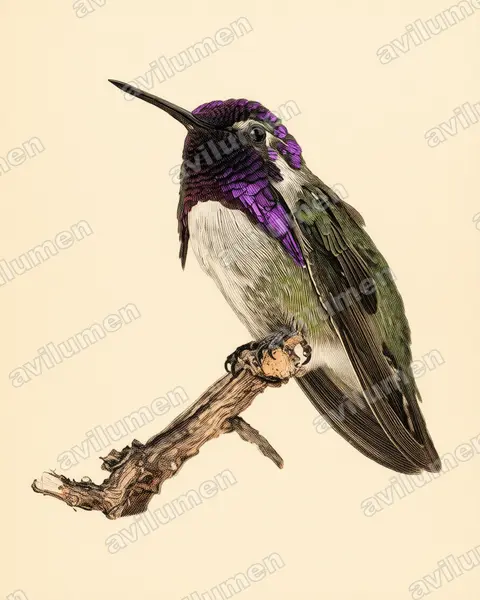
Vintage plate 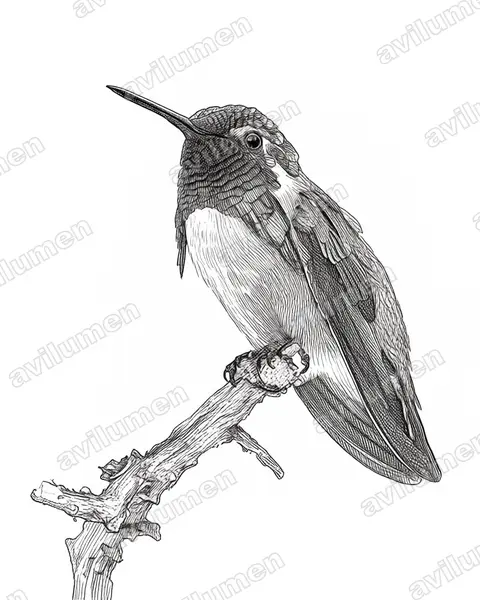
Ink 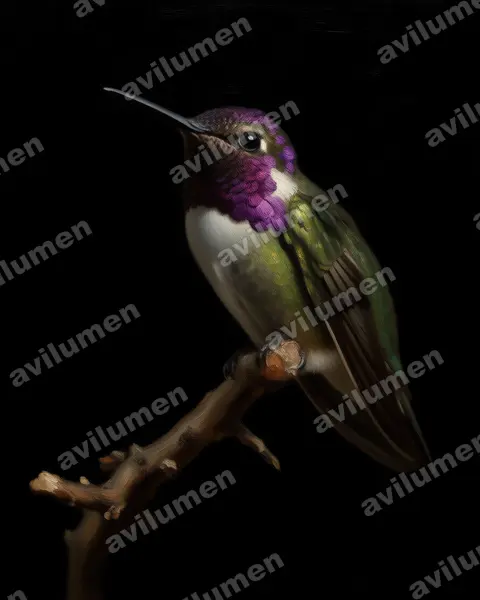
Oil 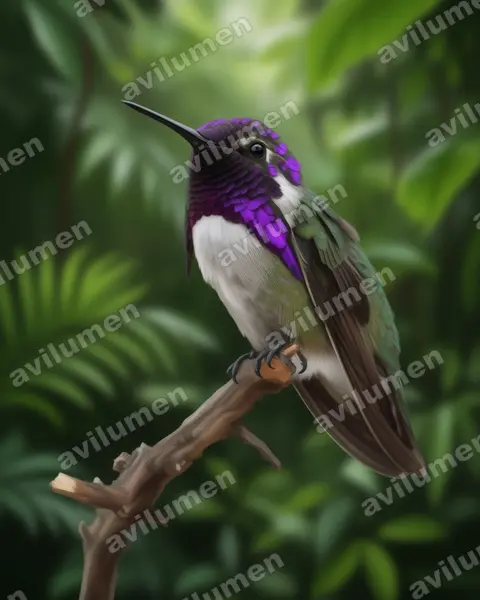
Realistic 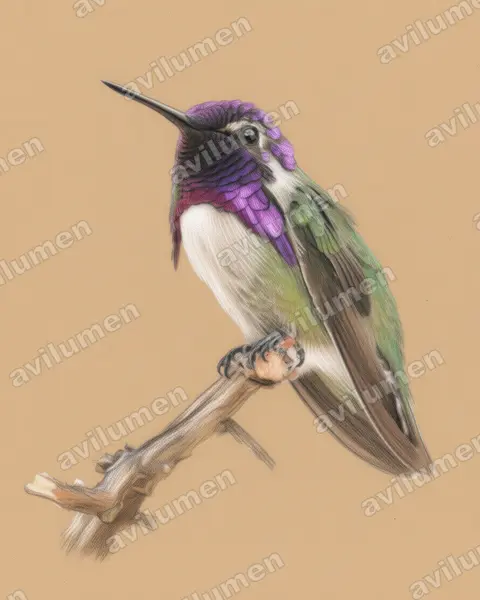
Colored pencil
Illustrations based on the photograph by K.lee (CC BY-SA 3.0), from Wikimedia Commons.
Digital editions
HD Digital Art Pack — Costa's hummingbird
Digital download: 6 high-resolution illustrations of the Costa's hummingbird (Calypte costae), print-ready. This is a digital file; no animal or physical item is included.
AI Avatar — Costa's hummingbird
Generate an avatar fusing your face with the Costa's hummingbird (Calypte costae). Delivered digitally in 8K, watermark-free. Digital product; no animals are sold or brokered.
Instant download. No live birds are sold.
Frequently asked questions
- Is Calypte costae (Costa's hummingbird) endangered?
- The IUCN Red List places Calypte costae, commonly known as the Costa's hummingbird, in the «Least concern» category. «Least concern» means it is not currently threatened.
- What family does Calypte costae (Costa's hummingbird) belong to?
- Calypte costae (Costa's hummingbird) belongs to the family Trochilidae, in the order Apodiformes.
- What colour is Calypte costae (Costa's hummingbird)?
- The plumage of Calypte costae (Costa's hummingbird) combines these colours: Green and Violet.
More from the same family
 Least concern
Emerald-chinned Hummingbird
Abeillia abeillei
The emerald-chinned hummingbird is a species of hummingbird in the "emeralds", tribe Trochilini of subfamily Trochilinae.
from $1.99
 Least concern
Speckled hummingbird
Adelomyia melanogenys
The speckled hummingbird is a species of hummingbird. It is the only member of the genus Adelomyia. It inhabits Neotropical montane cloud forests at elevations of 1,000–2,500 meters and is confined to the Andes of Argentina, Bolivia, Peru, Ecuador, Colombia and Venezuela; as well as to some isolated montane forests in western Ecuador and Venezuela.
from $1.99
 Vulnerable
Purple-backed sunbeam
Aglaeactis aliciae
The purple-backed sunbeam is a bird species in the family Trochilidae. It is found only in Peru.
from $1.99
 Near threatened
White-tufted sunbeam
Aglaeactis castelnaudii
The white-tufted sunbeam is a species of hummingbird in the family Trochilidae. It is found only in Peru. Its natural habitats are subtropical or tropical moist montane forest and subtropical or tropical high-altitude shrubland.
from $1.99