Violet sabrewing
Campylopterus hemileucurus
Avilumen editorial team ·

The violet sabrewing is a species of hummingbird in the "emeralds", tribe Trochilini of the subfamily Trochilinae. It is found from Mexico to Panama.
The violet sabrewing (Campylopterus hemileucurus) is a species of hummingbird in the "emeralds", tribe Trochilini of the subfamily Trochilinae. It is found from Mexico to Panama.
Taxonomy and systematics
The violet sabrewing has two subspecies, the nominate C. h. hemileucurus and C. h. mellitus.
Description
The violet sabrewing is the largest hummingbird of Mexico and Central America. It is 13 to 15 cm (5.1 to 5.9 in) long and weighs 9 to 12 g (0.32 to 0.42 oz). Both sexes have a black bill, though those of subspecies C. h. mellitus are longer than the nominate's. Males of the nominate subspecies have a dusky crown with a bluish green gloss. Their nape and upper back, face, and underparts are metallic violet blue that is somewhat bluer on the belly. Their lower back and uppertail coverts are metallic green. Their central tail feathers are bluish green to bluish black and the rest blackish with wide white tips. Females have a dusky crown and metallic green to bronze green upperparts with a more bluish green rump. They have a violet blue throat. Their underparts are mostly gray with a whiter belly and metallic green spots along the sides and green undertail coverts. Their central tail feathers are bluish green and the rest blacker with wide white tips.
Males of subspecies C. h. mellitus have more green on their upper parts than the nominate and almost entirely violet underparts with no blue on the belly. Female's upper-parts have a coppery tinge and their throat is violet.
Distribution and habitat
The nominate subspecies of violet sabrewing is found from the Mexican states of Guerrero and Veracruz intermittently south through Guatemala, southern Belize, Honduras, and El Salvador into northern Nicaragua. Subspecies C. h. mellitus is found most of the length of Costa Rica into western Panama. The species inhabits the edges and interior of humid evergreen montane forest and mature secondary forest, banana plantations, and gardens. In Mexico, it generally ranges in elevation between 500 and 2,000 m (1,600 and 6,600 ft) but occurs as high as 2,500 m (8,200 ft). In Costa Rica, it ranges between 1,500 and 2,400 m (4,900 and 7,900 ft).
Movement
The violet sabrewing is mostly sedentary, but individuals frequently move to lower elevations after the breeding season.
Feeding
The violet sabrewing feeds on nectar primarily by trap-lining, visiting a circuit of flowering plants. Males occasionally defend patches of flowers and are dominant over other hummingbirds. The species forages mostly in the understory, often on Heliconia, banana (Musa), Cephalism, and Palic urea though it visits others as well. It frequents nectar (sugar water) feeders and chases other hummingbirds from them. In addition to nectar, violet sabrewings also eat arthropods gleaned from foliage and spiderwebs.
Breeding
The violet sabrewing breeds during the local rainy season, which ranges from June to September in Mexico and May to November in Costa Rica. In the latter country they may raise two broods. Males court females by singing in leks, typically in the understory or at the forest edge. The nest is a cup of moss cemented with spiderwebs and lined with fine fibers. In Costa Rica it is often built above a ravine or stream, on a horizontal branch 1 to 6 m (3 to 20 ft) above the ground. The female incubates the clutch of two eggs for 19 to 22 days and fledging occurs 22 to 24 days after hatch.
Vocalization
The violet sabrewing's song has been described as "cheep tsew cheep tik-tik tsew cheep ..., high-pitched, piercing and ventriloquial" and as "varied, loud, sharp chipping and warbles, often punctuated with fairly shrill, slightly explosive notes". Its calls are "high, sharp chippering", "prolonged, hard chipping", and "single sharp chips given in flight."
Status
The IUCN has assessed the violet sabrewing as being of Least Concern. It has a very large range and a population of at least 50,000 mature individuals, though the latter is believed to be decreasing. No specific threats have been identified. "This species can tolerate habitat disturbance, however, as long as some forest cover or tall second growth persists."
Text adapted from Wikipedia · CC BY-SA 4.0
Plumage colours
Distribution

Taxonomy
- Order
- Apodiformes
- Family
- Trochilidae
- Genus
- Campylopterus
- Conservation status
- Least concern
Listen to its call
No recording yet
Illustration gallery
6 illustrations of Campylopterus hemileucurus (Violet sabrewing) in different styles, true to its real plumage. Shown watermarked; the art pack includes the high-resolution originals, ready to print.
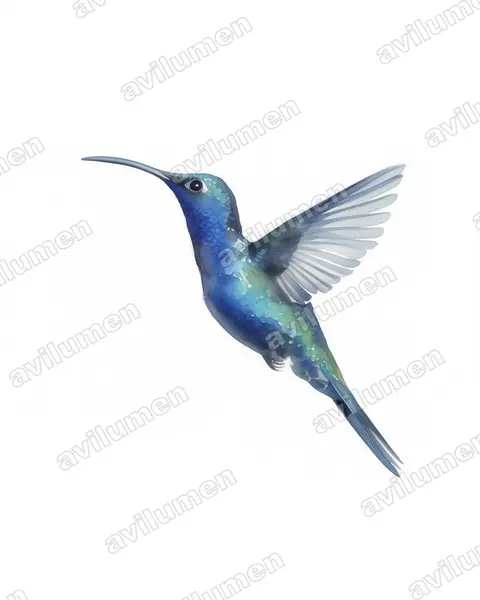
Watercolor 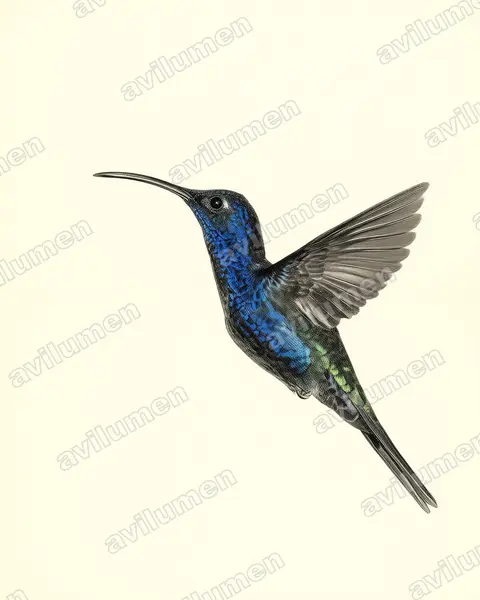
Vintage plate 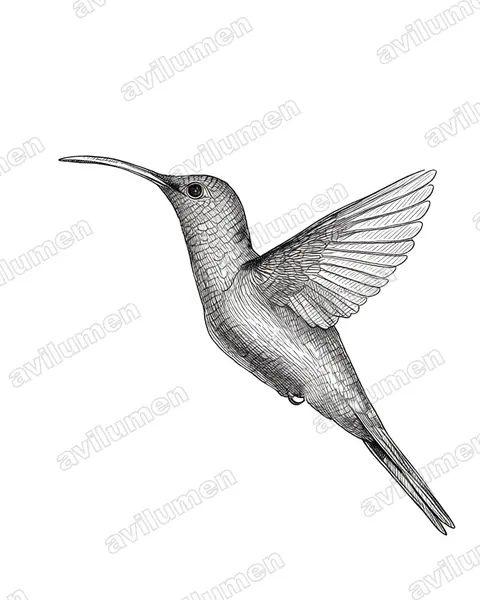
Ink 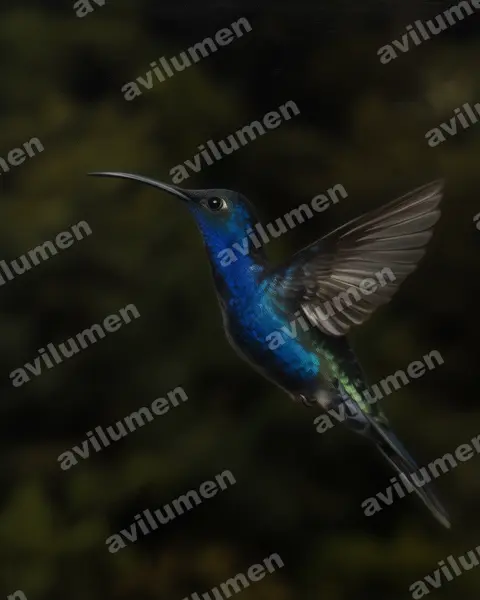
Oil 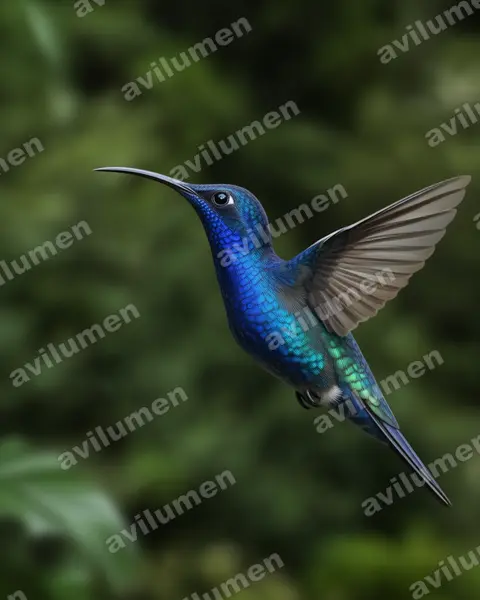
Realistic 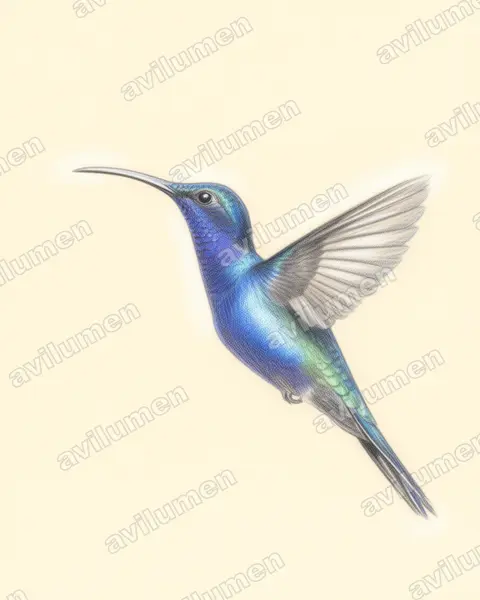
Colored pencil
Illustrations based on the photograph by Charles J. Sharp (CC BY-SA 4.0), from Wikimedia Commons.
Digital editions
HD Digital Art Pack — Violet sabrewing
Digital download: 6 high-resolution illustrations of the Violet sabrewing (Campylopterus hemileucurus), print-ready. This is a digital file; no animal or physical item is included.
AI Avatar — Violet sabrewing
Generate an avatar fusing your face with the Violet sabrewing (Campylopterus hemileucurus). Delivered digitally in 8K, watermark-free. Digital product; no animals are sold or brokered.
Instant download. No live birds are sold.
Frequently asked questions
- Is Campylopterus hemileucurus (Violet sabrewing) endangered?
- The IUCN Red List places Campylopterus hemileucurus, commonly known as the Violet sabrewing, in the «Least concern» category. «Least concern» means it is not currently threatened.
- What family does Campylopterus hemileucurus (Violet sabrewing) belong to?
- Campylopterus hemileucurus (Violet sabrewing) belongs to the family Trochilidae, in the order Apodiformes.
- What colour is Campylopterus hemileucurus (Violet sabrewing)?
- The plumage of Campylopterus hemileucurus (Violet sabrewing) combines these colours: Green.
More from the same family
 Least concern
Emerald-chinned Hummingbird
Abeillia abeillei
The emerald-chinned hummingbird is a species of hummingbird in the "emeralds", tribe Trochilini of subfamily Trochilinae.
from $1.99
 Least concern
Speckled hummingbird
Adelomyia melanogenys
The speckled hummingbird is a species of hummingbird. It is the only member of the genus Adelomyia. It inhabits Neotropical montane cloud forests at elevations of 1,000–2,500 meters and is confined to the Andes of Argentina, Bolivia, Peru, Ecuador, Colombia and Venezuela; as well as to some isolated montane forests in western Ecuador and Venezuela.
from $1.99
 Vulnerable
Purple-backed sunbeam
Aglaeactis aliciae
The purple-backed sunbeam is a bird species in the family Trochilidae. It is found only in Peru.
from $1.99
 Near threatened
White-tufted sunbeam
Aglaeactis castelnaudii
The white-tufted sunbeam is a species of hummingbird in the family Trochilidae. It is found only in Peru. Its natural habitats are subtropical or tropical moist montane forest and subtropical or tropical high-altitude shrubland.
from $1.99