Blue-mantled thornbill
Chalcostigma stanleyi
Avilumen editorial team ·

The blue-mantled thornbill is a species of hummingbird in the "coquettes", tribe Lesbiini of subfamily Lesbiinae. It is found in Bolivia, Ecuador, and Peru.
The blue-mantled thornbill (Chalcostigma stanleyi) is a species of hummingbird in the "coquettes", tribe Lesbiini of subfamily Lesbiinae. It is found in Bolivia, Ecuador, and Peru.
Taxonomy and systematics
The taxonomy of genus Chalcostigma is unsettled. The South American Classification Committee (SACC) of the American Ornithological Society is considering a proposal to merge the genus into Oxypogon. The blue-mantled thornbill has three recognized subspecies, the nominate C. s. stanleyi (Bourcier, 1851), C. s. versigulare (Zimmer, 1924), and C. s. vulcani (Gould, 1852).
Description
The blue-mantled thornbill is 12 to 13 cm (4.7 to 5.1 in) long; males weigh about 6.2 g (0.22 oz) and females 4.5 g (0.16 oz). Both sexes have a short straight black bill and a small white spot behind the eye. Adult males of the nominate subspecies are generally dark sooty brown. The crown and nape have a bronzy green sheen, the back reflects violet-blue, and the uppertail coverts are turquoise. The forked tail is steel blue. They have a narrow gorget that is emerald green on the chin and transitions through pink to purple-violet or violet-blue at the lower edge. Adult females are similar, but the gorget has only the green under the chin and the outer tail feathers have pale tips. Juveniles resemble the adult female.
Subspecies C. s. versigulare's entire upperparts (not just the back) reflect deep violet-blue, and the lower pink to violet of the gorget is narrower than in the nominate. C. s. vulcani is similar to versigulare but the lower part of its gorget becomes blue-gray or gray-violet.
Distribution and habitat
The nominate subspecies of blue-mantled thornbill is found on both slopes of the Andes of Ecuador between the departments of Carchi and Azauy. C. s. versigulare is found on the Peruvian Andes' east slope from east of the Marañón River south to the Cordillera Carpish in Huánuco Department and also in the Cordillera Blanca on the west slope. C. s. vulcani is found on the eastern Andean slope from southern Peru to Cochabamba Department in central Bolivia.
The blue-mantled thornbill inhabits steep, rocky slopes with somewhat humid páramo grasslands and jalca vegetation. Within those landscapes it favors patches of Polylepis and Gynoxys woodland. In elevation it generally occurs between 3,000 and 4,200 m (9,800 and 13,800 ft) but has been recorded as low as 2,200 m (7,200 ft) and as high as 4,500 m (14,800 ft).
Movement
The blue-mantled thornbill is known to temporarily move to lower elevations during periods of harsh weather, so it is hypothesized to also make seasonal elevational migration.
Feeding
The blue-mantled thornbill feeds on the nectar of small flowers such as Berberis, Gaultheria, Ribes, and Gentiana. It defends feeding territories. It has been observed gleaning tiny insects from the underside of Gynoxys leaves while clinging to them. It also picks insects from matted grass or rocks by hopping among them, and occasionally sallies to take insects on the wing.
Breeding
The blue-mantled thornbill is believed to breed during the rainy season. As is typical of hummingbirds, the female alone incubates the two white eggs. Nothing else has been documented about its breeding phenology.
Vocalization
The blue-mantled thornbill's calls have been described as "a descending squeaky twitter followed by a mellower upslurred note" and "a downslurred 'tseetsitsitsitsitr-whee-tsew' [with] variations."
Status
The IUCN has assessed the blue-mantled thornbill as being of Least Concern. It has a large range but its population size is unknown and believed to be decreasing. Though it is generally fairly common, it is locally under threat by destruction of Polylepis woodlands and conversion of natural grasslands to pasture.
Additional reading
McMullan, Miles; Navarrete, Lelis (2013). Fieldbook of the Birds of Ecuador. Quito, Ecuador: Jocotoco. p. 80. ISBN 978-0982-7615-33.
Graham, Catherine; Parra, Juan; Rahbek, Carsten; McGuire, Jimmy (2009). "Phylogenetic Structure in Tropical Hummingbird Communities". Proceedings of the National Academy of Sciences of the United States of America. 106 (Suppl 2). National Academy of Sciences: 19673–19678. doi:10.1073/pnas.0901649106. JSTOR 25593253. PMC 2780942. PMID 19805042.
Text adapted from Wikipedia · CC BY-SA 4.0
Where it lives
Plumage colours
Distribution

Taxonomy
- Order
- Apodiformes
- Family
- Trochilidae
- Genus
- Chalcostigma
- Conservation status
- Least concern
Listen to its call
No recording yet
Illustration gallery
6 illustrations of Chalcostigma stanleyi (Blue-mantled thornbill) in different styles, true to its real plumage. Shown watermarked; the art pack includes the high-resolution originals, ready to print.
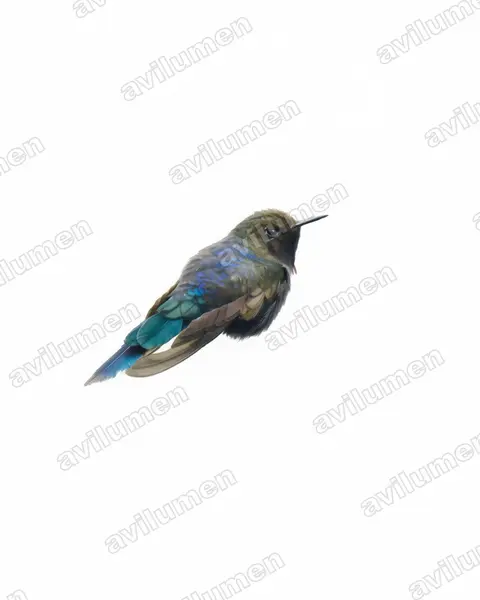
Watercolor 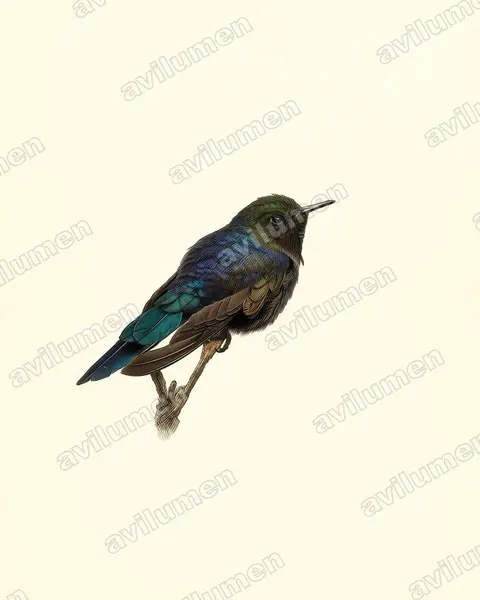
Vintage plate 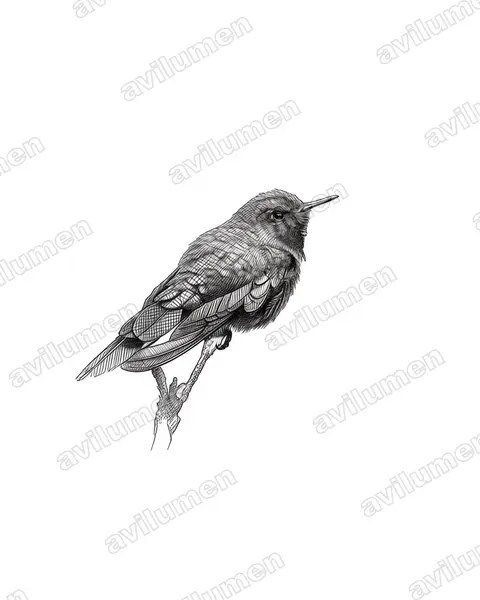
Ink 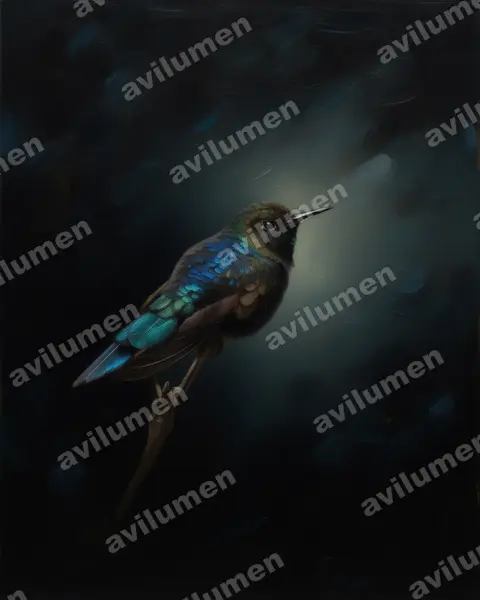
Oil 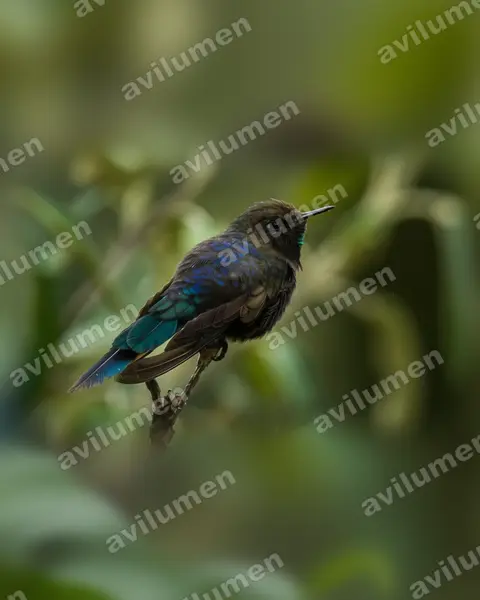
Realistic 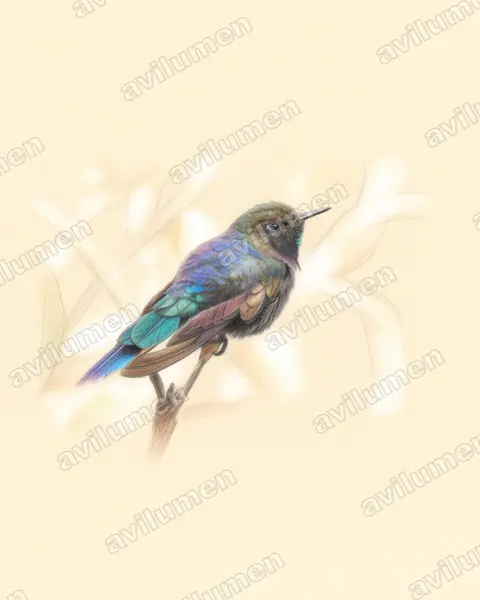
Colored pencil
Illustrations based on the photograph by Francesco Veronesi from Italy (CC BY-SA 2.0), from Wikimedia Commons.
Digital editions
HD Digital Art Pack — Blue-mantled thornbill
Digital download: 6 high-resolution illustrations of the Blue-mantled thornbill (Chalcostigma stanleyi), print-ready. This is a digital file; no animal or physical item is included.
AI Avatar — Blue-mantled thornbill
Generate an avatar fusing your face with the Blue-mantled thornbill (Chalcostigma stanleyi). Delivered digitally in 8K, watermark-free. Digital product; no animals are sold or brokered.
Instant download. No live birds are sold.
Frequently asked questions
- Is Chalcostigma stanleyi (Blue-mantled thornbill) endangered?
- The IUCN Red List places Chalcostigma stanleyi, commonly known as the Blue-mantled thornbill, in the «Least concern» category. «Least concern» means it is not currently threatened.
- Where does Chalcostigma stanleyi (Blue-mantled thornbill) live?
- Chalcostigma stanleyi (Blue-mantled thornbill) is found in South America.
- What family does Chalcostigma stanleyi (Blue-mantled thornbill) belong to?
- Chalcostigma stanleyi (Blue-mantled thornbill) belongs to the family Trochilidae, in the order Apodiformes.
- What colour is Chalcostigma stanleyi (Blue-mantled thornbill)?
- The plumage of Chalcostigma stanleyi (Blue-mantled thornbill) combines these colours: Blue.
More from the same family
 Least concern
Emerald-chinned Hummingbird
Abeillia abeillei
The emerald-chinned hummingbird is a species of hummingbird in the "emeralds", tribe Trochilini of subfamily Trochilinae.
from $1.99
 Least concern
Speckled hummingbird
Adelomyia melanogenys
The speckled hummingbird is a species of hummingbird. It is the only member of the genus Adelomyia. It inhabits Neotropical montane cloud forests at elevations of 1,000–2,500 meters and is confined to the Andes of Argentina, Bolivia, Peru, Ecuador, Colombia and Venezuela; as well as to some isolated montane forests in western Ecuador and Venezuela.
from $1.99
 Vulnerable
Purple-backed sunbeam
Aglaeactis aliciae
The purple-backed sunbeam is a bird species in the family Trochilidae. It is found only in Peru.
from $1.99
 Near threatened
White-tufted sunbeam
Aglaeactis castelnaudii
The white-tufted sunbeam is a species of hummingbird in the family Trochilidae. It is found only in Peru. Its natural habitats are subtropical or tropical moist montane forest and subtropical or tropical high-altitude shrubland.
from $1.99