Black Guan
Chamaepetes unicolor
Avilumen editorial team ·

The black guan is a species of bird in the chachalaca, guan, and curassow family Cracidae. It is found in Costa Rica and Panama.
The black guan (Chamaepetes unicolor) is a species of bird in the chachalaca, guan, and curassow family Cracidae. It is found in Costa Rica and Panama.
Taxonomy and systematics
The black guan shares the genus Chamaepetes with the sickle-winged guan (C. goudotii) of western South America and may form a superspecies with it.
Description
The black guan is 62 to 69 cm (2.03 to 2.26 ft) long and weighs about 1,135 g (2.502 lb). Adults have all black plumage with contrasting bright blue facial skin around a red eye. Their legs and feet are pinkish-red. Juveniles are similar but less glossy and their underparts browner and their facial skin is blackish or dark brown.
Distribution and habitat
The black guan is found from the Cordillera de Guanacaste in northern Costa Rica to western Coclé Province in Panama. It inhabits cloudforest in the Talamancan montane forest ecozone. It prefers steep terrain in the temperate, subtropical, and tropical zones, usually between about 1,000 and 2,250 m (3,280 and 7,380 ft) of elevation, but in some areas as low as 800 m (2,600 ft) and in others as high as 3,000 m (9,800 ft).
Movement
The black guan is thought to be mainly sedentary but there is some evidence of seasonal elevation changes.
Feeding
The black guan forages singly, in pairs, or in small groups. Its primary diet is fruits; studies in Costa Rica have identified at least 35 different species eaten. It mostly feeds in trees but will also eat fallen fruit on the ground.
Breeding
The black guan's breeding season is believed to span from February to June. The one described nest was a small platform of twigs and leaves placed in a clump of epiphytes in a tree 4.5 m (15 ft) above the ground. The clutch size is two or three eggs.
Vocal and non-vocal sounds
The black guan's vocalizations include piping calls in the breeding season, a "a low, deep 'ro-rooo' or coughing 'kowr' if disturbed", and a "tsik tsik..." alarm call. At dawn and dusk it gives a "loud, sharp, crackling" wing-rattling display.
Status
The IUCN has assessed the black guan as being of Least Concern. In Costa Rica it is fairly common in protected areas but in Panama only locally "rather numerous". However, even where nominally protected it is heavily hunted for food.
Text adapted from Wikipedia · CC BY-SA 4.0
Plumage colours
Distribution

Taxonomy
- Order
- Galliformes
- Family
- Cracidae
- Genus
- Chamaepetes
- Conservation status
- Least concern
Listen to its call
No recording yet
Illustration gallery
6 illustrations of Chamaepetes unicolor (Black Guan) in different styles, true to its real plumage. Shown watermarked; the art pack includes the high-resolution originals, ready to print.
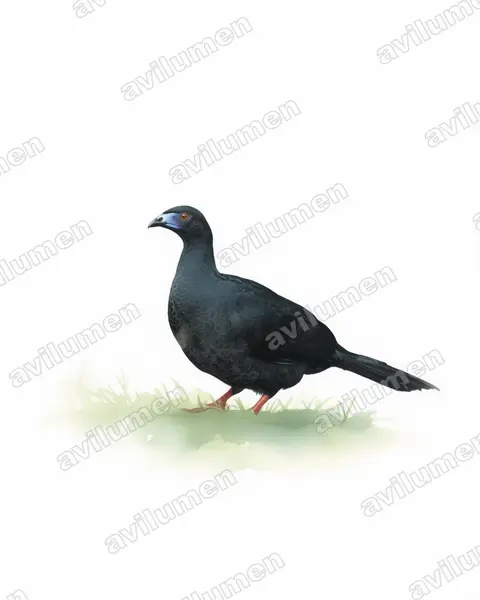
Watercolor 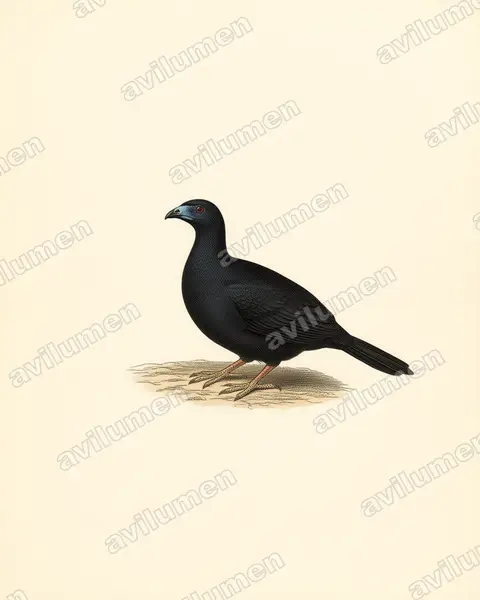
Vintage plate 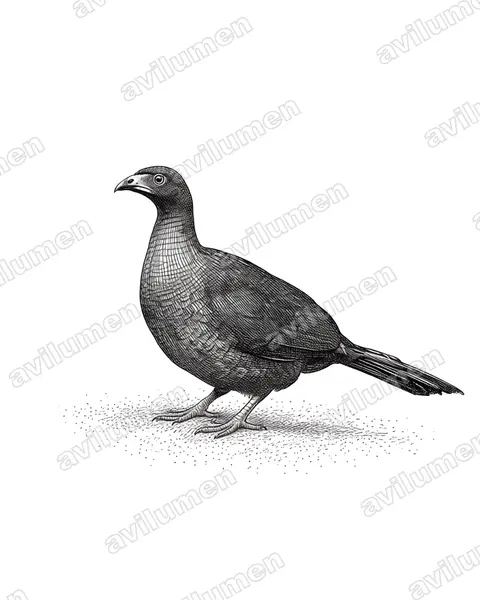
Ink 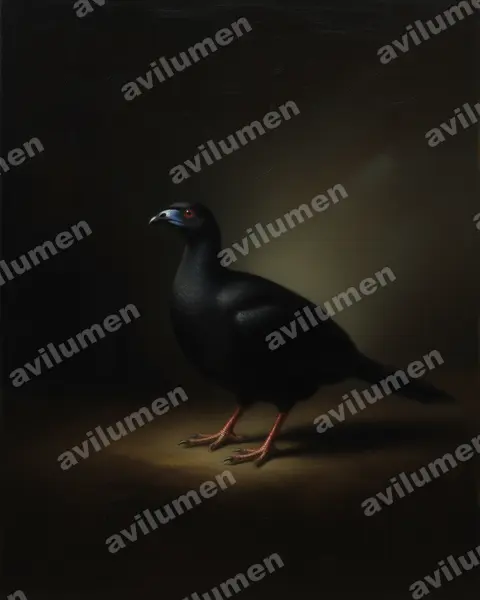
Oil 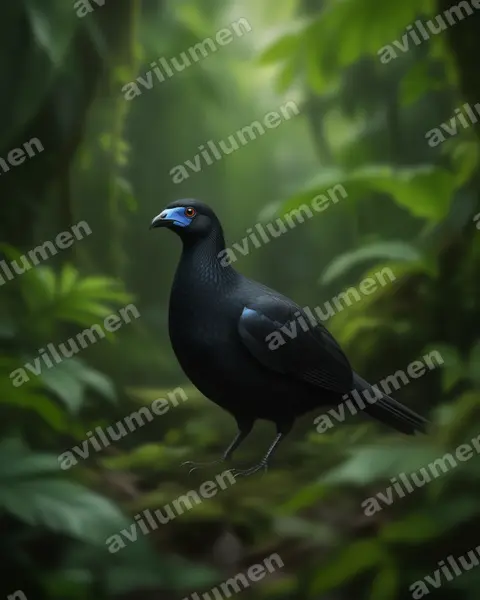
Realistic 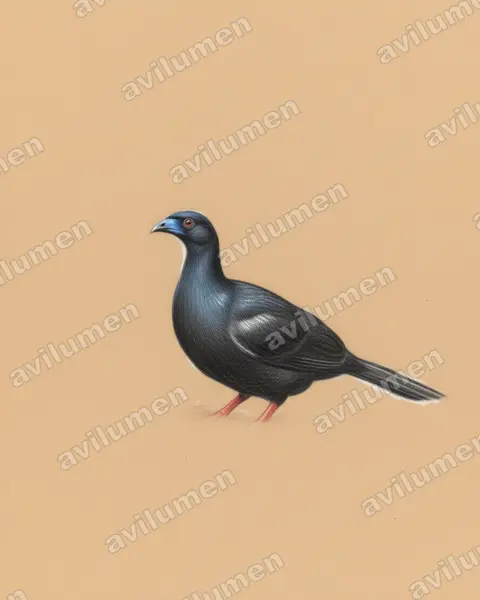
Colored pencil
Illustrations based on the photograph by Charles J. Sharp (CC BY-SA 3.0), from Wikimedia Commons.
Digital editions
HD Digital Art Pack — Black Guan
Digital download: 6 high-resolution illustrations of the Black Guan (Chamaepetes unicolor), print-ready. This is a digital file; no animal or physical item is included.
AI Avatar — Black Guan
Generate an avatar fusing your face with the Black Guan (Chamaepetes unicolor). Delivered digitally in 8K, watermark-free. Digital product; no animals are sold or brokered.
Instant download. No live birds are sold.
Frequently asked questions
- Is Chamaepetes unicolor (Black Guan) endangered?
- The IUCN Red List places Chamaepetes unicolor, commonly known as the Black Guan, in the «Least concern» category. «Least concern» means it is not currently threatened.
- What family does Chamaepetes unicolor (Black Guan) belong to?
- Chamaepetes unicolor (Black Guan) belongs to the family Cracidae, in the order Galliformes.
- What colour is Chamaepetes unicolor (Black Guan)?
- The plumage of Chamaepetes unicolor (Black Guan) combines these colours: Black.
More from the same family
 Least concern
Wattled Guan
Aburria aburri
The wattled guan is a species of bird in the family Cracidae. It is a fairly large black cracid with blue-based, black-tipped beak and a long, red-and-yellow wattle.
from $1.99
 Least concern
Sickle-winged Guan
Chamaepetes goudotii
The sickle-winged guan is a species of bird in the chachalaca, guan, and curassow family Cracidae. It is found in Bolivia, Colombia, Ecuador, and Peru.
from $1.99
 Critically endangered
Blue-billed Curassow
Crax alberti
The blue-billed curassow is a species of bird in the family Cracidae, the chachalacas, guans, and curassows. It is endemic to Colombia.
from $1.99
 Least concern
Black Curassow
Crax alector
The black curassow, also known as the smooth-billed curassow and the crested curassow, is a species of bird in the family Cracidae, the chachalacas, guans, and curassows. It is found in humid forests in northern South America in Colombia, Venezuela, the Guianas including Suriname, and far northern Brazil, and is introduced to Bahamas, Cuba, Jamaica, Haiti, Dominican Republic, Puerto Rico and Lesser Antilles.
from $1.99