Green-tailed emerald
Chlorostilbon alice
Avilumen editorial team ·

The green-tailed emerald is a species of hummingbird in the "emeralds", tribe Trochilini of subfamily Trochilinae. It is endemic to Venezuela.
The green-tailed emerald (Chlorostilbon alice) is a species of hummingbird in the "emeralds", tribe Trochilini of subfamily Trochilinae. It is endemic to Venezuela.
Taxonomy and systematics
The green-tailed emerald was originally described as Trochilus alice and later moved to its present genus Chlorostilbon. The South American Classification Committee of the American Ornithological Society, the International Ornithological Committee (IOC), and the Clements taxonomy recognize it as a monotypic species. However, BirdLife International's Handbook of the Birds of the World treats it as a subspecies of the short-tailed emerald, (C. poortmani). At least one author has suggested that it is a subspecies of narrow-tailed emerald (C. stenurus).
Description
The male green-tailed emerald is 7.5 to 8.5 cm (3.0 to 3.3 in) long and females 6.5 to 7.5 cm (2.6 to 3.0 in). The species weighs between 3 and 4 g (0.11 and 0.14 oz). Both sexes have a short, straight, black bill. The male's forehead and crown are shining dark green, its upperparts bronzy green, its tail glittering bronze-green, and its underparts grass green. The female's upperparts are like the male's. It has a white line behind the eye. Its underparts are pale grayish and the undertail coverts are dark gray. Its central tail feathers are green and the rest have green bases with black near the end and grayish tips. Immature birds resemble the female with buffy fringes on the feathers of the head.
Distribution and habitat
The green-tailed emerald is endemic to northern Venezuela, from Falcón south to Lara and Sucre and east to Monagas. It inhabits the semi-open edges of a variety of forest types including semi-humid rainforest, cloudforest, secondary forest, plantations, and sometimes dry forest. In elevation it ranges between 700 and 1,800 m (2,300 and 5,900 ft).
Movement
The green-tailed emerald's movements are not well understood. It is not a long-distance migrant but makes irregular movements among locations and elevations.
Feeding
The green-tailed emerald uses a variety of foraging strategies to feed on nectar. It uses trap-lining at low-quality sources and "steals" nectar from richer sources in other hummingbird's territories. Males sometimes defend nectar-rich feeding territories. The species forages fairly low in the vegetation, usually between 1 and 6 m (3 and 20 ft) above the ground, and seeks nectar at a variety of flowering plants and shrubs. In addition to nectar, it also feeds on small insects captured by hawking from a perch.
Breeding
The green-tailed emerald's breeding season spans from January to March. It builds a cup nest of plant fibers, leaf bits, and bark lined with softer material and covered on the outside with leaf pieces and twigs. It typically places it as a saddle on a thin branch about 1 m (3 ft) above the ground. The female incubates the clutch of two eggs for about 14 days and fledging occurs 20 to 22 days after hatch.
Vocalization
The green-tailed emerald's song has apparently not been recorded or described, and there are few recordings of its call. It makes a "[t]high soft chittering while foraging".
Status
The IUCN follows HBW taxonomy, and so has not assessed the green-tailed emerald separately from the more widespread short-tailed emerald. It has a restricted range and is considered locally common. It "[r]eadily accepts man-made habitats such as plantations, parks, gardens, and roadsides".
Text adapted from Wikipedia · CC BY-SA 4.0
Where it lives
Plumage colours
Distribution

Taxonomy
- Order
- Apodiformes
- Family
- Trochilidae
- Genus
- Chlorostilbon
- Conservation status
- Least concern
Listen to its call
No recording yet
Illustration gallery
6 illustrations of Chlorostilbon alice (Green-tailed emerald) in different styles, true to its real plumage. Shown watermarked; the art pack includes the high-resolution originals, ready to print.
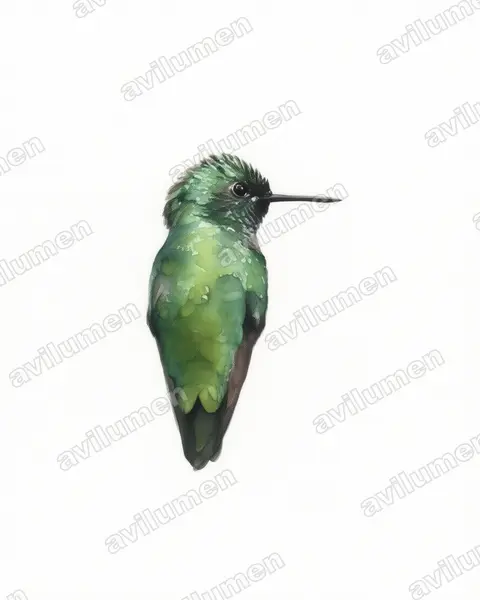
Watercolor 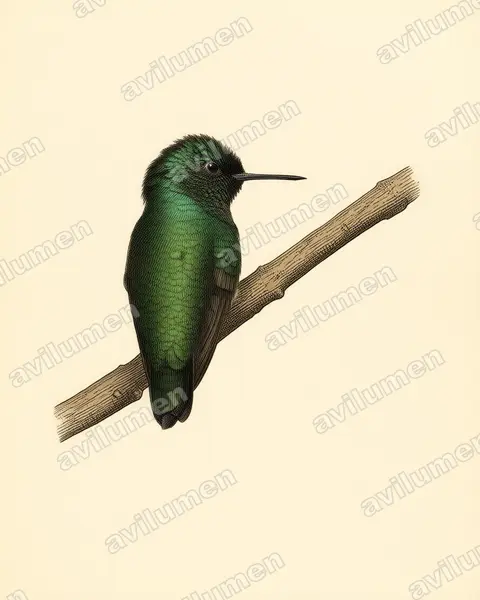
Vintage plate 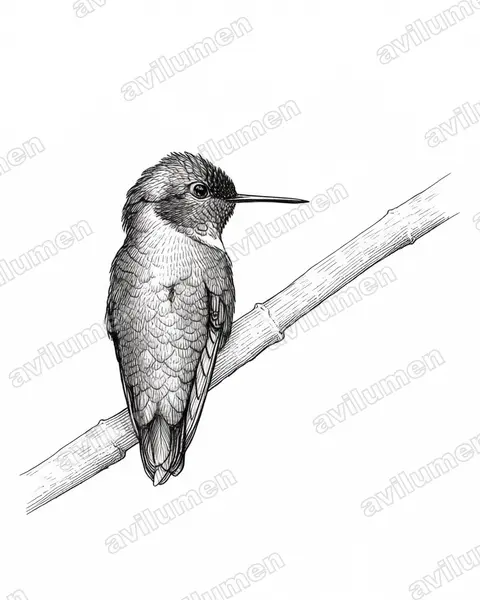
Ink 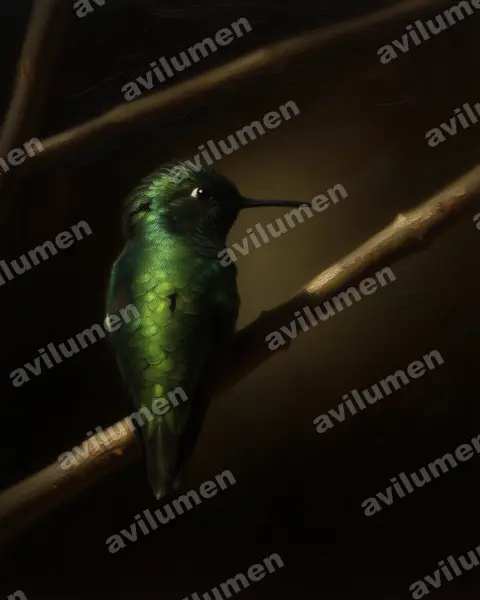
Oil 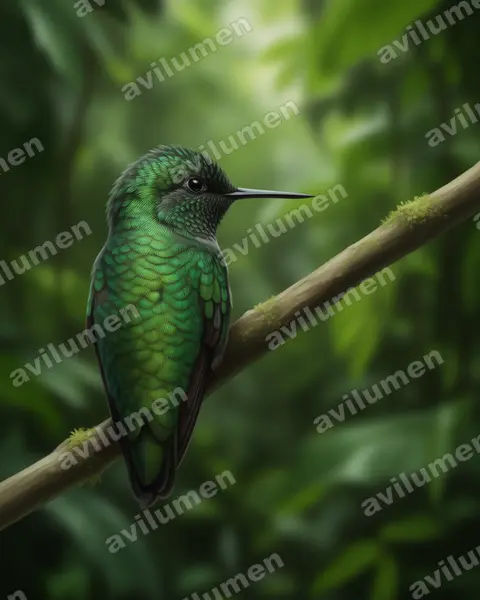
Realistic 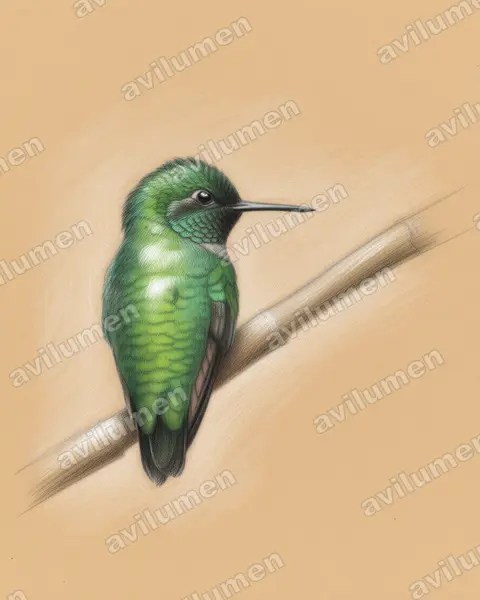
Colored pencil
Illustrations based on the photograph by Aitor (CC BY 4.0), from Wikimedia Commons.
Digital editions
HD Digital Art Pack — Green-tailed emerald
Digital download: 6 high-resolution illustrations of the Green-tailed emerald (Chlorostilbon alice), print-ready. This is a digital file; no animal or physical item is included.
AI Avatar — Green-tailed emerald
Generate an avatar fusing your face with the Green-tailed emerald (Chlorostilbon alice). Delivered digitally in 8K, watermark-free. Digital product; no animals are sold or brokered.
Instant download. No live birds are sold.
Frequently asked questions
- Is Chlorostilbon alice (Green-tailed emerald) endangered?
- The IUCN Red List places Chlorostilbon alice, commonly known as the Green-tailed emerald, in the «Least concern» category. «Least concern» means it is not currently threatened.
- Where does Chlorostilbon alice (Green-tailed emerald) live?
- Chlorostilbon alice (Green-tailed emerald) is found in South America.
- What family does Chlorostilbon alice (Green-tailed emerald) belong to?
- Chlorostilbon alice (Green-tailed emerald) belongs to the family Trochilidae, in the order Apodiformes.
- What colour is Chlorostilbon alice (Green-tailed emerald)?
- The plumage of Chlorostilbon alice (Green-tailed emerald) combines these colours: Green.
More from the same family
 Least concern
Emerald-chinned Hummingbird
Abeillia abeillei
The emerald-chinned hummingbird is a species of hummingbird in the "emeralds", tribe Trochilini of subfamily Trochilinae.
from $1.99
 Least concern
Speckled hummingbird
Adelomyia melanogenys
The speckled hummingbird is a species of hummingbird. It is the only member of the genus Adelomyia. It inhabits Neotropical montane cloud forests at elevations of 1,000–2,500 meters and is confined to the Andes of Argentina, Bolivia, Peru, Ecuador, Colombia and Venezuela; as well as to some isolated montane forests in western Ecuador and Venezuela.
from $1.99
 Vulnerable
Purple-backed sunbeam
Aglaeactis aliciae
The purple-backed sunbeam is a bird species in the family Trochilidae. It is found only in Peru.
from $1.99
 Near threatened
White-tufted sunbeam
Aglaeactis castelnaudii
The white-tufted sunbeam is a species of hummingbird in the family Trochilidae. It is found only in Peru. Its natural habitats are subtropical or tropical moist montane forest and subtropical or tropical high-altitude shrubland.
from $1.99