Brace's emerald
Chlorostilbon bracei
Avilumen editorial team ·

Brace's emerald is an extinct species of hummingbird which was endemic to the main island of the Bahamas, New Providence.
Brace's emerald (Riccordia bracei) is an extinct species of hummingbird which was endemic to the main island of the Bahamas, New Providence.
Description
Its weight was 0.43 oz (12 g) its wingspan was 9.25 in (23.5 cm);its length was 5.5 in (14 cm) and the length of its tail was 2.5 in (6.4 cm). The black bill was slightly straight and short. The legs and feet were black. The back exhibited a slaty blue hue with a black gleam. The head was similarly coloured to the back, with the absence of the black gloss. Directly behind the eyes was a white eyebrow. The throat was white. The abdomen had white feathers with black and yellow splotches. The wings exhibited a bluish hue with white wingbars. The rectrices were blackish. The crissum (the undertail covert which surrounded the cloacal opening) was white with a faint yellow hue at the edges.
Status and extinction
For more than a hundred years, Brace's emerald was only known by the type specimen, one single male which was shot by bird collector Lewis J. K. Brace on July 13, 1877, around three miles (4.8 kilometres) away from Nassau on the island of New Providence. The skin (which is unfortunately heavily damaged at the throat) is now at the Smithsonian Institution in Washington, D.C. The species was long ignored by ornithological authorities. In 1880, it was listed without commentary as a synonym of the Cuban emerald (Riccordia ricordii).
Not until the 1930s was the unique status of the holotype even recognized, as it was seen as an aberrant specimen of the Cuban emerald that had become a vagrant to New Providence. American ornithologist James Bond was the first to discuss the differences between R. ricordii and R. bracei. In 1945, he split R. ricordii and regarded R. ricordii bracei as a new subspecies. In contrast to the Cuban species, the specimen from New Providence was smaller, had a longer bill and a different plumage.
In 1982, palaeornithologists William Hilgartner and Storrs Olson discovered fossil remains of three hummingbird species from the Pleistocene in the deposits in a cave of New Providence. These were the Bahama woodstar (Nesophlox evelynae), Cuban emerald (R. ricordii; also R. elegans), and another species, which was later identified as Riccordia bracei. This provided evidence that Brace had discovered a new hummingbird species which lived on New Providence since the Pleistocene. It formed a relict population, and most likely due to habitat loss and human disturbance (e.g. agriculture), it became extinct at the end of the 19th century. Both R. bracei and R. elegans are listed as extinct on the 2024 IUCN Red List as extinct species.
Text adapted from Wikipedia · CC BY-SA 4.0
Plumage colours
Distribution

Taxonomy
- Order
- Apodiformes
- Family
- Trochilidae
- Genus
- Chlorostilbon
- Conservation status
- Extinct
Listen to its call
No recording yet
Illustration gallery
6 illustrations of Chlorostilbon bracei (Brace's emerald) in different styles, true to its real plumage. Shown watermarked; the art pack includes the high-resolution originals, ready to print.
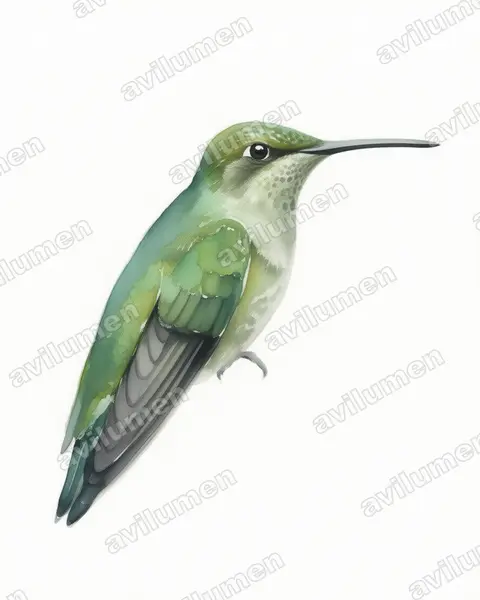
Watercolor 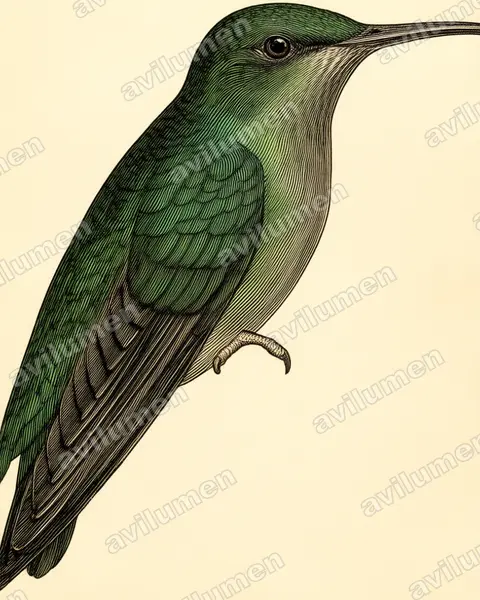
Vintage plate 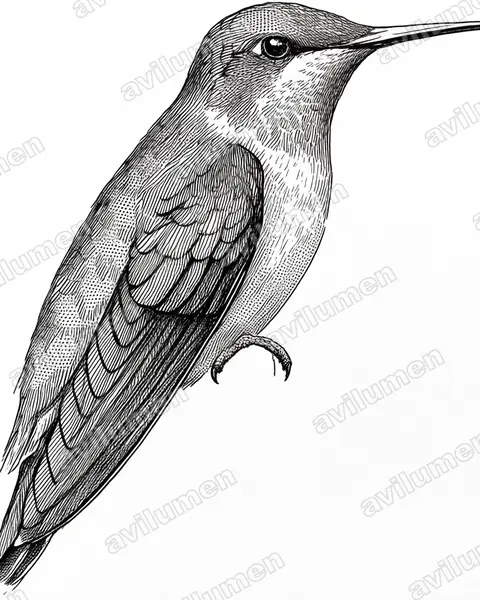
Ink 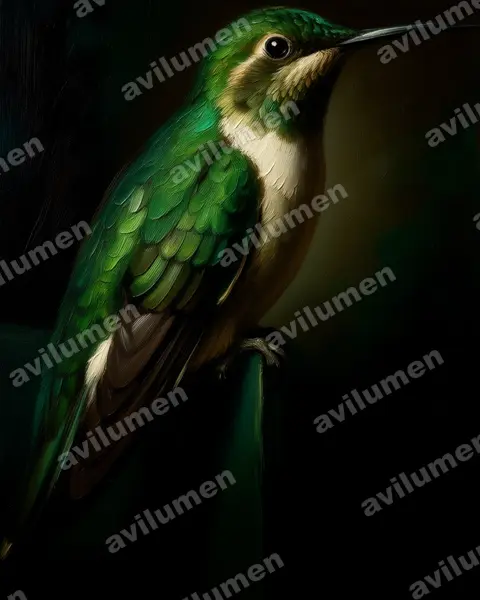
Oil 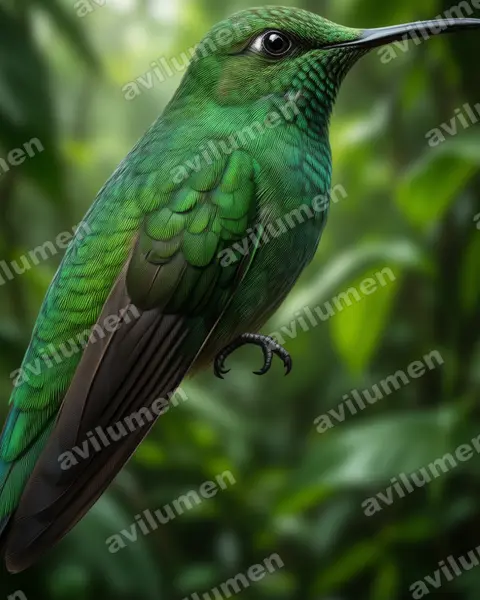
Realistic 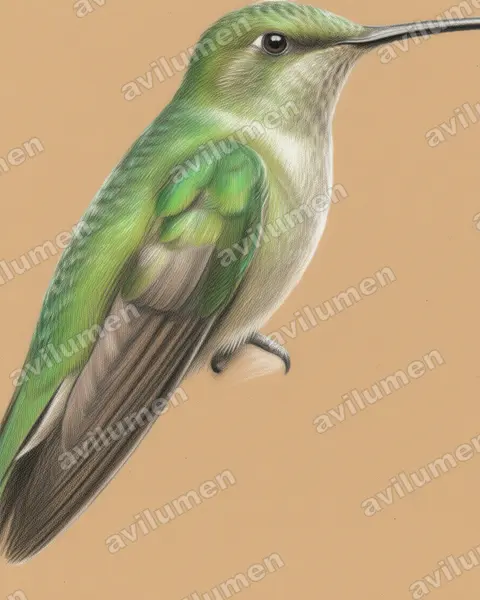
Colored pencil
Illustrations based on the photograph by Flea-15038 (CC BY-SA 4.0), from Wikimedia Commons.
Digital editions
HD Digital Art Pack — Brace's emerald
Digital download: 6 high-resolution illustrations of the Brace's emerald (Chlorostilbon bracei), print-ready. This is a digital file; no animal or physical item is included.
AI Avatar — Brace's emerald
Generate an avatar fusing your face with the Brace's emerald (Chlorostilbon bracei). Delivered digitally in 8K, watermark-free. Digital product; no animals are sold or brokered.
Instant download. No live birds are sold.
Frequently asked questions
- Is Chlorostilbon bracei (Brace's emerald) endangered?
- The IUCN Red List places Chlorostilbon bracei, commonly known as the Brace's emerald, in the «Extinct» category. «Extinct» means no individual is known to remain alive.
- What family does Chlorostilbon bracei (Brace's emerald) belong to?
- Chlorostilbon bracei (Brace's emerald) belongs to the family Trochilidae, in the order Apodiformes.
- What colour is Chlorostilbon bracei (Brace's emerald)?
- The plumage of Chlorostilbon bracei (Brace's emerald) combines these colours: Green.
More from the same family
 Least concern
Emerald-chinned Hummingbird
Abeillia abeillei
The emerald-chinned hummingbird is a species of hummingbird in the "emeralds", tribe Trochilini of subfamily Trochilinae.
from $1.99
 Least concern
Speckled hummingbird
Adelomyia melanogenys
The speckled hummingbird is a species of hummingbird. It is the only member of the genus Adelomyia. It inhabits Neotropical montane cloud forests at elevations of 1,000–2,500 meters and is confined to the Andes of Argentina, Bolivia, Peru, Ecuador, Colombia and Venezuela; as well as to some isolated montane forests in western Ecuador and Venezuela.
from $1.99
 Vulnerable
Purple-backed sunbeam
Aglaeactis aliciae
The purple-backed sunbeam is a bird species in the family Trochilidae. It is found only in Peru.
from $1.99
 Near threatened
White-tufted sunbeam
Aglaeactis castelnaudii
The white-tufted sunbeam is a species of hummingbird in the family Trochilidae. It is found only in Peru. Its natural habitats are subtropical or tropical moist montane forest and subtropical or tropical high-altitude shrubland.
from $1.99