Cozumel emerald
Chlorostilbon forficatus
Avilumen editorial team ·

The Cozumel emerald is a species of hummingbird in the "emeralds", tribe Trochilini of subfamily Trochilinae. It is endemic to the Mexican island of Cozumel off the Yucatán Peninsula.
The Cozumel emerald (Cynanthus forficatus) is a species of hummingbird in the "emeralds", tribe Trochilini of subfamily Trochilinae. It is endemic to the Mexican island of Cozumel off the Yucatán Peninsula.
Taxonomy and systematics
The Cozumel emerald's taxonomic history is complicated. It was originally described as Chlorostilbon forficatus, then as a subspecies of golden-crowned emerald (now Cynanthus auriceps) which itself has been treated as a subspecies of Canivet's emerald (now Cynanthus canivetii). Other more recent authors include it and many other taxa as subspecies of the blue-tailed emerald (Chlorostilbon mellisugus).
The North American Classification Committee of the American Ornithological Society, the International Ornithological Committee (IOC), and the Clements taxonomy assign it the binomial Cynanthus forficatus. However, as of 2020 BirdLife International's Handbook of the Birds of the World (HBW) retains it in genus Chlorostilbon.
Description
Male Cozumel emeralds are 9 to 10.5 cm (3.5 to 4.1 in) long and females 8 to 9.1 cm (3.1 to 3.6 in). Males and females both weigh about 2.5 g (0.088 oz). Males have a black bill with a red tip. Its crown is bright golden to golden green and the rest of the upperparts are a slightly duller golden green. Its underparts are brilliant metallic golden green with white tibial tufts. The tail is long and deeply forked, blue-black or black with a blue gloss, and the central two or three pairs of feathers have dark brownish gray tips. The female's maxilla is black and the mandible red with a black tip. Its upperparts are bright metallic green to bronze green. It has a white stripe behind the eye and blackish cheeks. Its underparts are light gray. Its tail is not as long or deeply forked as the male's. The central pair of feathers are metallic green to blue green and the next two pairs are the same color with a blue-black or black band near the end and white tips. The outermost two pairs have white outer webs at their base, a wide black band near the end, and white tips.
Distribution and habitat
The Cozumel emerald is found essentially only on Cozumel Island of the coast of Mexico's Yucatán Peninsula. There is a single specimen from Isla Mujeres about 90 km (56 mi) north of Cozumel, and the species is thought to occasionally visit there. Authors have described its habitat as "scrub and low deciduous insular forest" and "brushy woodland and scrub, second growth".
Movement
The Cozumel emerald is a year-round resident of the island.
Feeding
The Cozumel emerald's feeding strategy and diet have not been detailed. They are assumed to be similar to those of Canivet's emerald, which forages by trap-lining, visiting a circuit of a variety of flowering plants, and also feeds on small arthropods.
Breeding
The Cozumel emerald's breeding season, nest, and other details of its breeding phenology have not been described.
Vocalization
The Cozumel emerald's vocalizations are described as similar to those of it close relatives, "dry, rattling and chattering calls".
Status
The IUCN has assessed the Cozumel emerald as being of Least Concern. It has an estimated population between 20,000 and 50,000 mature individuals that is believed to be stable. No immediate threats have been identified. It is described as fairly common to common and "[h]uman activity probably has little short term effect on [the] Cozumel Emerald, which occupies edge and disturbed habitats."
Text adapted from Wikipedia · CC BY-SA 4.0
Plumage colours
Distribution

Taxonomy
- Order
- Apodiformes
- Family
- Trochilidae
- Genus
- Chlorostilbon
- Conservation status
- Least concern
Listen to its call
No recording yet
Illustration gallery
6 illustrations of Chlorostilbon forficatus (Cozumel emerald) in different styles, true to its real plumage. Shown watermarked; the art pack includes the high-resolution originals, ready to print.
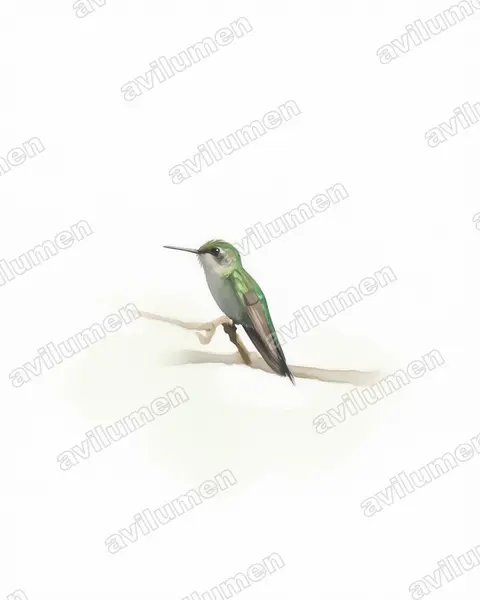
Watercolor 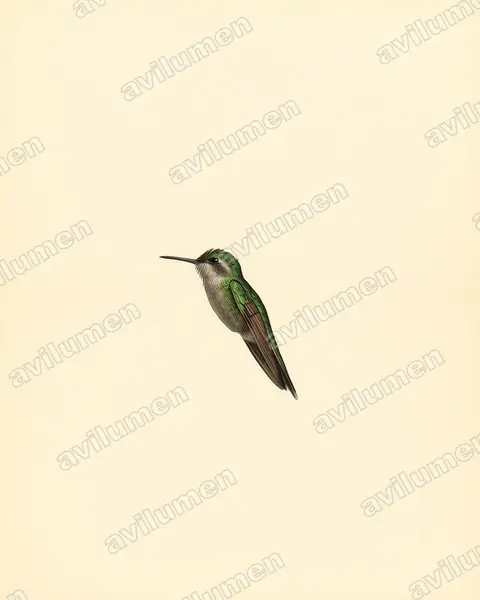
Vintage plate 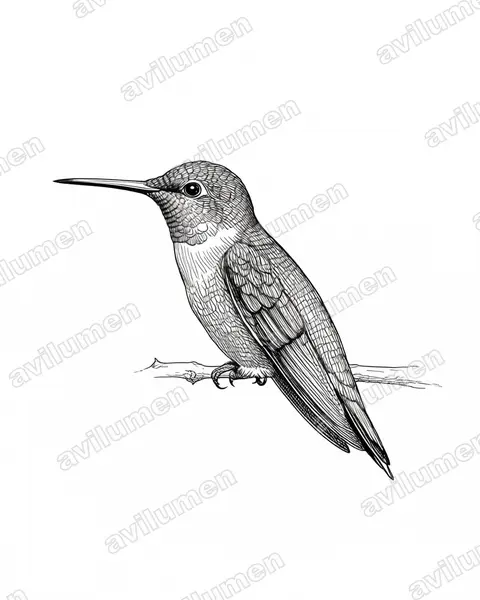
Ink 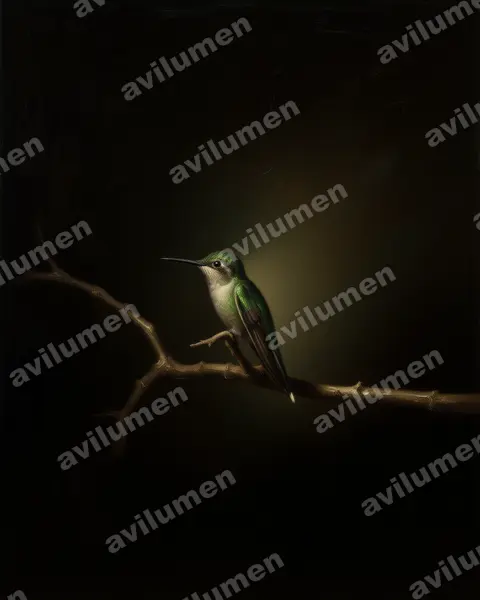
Oil 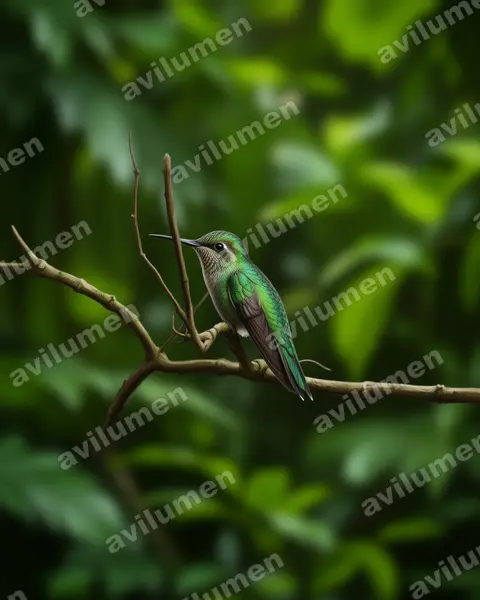
Realistic 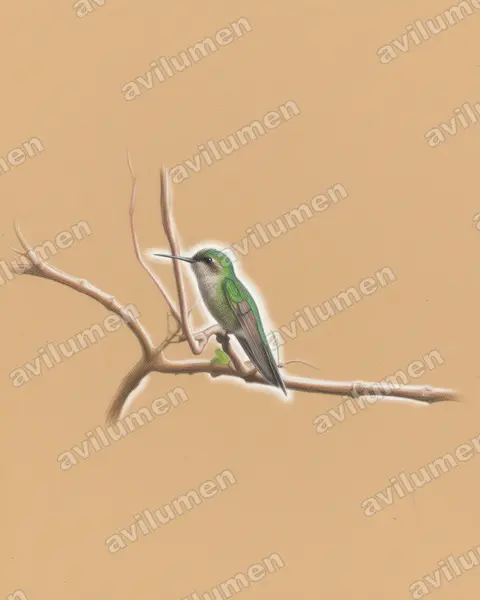
Colored pencil
Illustrations based on the photograph by dfaulder (CC BY 2.0), from Wikimedia Commons.
Digital editions
HD Digital Art Pack — Cozumel emerald
Digital download: 6 high-resolution illustrations of the Cozumel emerald (Chlorostilbon forficatus), print-ready. This is a digital file; no animal or physical item is included.
AI Avatar — Cozumel emerald
Generate an avatar fusing your face with the Cozumel emerald (Chlorostilbon forficatus). Delivered digitally in 8K, watermark-free. Digital product; no animals are sold or brokered.
Instant download. No live birds are sold.
Frequently asked questions
- Is Chlorostilbon forficatus (Cozumel emerald) endangered?
- The IUCN Red List places Chlorostilbon forficatus, commonly known as the Cozumel emerald, in the «Least concern» category. «Least concern» means it is not currently threatened.
- What family does Chlorostilbon forficatus (Cozumel emerald) belong to?
- Chlorostilbon forficatus (Cozumel emerald) belongs to the family Trochilidae, in the order Apodiformes.
- What colour is Chlorostilbon forficatus (Cozumel emerald)?
- The plumage of Chlorostilbon forficatus (Cozumel emerald) combines these colours: Green.
More from the same family
 Least concern
Emerald-chinned Hummingbird
Abeillia abeillei
The emerald-chinned hummingbird is a species of hummingbird in the "emeralds", tribe Trochilini of subfamily Trochilinae.
from $1.99
 Least concern
Speckled hummingbird
Adelomyia melanogenys
The speckled hummingbird is a species of hummingbird. It is the only member of the genus Adelomyia. It inhabits Neotropical montane cloud forests at elevations of 1,000–2,500 meters and is confined to the Andes of Argentina, Bolivia, Peru, Ecuador, Colombia and Venezuela; as well as to some isolated montane forests in western Ecuador and Venezuela.
from $1.99
 Vulnerable
Purple-backed sunbeam
Aglaeactis aliciae
The purple-backed sunbeam is a bird species in the family Trochilidae. It is found only in Peru.
from $1.99
 Near threatened
White-tufted sunbeam
Aglaeactis castelnaudii
The white-tufted sunbeam is a species of hummingbird in the family Trochilidae. It is found only in Peru. Its natural habitats are subtropical or tropical moist montane forest and subtropical or tropical high-altitude shrubland.
from $1.99