Black-bellied Sunbird
Cinnyris nectarinioides
Avilumen editorial team ·

The black-bellied sunbird (Cinnyris nectarinioides) is a small sunbird located primarily in Africa. Two subspecies are recognized: the Cinnyris nectarinioides erlangeri, which is smaller and found in Ethiopia, Somalia, and Kenya; and the Cinnyris nectarinioides nectarinioides, which is larger and found in Kenya and Tanzania. This bird inhabits savannah, wetlands, and terrestrial freshwater areas.
The black-bellied sunbird (Cinnyris nectarinioides) is a small sunbird located primarily in Africa. Two subspecies are recognized: the Cinnyris nectarinioides erlangeri, which is smaller and found in Ethiopia, Somalia, and Kenya; and the Cinnyris nectarinioides nectarinioides, which is larger and found in Kenya and Tanzania. This bird inhabits savannah, wetlands, and terrestrial freshwater areas.
This species has an average size of 13cm for males and 10 cm for females with both weights typically ranging from 4 to 6 grams. The black-bellied sunbird feeds on nectar, insects and spiders, the latter having gained it the nickname "spiderhunter". They forage in the higher levels of trees and perch in order to feed. These birds do not migrate in different seasons of the year, and inhabit the same area year round.
Taxonomy
The black-bellied sunbird is part of the species Cinnyris nectarinioides and has two recognized subspecies. The smaller, the Cinnyris nectarinioides erlangeri inhabits Northeast Kenya and can also be found in Southeast Ethiopia and South Somalia. The larger subspecies, the Cinnyris nectarinioides nectarinioides, inhabits Southeast Kenya and Northeast Tanzania. Both subspecies are similar in most aspects besides size. Their songs are also very similar.
Description
The black-bellied sunbird can be characterized by a curved bill used for nectar feeding and a small frame. These birds often weigh just 4–6 grams and as grown males tend to be around 13 cm large, while females remain around 10 cm. This sunbird is sexually dimorphic with differences in plumage between males and females and slight differences between breeding and non-breeding males.
A breeding male has a golden-green head, upperparts, chin, and throat. The bases of its feathers and upper tail are black with the rest of the upper tail being a dark metallic blue. Feathers are occasionally purple or a lustrous greenish-blue at the edges, with faint blue bands stretching across the feathers. They have an orange breastband, that is redder in the erlangeri species, tufts of yellow on the pecs and slight streaks of white on their flanks. The male's bill and legs are both black. The non-breeding males are similar, differentiated only by upperparts being a more dull brown and some white-yellow underparts, also known as eclipse plumage.
Female plumage is yellow-olive with streaks of dark brown on their crown. One distinguishing feature is the streak of yellow above their eye. Their tail is similar to the male, only differentiated by white tips and edges. The middle of a female belly and its undertail are pale yellow and its beak and legs are black like their male counterparts.
Habitat
The black-bellied sunbird is predominantly located in Kenya. Its main habitats are savannah, terrestrial areas, and inland wetlands and freshwater. It inhabits 4 main countries total: Kenya, Ethiopia, Tanzania, and Somalia. Though the population size has not been quantified, the species is marked as locally common in Kenya. It is described as uncommon in Somalia and rare in Ethiopia. The species is located in some protected areas though the species itself is not protected. The sunbird prefers areas of arid savanna and river vegetation.
Range
There are no fluctuations in the black-bellied sunbird area of occupancy. They inhabit the same location year-round. Unlike other birds, these do not migrate in the winter. They are mostly concentrated in the eastern edge of Africa, only coming as far west as Northeastern Kenya.
Song and call
The black-bellied sunbird calls 6–20 "chip" notes that are repeated over 5 times per second. There is a brief rising and falling of a "tsi" note that accelerates near the end of successive calls. The entirety of the call often repeats for a period of over 3 minutes.
Diet and feeding
The primary food source for the black-bellied sunbird is nectar, though they also feed on insects and spiders. In order to find the latter two, this bird will often forage in the high levels of trees. When feeding on nectar, they prefer acacias, baobab, and mistletoes. Despite feeding on nectar like a hummingbird, they do not float while feeding, but instead perch on the flowers they feed on.
Text adapted from Wikipedia · CC BY-SA 4.0
Taxonomy
- Order
- Passeriformes
- Family
- Nectariniidae
- Genus
- Cinnyris
- Conservation status
- Least concern
Listen to its call
No recording yet
Illustration gallery
6 illustrations of Cinnyris nectarinioides (Black-bellied Sunbird) in different styles, true to its real plumage. Shown watermarked; the art pack includes the high-resolution originals, ready to print.
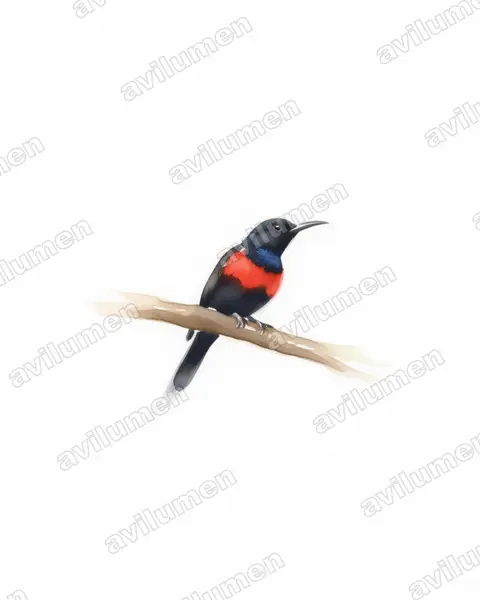
Watercolor 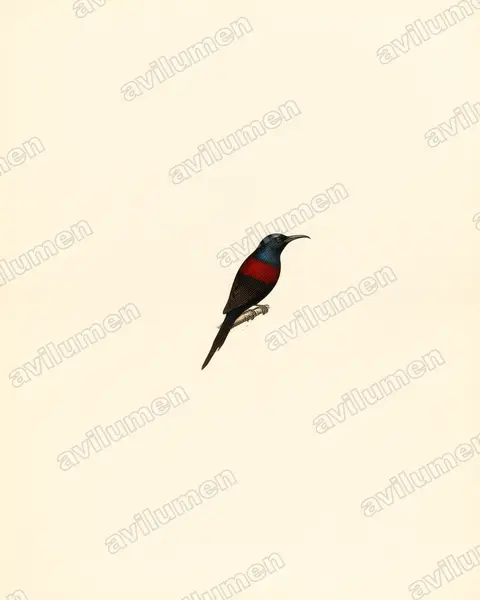
Vintage plate 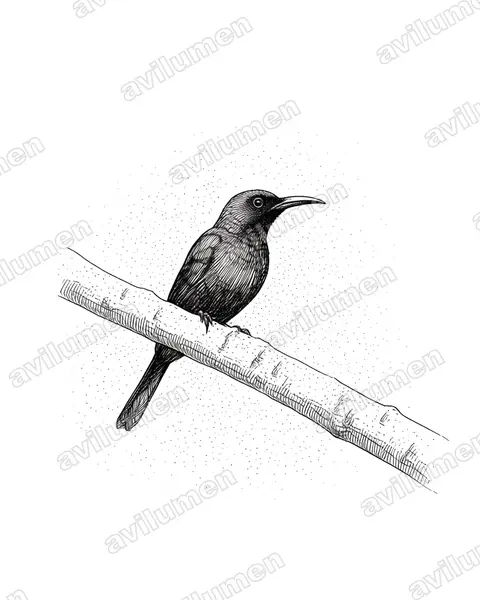
Ink 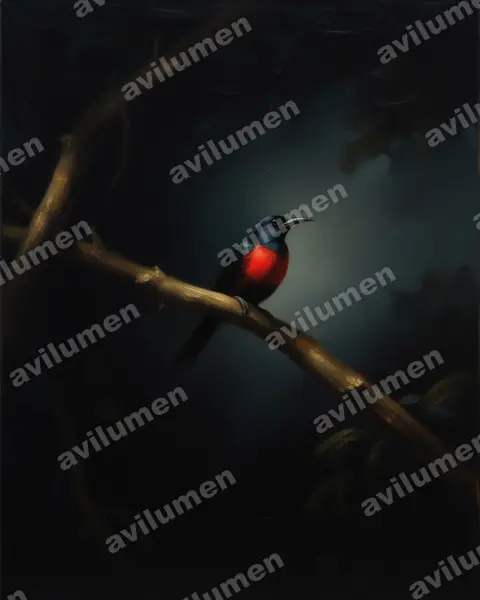
Oil 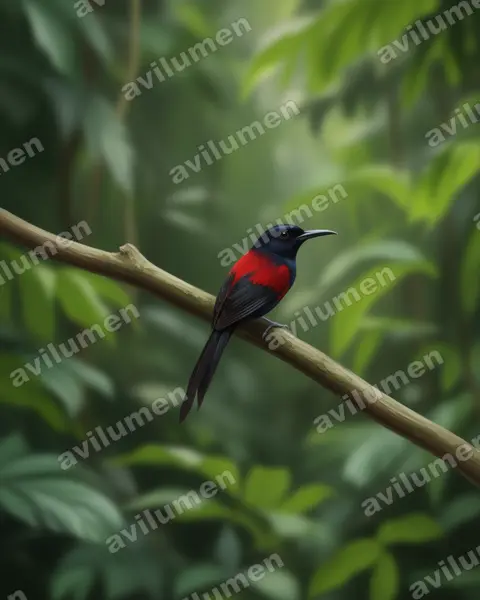
Realistic 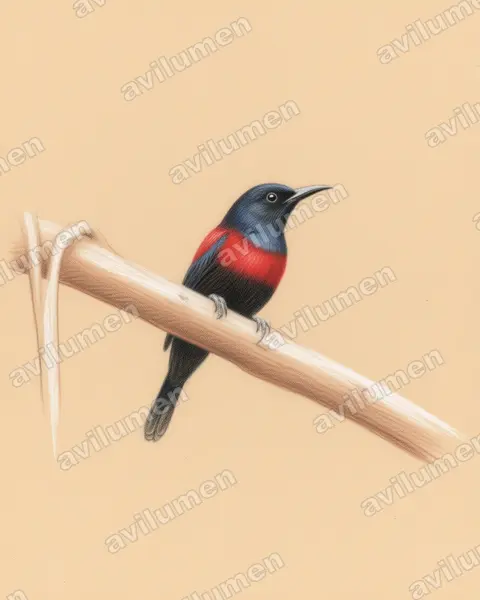
Colored pencil
Illustrations based on the photograph by ChriKo (CC BY-SA 3.0), from Wikimedia Commons.
Digital editions
HD Digital Art Pack — Black-bellied Sunbird
Digital download: 6 high-resolution illustrations of the Black-bellied Sunbird (Cinnyris nectarinioides), print-ready. This is a digital file; no animal or physical item is included.
AI Avatar — Black-bellied Sunbird
Generate an avatar fusing your face with the Black-bellied Sunbird (Cinnyris nectarinioides). Delivered digitally in 8K, watermark-free. Digital product; no animals are sold or brokered.
Instant download. No live birds are sold.
Frequently asked questions
- Is Cinnyris nectarinioides (Black-bellied Sunbird) endangered?
- The IUCN Red List places Cinnyris nectarinioides, commonly known as the Black-bellied Sunbird, in the «Least concern» category. «Least concern» means it is not currently threatened.
- Where does Cinnyris nectarinioides (Black-bellied Sunbird) live?
- Cinnyris nectarinioides (Black-bellied Sunbird) is found in Africa.
- What family does Cinnyris nectarinioides (Black-bellied Sunbird) belong to?
- Cinnyris nectarinioides (Black-bellied Sunbird) belongs to the family Nectariniidae, in the order Passeriformes.
- What colour is Cinnyris nectarinioides (Black-bellied Sunbird)?
- The plumage of Cinnyris nectarinioides (Black-bellied Sunbird) combines these colours: Black and Green.
More from the same family
 Least concern
Handsome Sunbird
Aethopyga bella
The handsome sunbird is a species of bird in the family Nectariniidae. It is endemic to the Philippines.
from $1.99
 Least concern
Apo Sunbird
Aethopyga boltoni
The Apo sunbird is a species of bird in the sunbird family Nectariniidae. It is endemic to the island of Mindanao in the Philippines. It is found in tropical moist montane forests at elevations ranging from 820 to 2,000 metres above sea level.
from $1.99
 Least concern
Fork-tailed Sunbird
Aethopyga christinae
The fork-tailed sunbird is a bird in the family Nectariniidae. The species was first described by Robert Swinhoe in 1869.
from $1.99
 Endangered
Elegant Sunbird
Aethopyga duyvenbodei
The elegant sunbird is a large, up to 12 cm long, Australasian sunbird in the genus Aethopyga. The male has an iridescent blue-green crown, shoulder patch and uppertail coverts, yellow bar across lower back, red ear coverts, olive back, yellow throat, red neck collar and yellow below. The female has a yellowish olive upperparts, scaly crown and yellow underparts.
from $1.99