Dusky starfrontlet
Coeligena orina
Avilumen editorial team ·

The dusky starfrontlet, also known as glittering starfrontlet, is an Endangered species of hummingbird in the "brilliants", tribe Heliantheini in subfamily Lesbiinae. It is endemic to a few small areas in western Colombia.
The dusky starfrontlet (Coeligena orina), also known as glittering starfrontlet, is an Endangered species of hummingbird in the "brilliants", tribe Heliantheini in subfamily Lesbiinae. It is endemic to a few small areas in western Colombia.
Taxonomy and systematics
The dusky starfrontlet was originally known from a single museum specimen collected in 1951 and described as a full species in 1953. In 1988 its status was reassessed as a subspecies of golden-bellied starfrontlet (Coeligena bonapartei). It was rediscovered in 2004, in what is now the Colibri del Sol Bird Reserve, and additional specimens confirmed its identity as a species. It and the buff-winged starfrontlet (C. lutetiae) are sister species and it is also closely related to the golden-bellied, violet-throated (C. violifer), and blue-throated (C. helianthea) starfrontlets.
The dusky starfrontlet is monotypic.
Description
The dusky starfrontlet is about 14 cm (5.5 in) long. Males weigh 6.9 to 7.2 g (0.24 to 0.25 oz) and females 6.7 to 7 g (0.24 to 0.25 oz). The male has a glittering blue-green to golden green forehead and a velvety black crown, face, and mantle. The back is green with black highlights, the rump and uppertail coverts iridescent golden green, and the tail a paler green. The throat and breast are dark green, like the back suffused with black, and there is a large cobalt-blue spot on the lower throat. The belly and undertail coverts are the same golden green as the rump. The female's crown, face, and upper back are green with blackish tips to the feathers that give a scaly effect. The rump, uppertail coverts, and tail are like the male's but with less iridescence. The throat is a bright cinnamon buff with green spots on the sides, the belly iridescent golden green with dusky inclusions, and the undertail coverts dull golden green with buffy edges.
One Spanish name for the dusky starfrontlet is "Colibrí del Sol", which translates to "hummingbird of the Sun".
Distribution and habitat
The dusky starfrontlet is found in only about a dozen sites in a few small areas of the Western Andes of Colombia. The original 1951 specimen and some of the 2004 ones were collected at Páramo de Frontino, Antioquia Department. Others were collected in 2004 at nearby Las Orquídeas National Natural Park in Farallones del Citará on the Antioquia/Chocó border. Further observations have come from Jardín in Antioquia and Cerro Montezuma in Risaralda Department.
Specimens and sight records of dusky starfrontlet have come from tall humid forest, elfin forest, and the ecotone between forest and páramo. Most observations have been between about 3,100 and 3,500 m (10,200 and 11,500 ft) of elevation, but there is one record from 2,500 m (8,200 ft).
Movement
No movements of the dusky starfrontlet are definitely known, but the sighting at 2500 m might indicate that some take place.
Feeding
The dusky starfrontlet has been observed feeding on nectar at plants of genera Aetanthus, Bejaria, Bomarea, Cavendishia, and Centropogon. Stomachs of specimens have yielded spiders, wasps, flies, and what appeared to be a psocopteran.
Breeding
Little is known about the dusky starfrontlet's breeding phenology. Two nests are known, both from Tatamá National Natural Park. They were held by thin roots on rock faces about 3 m (10 ft) above the ground. Each contained two eggs. Immature birds have been reported in both January and August.
Vocalization
A few dusky starfrontlet vocalizations have been described, a "high-pitched wiry note becoming trill-like towards the end 'tseeririrrr', a single 'tsee' and a lower-pitched strident 'tsip'."
Status
The IUCN originally assessed the dusky starfrontlet in 2004 as being of Least Concern but in 2007 revised its status to Critically Endangered. In 2020 the status was again revised, to Endangered. Its population is estimated at between 250 and 2500 mature individuals and is believed to be declining. Even in national parks, continued deforestation for timber, agriculture, and settlement is a threat. The high probability of future mining for gold, zinc, and copper in Páramo de Frontino poses an additional threat.
Text adapted from Wikipedia · CC BY-SA 4.0
Where it lives
Distribution

Taxonomy
- Order
- Apodiformes
- Family
- Trochilidae
- Genus
- Coeligena
- Conservation status
- Endangered
Listen to its call
No recording yet
Illustration gallery
6 illustrations of Coeligena orina (Dusky starfrontlet) in different styles, true to its real plumage. Shown watermarked; the art pack includes the high-resolution originals, ready to print.
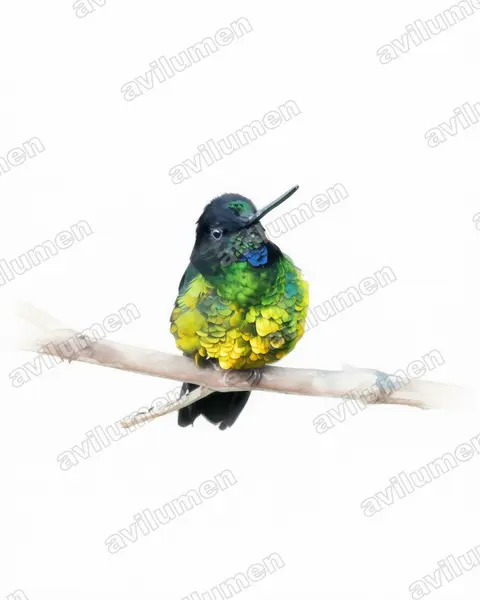
Watercolor 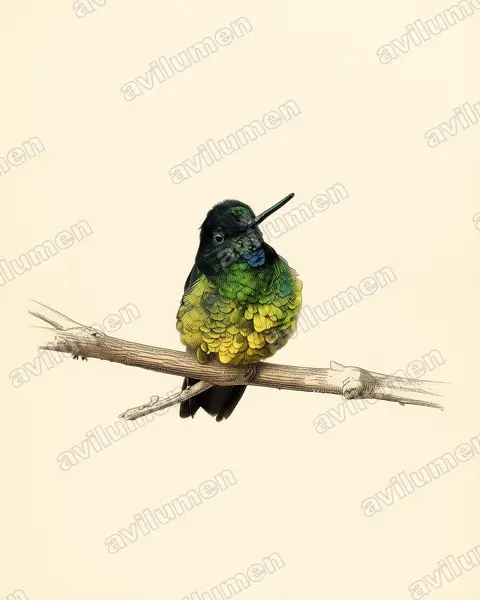
Vintage plate 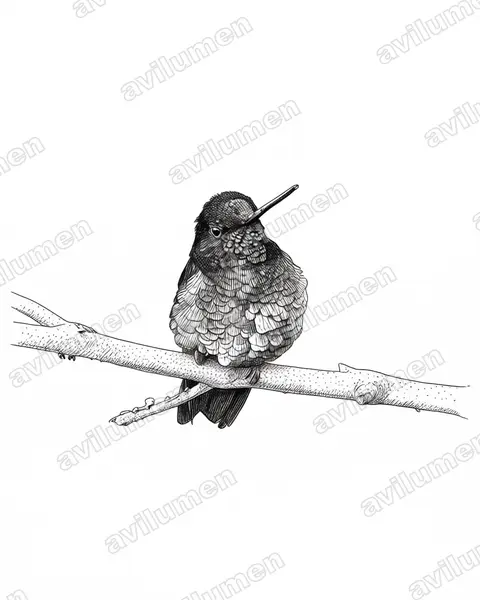
Ink 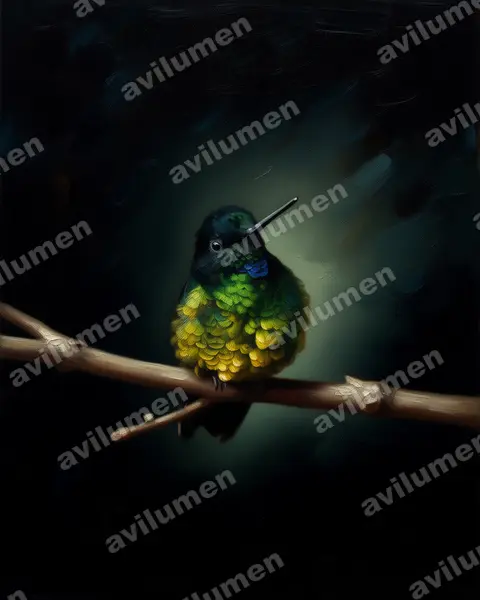
Oil 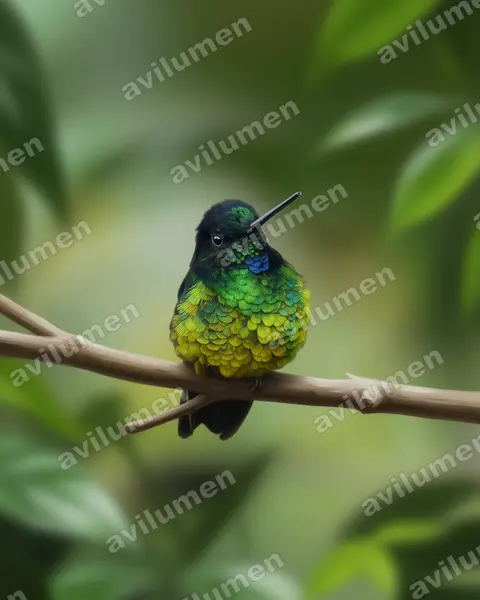
Realistic 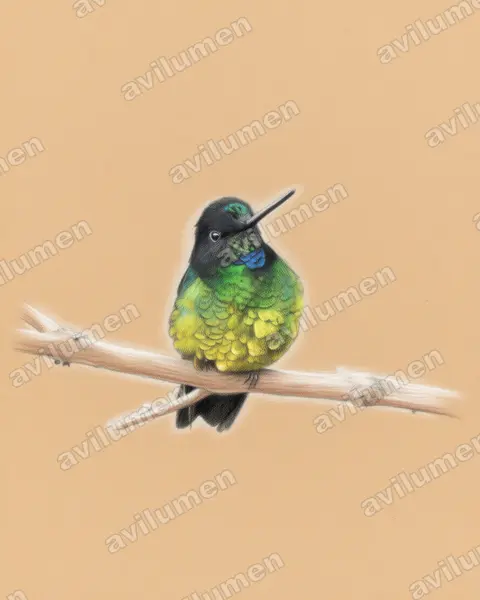
Colored pencil
Illustrations based on the photograph by Anthony Kaduck (CC BY-SA 4.0), from Wikimedia Commons.
Digital editions
HD Digital Art Pack — Dusky starfrontlet
Digital download: 6 high-resolution illustrations of the Dusky starfrontlet (Coeligena orina), print-ready. This is a digital file; no animal or physical item is included.
AI Avatar — Dusky starfrontlet
Generate an avatar fusing your face with the Dusky starfrontlet (Coeligena orina). Delivered digitally in 8K, watermark-free. Digital product; no animals are sold or brokered.
Instant download. No live birds are sold.
Frequently asked questions
- Is Coeligena orina (Dusky starfrontlet) endangered?
- The IUCN Red List places Coeligena orina, commonly known as the Dusky starfrontlet, in the «Endangered» category. «Endangered» means it faces a very high risk of disappearing in the wild.
- Where does Coeligena orina (Dusky starfrontlet) live?
- Coeligena orina (Dusky starfrontlet) is found in South America.
- What family does Coeligena orina (Dusky starfrontlet) belong to?
- Coeligena orina (Dusky starfrontlet) belongs to the family Trochilidae, in the order Apodiformes.
- What colour is Coeligena orina (Dusky starfrontlet)?
- The plumage of Coeligena orina (Dusky starfrontlet) combines these colours: Green and Blue.
More from the same family
 Least concern
Emerald-chinned Hummingbird
Abeillia abeillei
The emerald-chinned hummingbird is a species of hummingbird in the "emeralds", tribe Trochilini of subfamily Trochilinae.
from $1.99
 Least concern
Speckled hummingbird
Adelomyia melanogenys
The speckled hummingbird is a species of hummingbird. It is the only member of the genus Adelomyia. It inhabits Neotropical montane cloud forests at elevations of 1,000–2,500 meters and is confined to the Andes of Argentina, Bolivia, Peru, Ecuador, Colombia and Venezuela; as well as to some isolated montane forests in western Ecuador and Venezuela.
from $1.99
 Vulnerable
Purple-backed sunbeam
Aglaeactis aliciae
The purple-backed sunbeam is a bird species in the family Trochilidae. It is found only in Peru.
from $1.99
 Near threatened
White-tufted sunbeam
Aglaeactis castelnaudii
The white-tufted sunbeam is a species of hummingbird in the family Trochilidae. It is found only in Peru. Its natural habitats are subtropical or tropical moist montane forest and subtropical or tropical high-altitude shrubland.
from $1.99