Mexican violetear
Colibri thalassinus
Avilumen editorial team ·

The Mexican violetear is a medium-sized, metallic green hummingbird species commonly found in forested areas from Mexico to Nicaragua. This species, together with the lesser violetear were previously considered conspecific, and together called the green violetear.
The Mexican violetear (Colibri thalassinus) is a medium-sized, metallic green hummingbird species commonly found in forested areas from Mexico to Nicaragua. This species, together with the lesser violetear were previously considered conspecific, and together called the green violetear.
Taxonomy
The Mexican violetear belongs to the order Apodiformes. Hummingbirds share this order with the swifts, such as the white-collared swift. The name Apodiformes is derived from the Greek words "a pous", meaning "without foot". While apodiforms do in fact have feet, they are quite small and their legs are short and relatively weak. Many birds in this order cannot walk, and thus rarely if ever land on the ground, where they are not well-adapted to forage or to escape from predators. Members of this order spend a majority of their active time in the air.
Description
The Mexican violetear is roughly medium-sized by hummingbird standards. It averages around 9.7 to 12 cm (3.8 to 4.7 in) in total length. Its bill is black and mostly straight with only a slight downward curve and measures from 1.8 to 2.5 cm (0.71 to 0.98 in). The body mass can vary from 4.8 to 5.6 g (0.17 to 0.20 oz). Among standard measurements, the wing chord is 5.8 to 6.8 cm (2.3 to 2.7 in) and the tail is 3.5 to 4.3 cm (1.4 to 1.7 in). The bird has a wingspan of 12 cm. It is shining green above with a glittering violet ear-patch on the sides of its neck. Its throat and chest are a glittering green with a shining green belly. The tail is a metallic blue-green with more bronzy central feathers and a prominent black subterminal band.
Vocalizations
Solitary males sing from above, exposed twigs in their territory every day. Their song is a monotonously repeated sharp and dry "tsu-tzeek" at a rate of about one call per second.
Distribution
The Mexican violetear breeds from the highlands of southern Mexico south to Nicaragua. It is a rare but annual nonbreeding visitor to the United States, primarily southern and central Texas, with scattered records as far north as extreme southern Canada.
According to IUCN C. thalissinus can be found in much of montane areas of the northern Andes, stretching from Bolivia to Venezuela.
Habitat
Common habitats for the Mexican violetear is in the canopy and borders of subtropical and lower temperate forest, secondary woodland and scrub, and clearings and gardens in the subtropical zone. It is recorded mostly between altitudes of 1,200 to 2,300 m (3,900 to 7,500 ft), though they will sometimes wander as far down as 500 m (1,600 ft) in search of food sources. It generally prefers more humid and high-altitude areas, such as cloud forests.
Diet
The Mexican violetear forages alone but tends to gather at flowering trees, especially coffee-shade Inga. They feed at mid-level to canopy and often hold and defend a feeding territory. They primarily feed on nectar and small insects. They are a fairly common species that thrives in deforested areas.
Breeding
Like most hummingbirds, the Mexican violetear is a solitary nester. The male's only involvement in the breeding process is to attract and mate with the female. The female is then responsible for choosing a nest location, generally on a low, small horizontal branch in a protected area. The nest is small and built from various plant materials, spider webs, and down woven together to form a sturdy cup structure. Two small white eggs are laid within the nest and the female incubates them on her own. Incubation time is 14–18 days. Hatchlings are primarily fed insects due to high nutritional requirements. No information was found on the length of the nestling stage or age at fledgling. Breeding takes place though the wet season into the early dry season, which varies by latitude.
Migration
Seasonal movements of the Mexican violetear are not well understood. Many individuals of northern populations move south or and/or to lower elevations following the end of the breeding season (July to November in Mexico), but regular occurrence hundreds of kilometres north of this range suggests a more complex migration strategy.
Text adapted from Wikipedia · CC BY-SA 4.0
Plumage colours
Distribution

Taxonomy
- Order
- Apodiformes
- Family
- Trochilidae
- Genus
- Colibri
- Conservation status
- Least concern
Listen to its call
No recording yet
Illustration gallery
6 illustrations of Colibri thalassinus (Mexican violetear) in different styles, true to its real plumage. Shown watermarked; the art pack includes the high-resolution originals, ready to print.
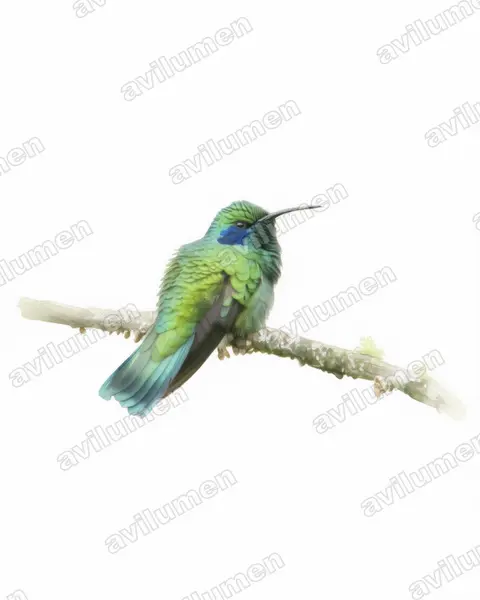
Watercolor 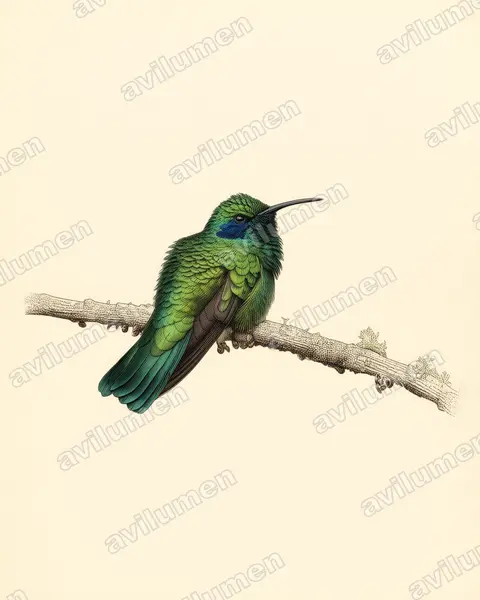
Vintage plate 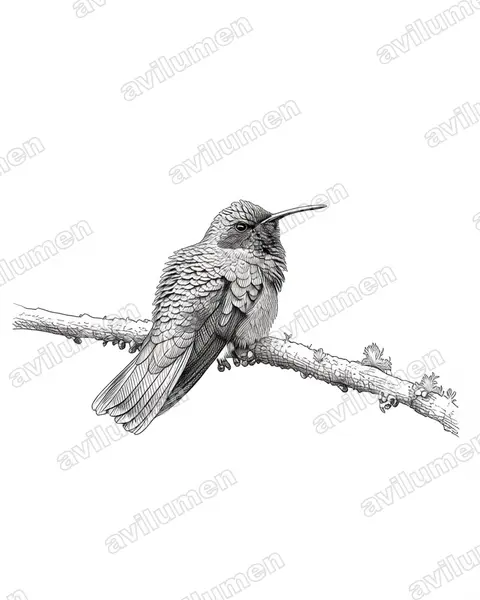
Ink 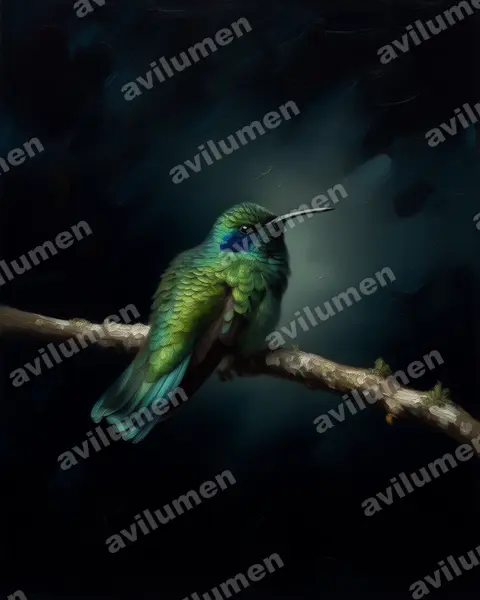
Oil 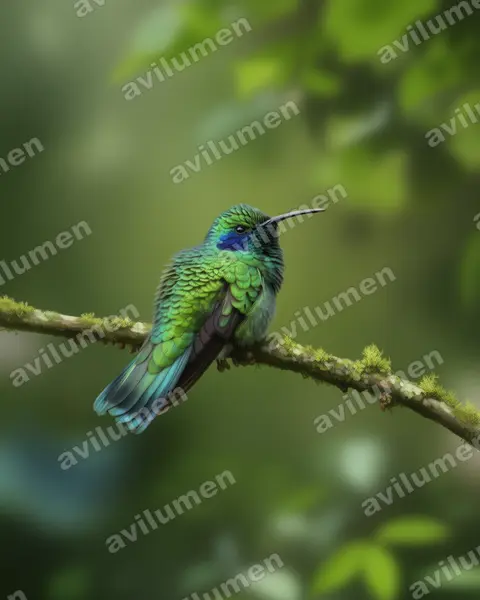
Realistic 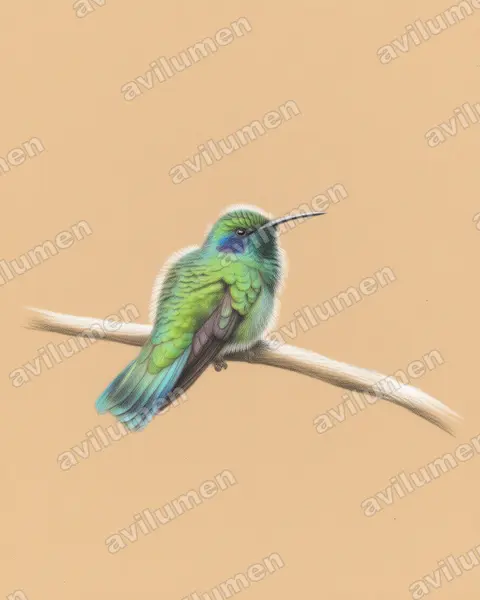
Colored pencil
Illustrations based on the photograph by Frank Vassen from Brussels, Belgium (CC BY 2.0), from Wikimedia Commons.
Digital editions
HD Digital Art Pack — Mexican violetear
Digital download: 6 high-resolution illustrations of the Mexican violetear (Colibri thalassinus), print-ready. This is a digital file; no animal or physical item is included.
AI Avatar — Mexican violetear
Generate an avatar fusing your face with the Mexican violetear (Colibri thalassinus). Delivered digitally in 8K, watermark-free. Digital product; no animals are sold or brokered.
Instant download. No live birds are sold.
Frequently asked questions
- Is Colibri thalassinus (Mexican violetear) endangered?
- The IUCN Red List places Colibri thalassinus, commonly known as the Mexican violetear, in the «Least concern» category. «Least concern» means it is not currently threatened.
- What family does Colibri thalassinus (Mexican violetear) belong to?
- Colibri thalassinus (Mexican violetear) belongs to the family Trochilidae, in the order Apodiformes.
- What colour is Colibri thalassinus (Mexican violetear)?
- The plumage of Colibri thalassinus (Mexican violetear) combines these colours: Green.
More from the same family
 Least concern
Emerald-chinned Hummingbird
Abeillia abeillei
The emerald-chinned hummingbird is a species of hummingbird in the "emeralds", tribe Trochilini of subfamily Trochilinae.
from $1.99
 Least concern
Speckled hummingbird
Adelomyia melanogenys
The speckled hummingbird is a species of hummingbird. It is the only member of the genus Adelomyia. It inhabits Neotropical montane cloud forests at elevations of 1,000–2,500 meters and is confined to the Andes of Argentina, Bolivia, Peru, Ecuador, Colombia and Venezuela; as well as to some isolated montane forests in western Ecuador and Venezuela.
from $1.99
 Vulnerable
Purple-backed sunbeam
Aglaeactis aliciae
The purple-backed sunbeam is a bird species in the family Trochilidae. It is found only in Peru.
from $1.99
 Near threatened
White-tufted sunbeam
Aglaeactis castelnaudii
The white-tufted sunbeam is a species of hummingbird in the family Trochilidae. It is found only in Peru. Its natural habitats are subtropical or tropical moist montane forest and subtropical or tropical high-altitude shrubland.
from $1.99