Blue-bellied Roller
Coracias cyanogaster
Avilumen editorial team ·

The blue-bellied roller is a member of the roller family of birds which breeds across Africa in a narrow belt from Senegal to northeast Democratic Republic of the Congo. It is resident, apart from some local seasonal movements, in mature moist savannah dominated by Isoberlinia trees.
The blue-bellied roller (Coracias cyanogaster) is a member of the roller family of birds which breeds across Africa in a narrow belt from Senegal to northeast Democratic Republic of the Congo. It is resident, apart from some local seasonal movements, in mature moist savannah dominated by Isoberlinia trees.
Taxonomy
The blue-bellied roller was given the binomial name Coracias cyanogaster in 1816 by the French naturalist Georges Cuvier based on "Le Rollier à ventre bleu" that had been described and illustrated by François Levaillant in 1806. The specific epithet combines the Ancient Greek kuanos meaning "dark-blue" with gastēr meaning "belly". Levaillant mistaken believed that the specimen had been collected on the island of Java. The species is resident in West-Africa and the type location was later designated as Senegal. The species is monotypic: no subspecies are recognised.
The phylogenetic relationships among the Coracias species are shown below, from the molecular study by Johansson et al. (2018)
Description
The blue-bellied roller is a large bird, nearly the size of a jackdaw at 28–30 cm (11–12 in). It has a very dark brown back, buffy or chalky white head, neck and breast, with the rest of the plumage mainly blue. Adults have 6 cm (2.4 in) tail streamers. Sexes are similar, but the juvenile is a drabber version of the adult.
The blue-bellied roller is striking in its strong direct flight, with the brilliant blues of the wings contrasting with the dark back and cream colored head, and the tail streamers trailing behind.
The call of blue-bellied roller is a harsh clicking ga-ga-ga sound.
Distribution and habitat
This is a common bird of warm open country with some trees. These rollers often perch prominently on trees, posts, or overhead wires, like giant shrikes, whilst watching for the grasshoppers and other large insects on which they feed.
Behaviour and ecology
The display of this bird is a lapwing-like display, with the twists and turns that give this species its English name. It nests in a hole in a tree - a tree cavity.
Status
Widespread and common throughout its large range, the blue-bellied roller is evaluated as Least Concern on the IUCN Red List of Threatened Species.
In captivity
The blue-bellied roller is kept in some zoos, open air aviaries and similar educational facilities. There are instances of the bird escaping captivity and adjusting to the local environment. In Nepalganj area of Joka, Kolkata, two blue-bellied rollers have been spotted since May 2023 that have adapted to the local environment.
Text adapted from Wikipedia · CC BY-SA 4.0
Where it lives
Taxonomy
- Order
- Coraciiformes
- Family
- Coraciidae
- Genus
- Coracias
- Conservation status
- Least concern
Listen to its call
No recording yet
Illustration gallery
6 illustrations of Coracias cyanogaster (Blue-bellied Roller) in different styles, true to its real plumage. Shown watermarked; the art pack includes the high-resolution originals, ready to print.
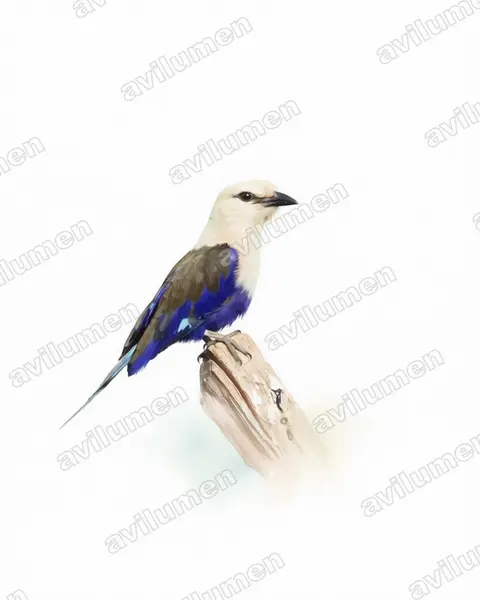
Watercolor 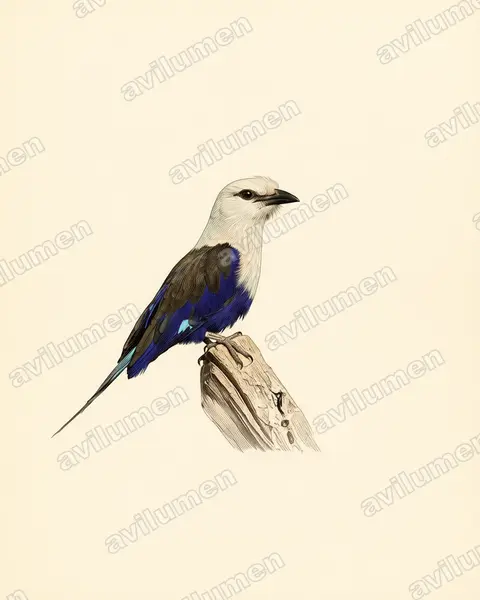
Vintage plate 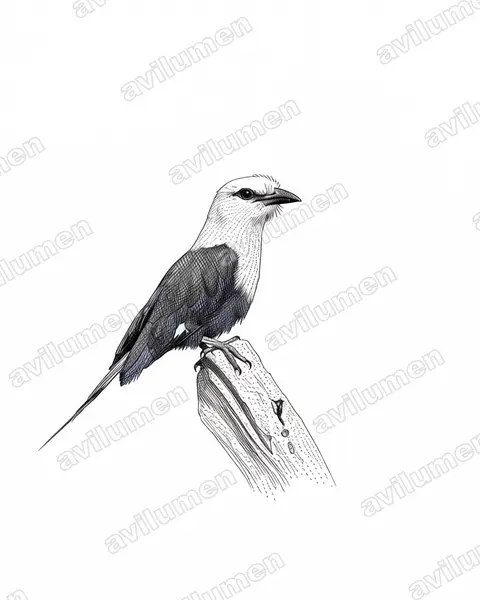
Ink 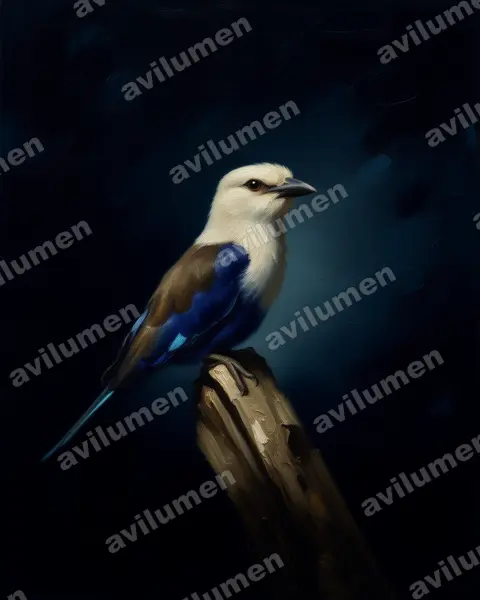
Oil 
Realistic 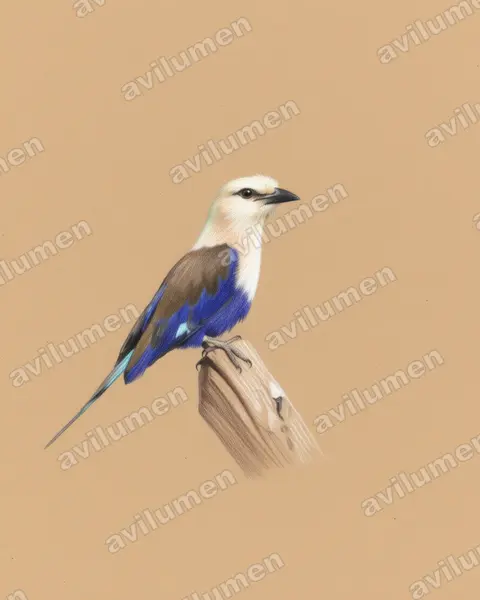
Colored pencil
Illustrations based on the photograph by gisela gerson lohman-braun (CC BY-SA 2.0), from Wikimedia Commons.
Digital editions
HD Digital Art Pack — Blue-bellied Roller
Digital download: 6 high-resolution illustrations of the Blue-bellied Roller (Coracias cyanogaster), print-ready. This is a digital file; no animal or physical item is included.
AI Avatar — Blue-bellied Roller
Generate an avatar fusing your face with the Blue-bellied Roller (Coracias cyanogaster). Delivered digitally in 8K, watermark-free. Digital product; no animals are sold or brokered.
Instant download. No live birds are sold.
Frequently asked questions
- Is Coracias cyanogaster (Blue-bellied Roller) endangered?
- The IUCN Red List places Coracias cyanogaster, commonly known as the Blue-bellied Roller, in the «Least concern» category. «Least concern» means it is not currently threatened.
- Where does Coracias cyanogaster (Blue-bellied Roller) live?
- Coracias cyanogaster (Blue-bellied Roller) is found in Africa and Burkina Faso.
- What family does Coracias cyanogaster (Blue-bellied Roller) belong to?
- Coracias cyanogaster (Blue-bellied Roller) belongs to the family Coraciidae, in the order Coraciiformes.
- What colour is Coracias cyanogaster (Blue-bellied Roller)?
- The plumage of Coracias cyanogaster (Blue-bellied Roller) combines these colours: Blue and Green.
More from the same family
 Least concern
Abyssinian Roller
Coracias abyssinicus
The Abyssinian roller, or Senegal roller, is a member of the roller family of birds which breeds across tropical Africa in a belt south of the Sahara, known as the Sahel. It is resident in the southern part of its range, but northern breeding populations are short-distance migrants, moving further south after the wet season.
from $1.99
 Least concern
Indian Roller
Coracias benghalensis
The Indian roller is a bird of the family Coraciidae. It is 30–34 cm (12–13 in) long with a wingspan of 65–74 cm (26–29 in) and weighs 166–176 g (5.9–6.2 oz). The face and throat are pinkish, the head and back are brown, with blue on the rump and contrasting light and dark blue on the wings and tail. The bright blue markings on the wing are prominent in flight. The sexes are similar in appearance.
from $1.99
 Least concern
Lilac-breasted Roller
Coracias caudatus
The lilac-breasted roller is an African bird of the roller family, Coraciidae. It is widely distributed in Southern and Eastern Africa, and is a vagrant to the southern Arabian Peninsula. It prefers open woodland and savanna, and it is for the most part absent from treeless places.
from $1.99
 Least concern
European Roller
Coracias garrulus
The European roller is the only member of the roller family Coraciidae breeding in Europe. Its range extends into the Maghreb, West Asia and Central Asia. It winters in southern Africa, primarily in dry wooded savanna and bushy plains. It occurs in a wide variety of habitats, but avoids treeless plains. It usually nests in tree holes.
from $1.99