Racket-tailed Roller
Coracias spatulatus
Avilumen editorial team ·

The racket-tailed roller is a species of bird in the family Coraciidae. It is found in southern Africa from Angola, south-eastern Democratic Republic of Congo and southern Tanzania to northern Botswana, Zimbabwe, Malawi and Mozambique.
The racket-tailed roller (Coracias spatulatus) is a species of bird in the family Coraciidae. It is found in southern Africa from Angola, south-eastern Democratic Republic of Congo and southern Tanzania to northern Botswana, Zimbabwe, Malawi and Mozambique.
Taxonomy and systematics
The racket-tailed roller was formally described in 1880 by the naturalist Roland Trimen under its current binomial name Coracias spatulatus from a specimen collected near the Zambezi River in southern Africa. The specific epithet spatulatus is Modern Latin meaning "spatulate" or "spoon-shaped". The species is monotypic: no subspecies are recognised. A molecular phylogenetic study published in 2018 found that the racket-tailed roller was most closely related to the purple roller (Coracias naevius).
The phylogenetic relationships among the Coracias species are shown below, from the molecular study by Johansson et al. (2018)
Alternate names for the racket-tailed roller include the Angola racket-tailed roller and Weigall's roller.
Description
The racket-tailed roller is so named for the conspicuous elongated outer feathers on its tail which have long streamers ending in paddle-shaped tips. The bird is 28 to 30 cm (11 to 12 in) long with the streamers extending another 8 cm (3 in). The forehead and superciliary streak are white, the crown dull green, the back rufous and the tail blue. The underparts are pale blue with whitish streaking. In flight, the purple upper wing with its azure-blue stripe can be seen. The under wing is pale blue with a purplish-black trailing edge and tip. The bird somewhat resembles the European roller (Coracias garrulus) and the lilac-breasted roller (Coracias caudatus), but those species lack the distinctive tail streamers. The beak is black, the eye brownish and the legs are dull yellowish. The juvenile is similar to the adult but less vivid, and lacks the attenuated tail feathers. The voice is a harsh guttural shriek, uttered as it swoops down.
Behaviour and ecology
Similar to other members of Coracias, this species hunts for prey from a perch in the mid-storey region of woodland. When it spots something edible on the forest floor it swoops down to grab the prey. The diet consists mainly of grasshoppers, beetles, insect larvae, scorpions and small lizards. This roller is usually a solitary bird or occurs in pairs, but may form small groups of six or seven birds. It is a territorial species, driving away intruders by rocketing from a height with a raucous screech, rolling from side to side as it levels off, before using its momentum to rise to a perch. It nests in a cavity in a tree trunk or branch about 7 m (23 ft) off the ground, often using a disused nest of a woodpecker or barbet. The clutch is laid in the unlined cavity and usually consists of three or four eggs, but little is known of the nesting habits of this species.
Status
The racket-tailed roller is a fairly common species with a very wide range. The population trend is thought to be declining because of loss of the forest habitat, especially miombo and mopane woodland. However, no particular threats have been identified and the International Union for Conservation of Nature has assessed the bird's conservation status as being of "least concern".
Text adapted from Wikipedia · CC BY-SA 4.0
Taxonomy
- Order
- Coraciiformes
- Family
- Coraciidae
- Genus
- Coracias
- Conservation status
- Least concern
Listen to its call
No recording yet
Illustration gallery
6 illustrations of Coracias spatulatus (Racket-tailed Roller) in different styles, true to its real plumage. Shown watermarked; the art pack includes the high-resolution originals, ready to print.
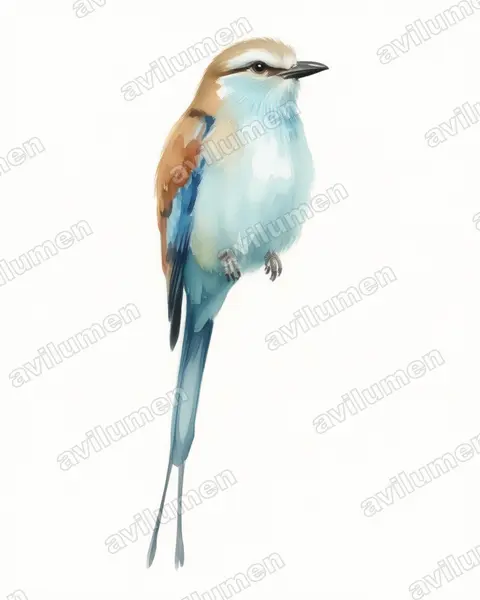
Watercolor 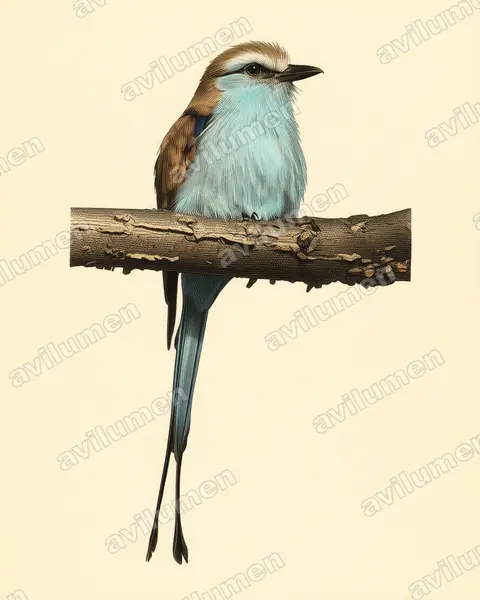
Vintage plate 
Ink 
Oil 
Realistic 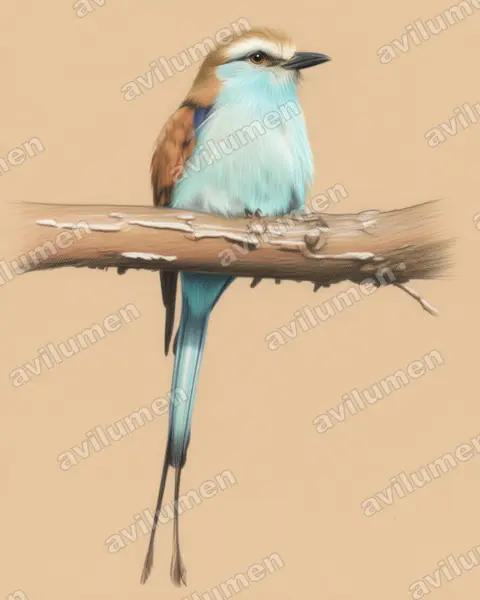
Colored pencil
Illustrations based on the photograph by Patrick Coin (Patrick Coin) (CC BY-SA 2.5), from Wikimedia Commons.
Digital editions
HD Digital Art Pack — Racket-tailed Roller
Digital download: 6 high-resolution illustrations of the Racket-tailed Roller (Coracias spatulatus), print-ready. This is a digital file; no animal or physical item is included.
AI Avatar — Racket-tailed Roller
Generate an avatar fusing your face with the Racket-tailed Roller (Coracias spatulatus). Delivered digitally in 8K, watermark-free. Digital product; no animals are sold or brokered.
Instant download. No live birds are sold.
Frequently asked questions
- Is Coracias spatulatus (Racket-tailed Roller) endangered?
- The IUCN Red List places Coracias spatulatus, commonly known as the Racket-tailed Roller, in the «Least concern» category. «Least concern» means it is not currently threatened.
- Where does Coracias spatulatus (Racket-tailed Roller) live?
- Coracias spatulatus (Racket-tailed Roller) is found in Africa.
- What family does Coracias spatulatus (Racket-tailed Roller) belong to?
- Coracias spatulatus (Racket-tailed Roller) belongs to the family Coraciidae, in the order Coraciiformes.
- What colour is Coracias spatulatus (Racket-tailed Roller)?
- The plumage of Coracias spatulatus (Racket-tailed Roller) combines these colours: Blue and Green.
More from the same family
 Least concern
Abyssinian Roller
Coracias abyssinicus
The Abyssinian roller, or Senegal roller, is a member of the roller family of birds which breeds across tropical Africa in a belt south of the Sahara, known as the Sahel. It is resident in the southern part of its range, but northern breeding populations are short-distance migrants, moving further south after the wet season.
from $1.99
 Least concern
Indian Roller
Coracias benghalensis
The Indian roller is a bird of the family Coraciidae. It is 30–34 cm (12–13 in) long with a wingspan of 65–74 cm (26–29 in) and weighs 166–176 g (5.9–6.2 oz). The face and throat are pinkish, the head and back are brown, with blue on the rump and contrasting light and dark blue on the wings and tail. The bright blue markings on the wing are prominent in flight. The sexes are similar in appearance.
from $1.99
 Least concern
Lilac-breasted Roller
Coracias caudatus
The lilac-breasted roller is an African bird of the roller family, Coraciidae. It is widely distributed in Southern and Eastern Africa, and is a vagrant to the southern Arabian Peninsula. It prefers open woodland and savanna, and it is for the most part absent from treeless places.
from $1.99
 Least concern
Blue-bellied Roller
Coracias cyanogaster
The blue-bellied roller is a member of the roller family of birds which breeds across Africa in a narrow belt from Senegal to northeast Democratic Republic of the Congo. It is resident, apart from some local seasonal movements, in mature moist savannah dominated by Isoberlinia trees.
from $1.99