Turquoise-crowned hummingbird
Cynanthus doubledayi
Avilumen editorial team ·

The turquoise-crowned hummingbird or Doubleday's hummingbird is a species of hummingbird in the "emeralds", tribe Trochilini of subfamily Trochilinae. It is endemic to Mexico.
The turquoise-crowned hummingbird or Doubleday's hummingbird (Cynanthus doubledayi) is a species of hummingbird in the "emeralds", tribe Trochilini of subfamily Trochilinae. It is endemic to Mexico.
Taxonomy and systematics
The International Ornithological Committee (IOC), the Clements taxonomy, and BirdLife International's Handbook of the Birds of the World consider the turquoise-crowned hummingbird to be a species.
The turquoise-crowned hummingbird is monotypic: no subspecies are recognised.
Description
The Cornell Lab of Ornithology's Birds of the World does not describe the turquoise-crowned hummingbird separately from the broad-billed hummingbird. The following is a Google translation of the original description's French:
"Male adult: straight beak, dilated at its base, white, and black at its extremity; round head; green cap, very brilliante has azure reflections; neck, scapular, back, cover caudal fin glossy dark green; throat, front and sides of the neck, ėpi-gastre covered with shiny bright blue scaly feathers, abdomen less blue and green on the sides; downy anal region White; slightly curved grey-black wings; cordate [notched] tail with wide and rounded rectrices, black-blue, the 4 middle ones ashy at their ends; bare black legs."
The Birds of the World account of the broad-billed hummingbird includes that the male turquoise-crowned hummingbird weighs about 2.4 g (0.085 oz).
Distribution and habitat
The turquoise-crowned hummingbird is found in the southern Mexican states of Guerrero, Oaxaca, and Chiapas. It inhabits a variety of landscapes including arid thorn, tropical deciduous, gallery, and secondary forests. It occasionally occurs in pine-oak woodlands and grassy slopes. In elevation it generally ranges from sea level to 2,200 m (7,200 ft) but occurs as high as 3,000 m (9,800 ft).
Movement
The turquoise-crowned hummingbird is a year-round resident throughout its range.
Food and feeding
The diet of the turquoise-crowned hummingbird is not separately described from that of the broad-billed hummingbird. In general, and like most hummingbirds, that species feeds on a wide variety of flowering plants and also small arthropods. The turquoise-crowned hummingbird is described as trap-lining for nectar in gallery forest.
Breeding
The turquoise-crowned hummingbird appears to nest throughout the year; its peak season is unknown. Other information on its breeding phenology is not separated in the Birds of the World account.
Vocalization
The turquoise-crowned hummingbird's vocalizations have not been separately described from those of the broad-billed hummingbird. That species' song, sung only by males, "[b]egins with short chip note, then a series of similar notes ranging in frequency from 2 to 13 kHz."
Status
The IUCN has assessed the turquoise-crowned hummingbird as being of Least Concern. Though its population size is not known it is believed to be stable. No specific threats have been identified. "Resident populations of broad-billed hummingbird in Mexico might...be impacted by habitat loss, but this has not been studied."
Text adapted from Wikipedia · CC BY-SA 4.0
Plumage colours
Distribution

Taxonomy
- Order
- Apodiformes
- Family
- Trochilidae
- Genus
- Cynanthus
- Conservation status
- Least concern
Listen to its call
No recording yet
Illustration gallery
6 illustrations of Cynanthus doubledayi (Turquoise-crowned hummingbird) in different styles, true to its real plumage. Shown watermarked; the art pack includes the high-resolution originals, ready to print.
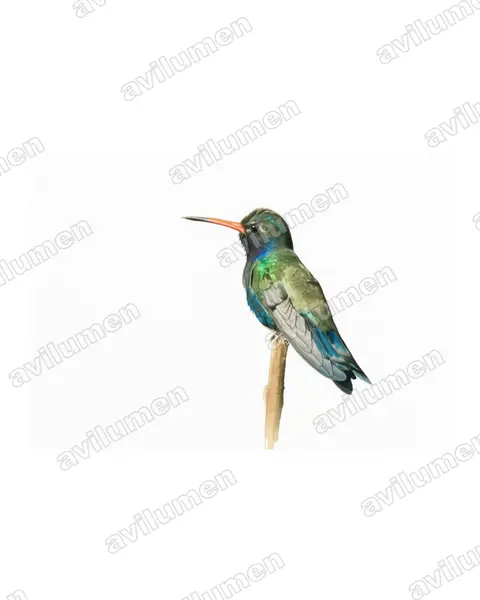
Watercolor 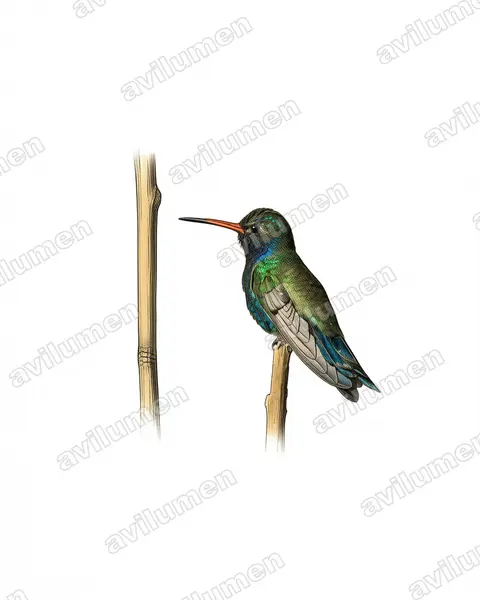
Vintage plate 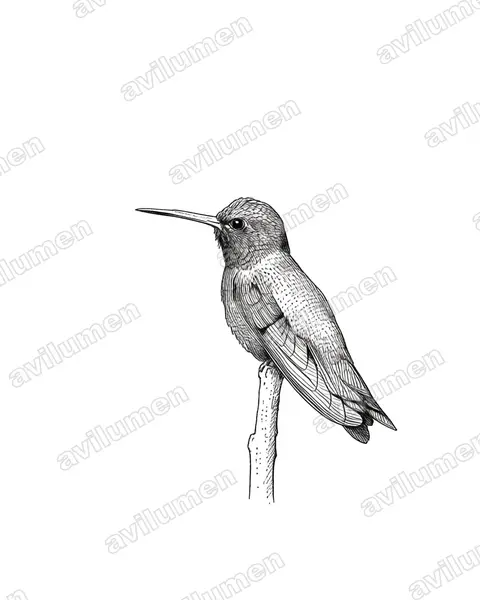
Ink 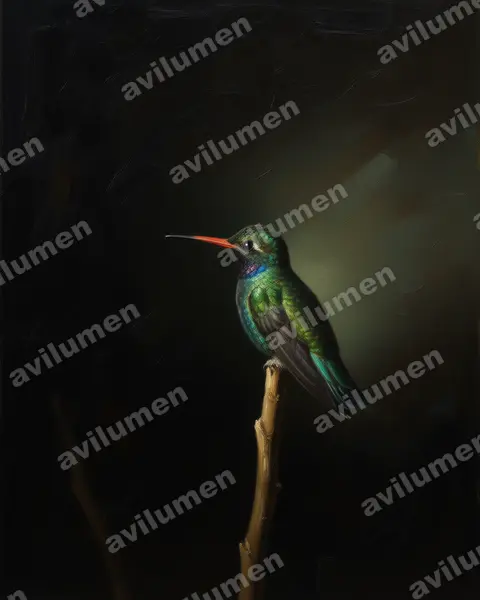
Oil 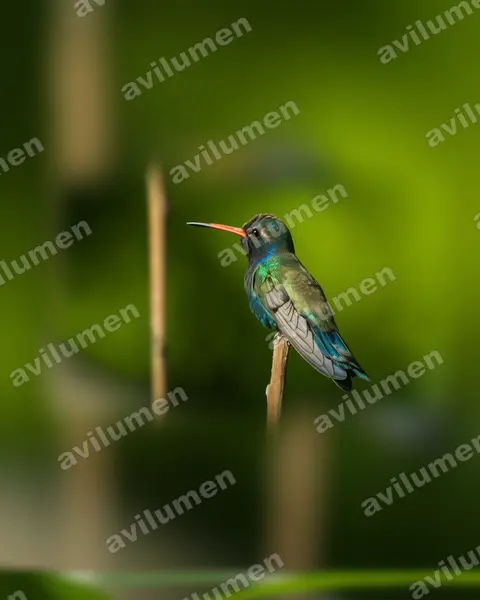
Realistic 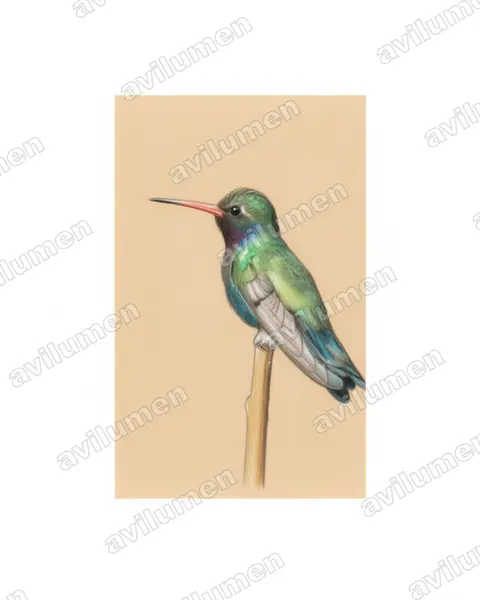
Colored pencil
Illustrations based on the photograph by Francesco Veronesi from Italy (CC BY-SA 2.0), from Wikimedia Commons.
Digital editions
HD Digital Art Pack — Turquoise-crowned hummingbird
Digital download: 6 high-resolution illustrations of the Turquoise-crowned hummingbird (Cynanthus doubledayi), print-ready. This is a digital file; no animal or physical item is included.
AI Avatar — Turquoise-crowned hummingbird
Generate an avatar fusing your face with the Turquoise-crowned hummingbird (Cynanthus doubledayi). Delivered digitally in 8K, watermark-free. Digital product; no animals are sold or brokered.
Instant download. No live birds are sold.
Frequently asked questions
- Is Cynanthus doubledayi (Turquoise-crowned hummingbird) endangered?
- The IUCN Red List places Cynanthus doubledayi, commonly known as the Turquoise-crowned hummingbird, in the «Least concern» category. «Least concern» means it is not currently threatened.
- What family does Cynanthus doubledayi (Turquoise-crowned hummingbird) belong to?
- Cynanthus doubledayi (Turquoise-crowned hummingbird) belongs to the family Trochilidae, in the order Apodiformes.
- What colour is Cynanthus doubledayi (Turquoise-crowned hummingbird)?
- The plumage of Cynanthus doubledayi (Turquoise-crowned hummingbird) combines these colours: Green.
More from the same family
 Least concern
Emerald-chinned Hummingbird
Abeillia abeillei
The emerald-chinned hummingbird is a species of hummingbird in the "emeralds", tribe Trochilini of subfamily Trochilinae.
from $1.99
 Least concern
Speckled hummingbird
Adelomyia melanogenys
The speckled hummingbird is a species of hummingbird. It is the only member of the genus Adelomyia. It inhabits Neotropical montane cloud forests at elevations of 1,000–2,500 meters and is confined to the Andes of Argentina, Bolivia, Peru, Ecuador, Colombia and Venezuela; as well as to some isolated montane forests in western Ecuador and Venezuela.
from $1.99
 Vulnerable
Purple-backed sunbeam
Aglaeactis aliciae
The purple-backed sunbeam is a bird species in the family Trochilidae. It is found only in Peru.
from $1.99
 Near threatened
White-tufted sunbeam
Aglaeactis castelnaudii
The white-tufted sunbeam is a species of hummingbird in the family Trochilidae. It is found only in Peru. Its natural habitats are subtropical or tropical moist montane forest and subtropical or tropical high-altitude shrubland.
from $1.99