Shovel-billed Kookaburra
Dacelo rex
Avilumen editorial team ·

The shovel-billed kookaburra, also known as the shovel-billed kingfisher, is a large, approximately 33 cm (13 in) long, dark brown tree kingfisher with a heavy, short, and broad bill that is unique among the kingfishers. It has a dark head with a rufous stripe behind the eyes, a white throat, a rufous neck collar and underparts, a bright blue rump, brown iris, brownish-black bill with paler mandible, and pale feet.
The shovel-billed kookaburra (Dacelo rex), also known as the shovel-billed kingfisher, is a large, approximately 33 cm (13 in) long, dark brown tree kingfisher with a heavy, short, and broad bill that is unique among the kingfishers. It has a dark head with a rufous (reddish/brown or rust coloured) stripe behind the eyes, a white throat, a rufous neck collar and underparts, a bright blue rump, brown iris, brownish-black bill with paler mandible (entire bill often appears brownish due to earth), and pale feet. Both sexes are similar in appearance, but are easily recognized from the colour of the tail. The male has a dark bluish tail while female's is rufous. The juvenile has a female-like plumage with scale-patterned feathers.
Formerly considered the sole representative of the genus Clytoceyx, a molecular phylogenetic study published in 2017 found that the shovel-billed kookaburra nested with the kookaburras in the genus Dacelo. It was reclassified into Dacelo by the International Ornithological Congress in 2023.
The shovel-billed kookaburra is endemic to New Guinea. No subspecies are recognised because the differences in plumage between the races imperator and septentrionalis is small. It primarily occurs in hill forests, but has been recorded from sea-level up to an altitude of 2400 m (7850 ft). The shovel-billed kookaburra finds its food in mud or on moist ground. The diet consists mainly of earthworms, snails, beetles, lizards, and insects. It is inconspicuous and infrequently seen. It is likely that it is partially crepuscular.
Widespread but uncommon throughout a large part of New Guinea, the shovel-billed kookaburra has a wide range and no special threats have been identified, so the bird is evaluated as being of Least Concern on the IUCN Red List of Threatened Species.
Text adapted from Wikipedia · CC BY-SA 4.0
Taxonomy
- Order
- Coraciiformes
- Family
- Alcedinidae
- Genus
- Dacelo
- Conservation status
- Least concern
Listen to its call
No recording yet
Illustration gallery
6 illustrations of Dacelo rex (Shovel-billed Kookaburra) in different styles, true to its real plumage. Shown watermarked; the art pack includes the high-resolution originals, ready to print.
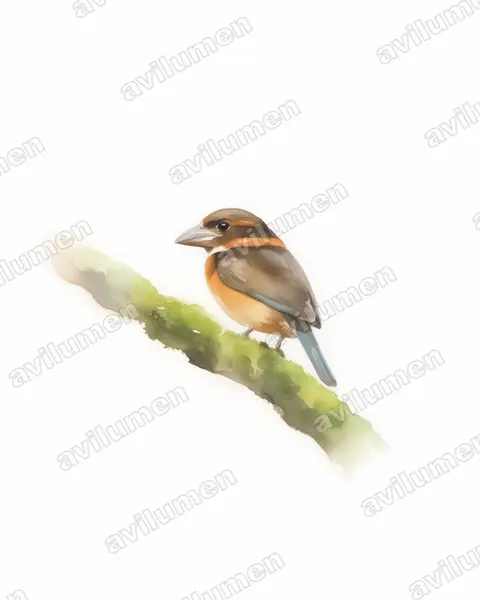
Watercolor 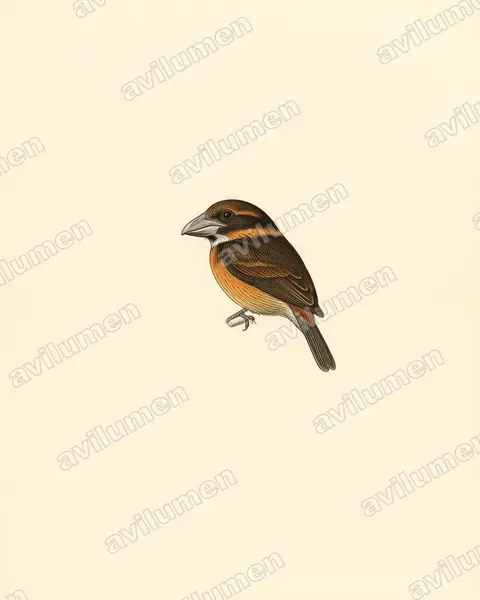
Vintage plate 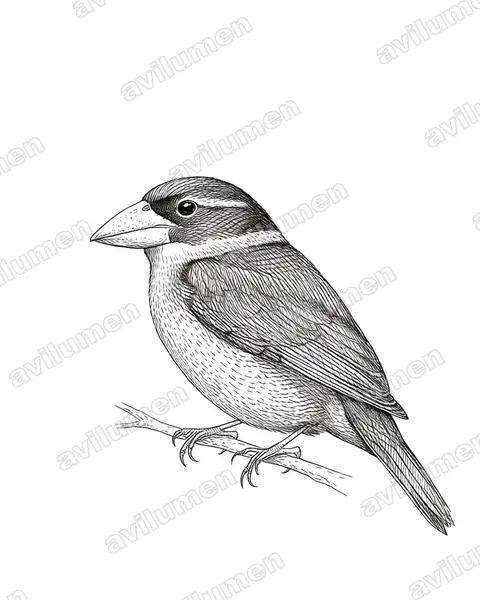
Ink 
Oil 
Realistic 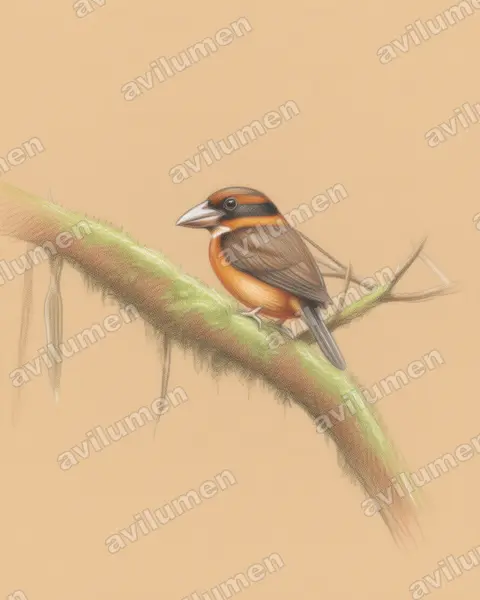
Colored pencil
Illustrations based on the photograph by markaharper1 (CC BY-SA 2.0), from Wikimedia Commons.
Digital editions
HD Digital Art Pack — Shovel-billed Kookaburra
Digital download: 6 high-resolution illustrations of the Shovel-billed Kookaburra (Dacelo rex), print-ready. This is a digital file; no animal or physical item is included.
AI Avatar — Shovel-billed Kookaburra
Generate an avatar fusing your face with the Shovel-billed Kookaburra (Dacelo rex). Delivered digitally in 8K, watermark-free. Digital product; no animals are sold or brokered.
Instant download. No live birds are sold.
Frequently asked questions
- Is Dacelo rex (Shovel-billed Kookaburra) endangered?
- The IUCN Red List places Dacelo rex, commonly known as the Shovel-billed Kookaburra, in the «Least concern» category. «Least concern» means it is not currently threatened.
- What family does Dacelo rex (Shovel-billed Kookaburra) belong to?
- Dacelo rex (Shovel-billed Kookaburra) belongs to the family Alcedinidae, in the order Coraciiformes.
- What colour is Dacelo rex (Shovel-billed Kookaburra)?
- The plumage of Dacelo rex (Shovel-billed Kookaburra) combines these colours: Brown and Blue.
More from the same family
 Least concern
Moustached Kingfisher
Actenoides bougainvillei
The moustached kingfisher, also called Bougainville moustached kingfisher, is a species of bird in the family Alcedinidae. It is endemic to Bougainville Island in Papua New Guinea. An estimated 1,300–7,000 mature individuals are left.
from $1.99
 Near threatened
Rufous-collared Kingfisher
Actenoides concretus
The rufous-collared kingfisher is a species of bird in the family Alcedinidae. It is found in Brunei, Indonesia, Malaysia, Myanmar, and Thailand. Its natural habitats are subtropical or tropical moist lowland forest and subtropical or tropical moist montane forest. It is threatened by habitat loss.
from $1.99
 Least concern
Hombron's Kingfisher
Actenoides hombroni
The blue-capped kingfisher, also known as Hombron's kingfisher, is a species of bird in the family Alcedinidae endemic to the Philippines and found only on Mindanao. It is one of the most colorful kingfishers in the country having a dark blue cap and wings with rufous spots, a striped rufous belly, white chin and red bill.
from $1.99
 Least concern
Spotted Wood Kingfisher
Actenoides lindsayi
The spotted wood kingfisher or spotted kingfisher is a species of bird in the family Alcedinidae. It is endemic to the Philippines found on the islands of Luzon, Catanduanes, Marinduque, Negros and Panay where its natural habitat is tropical moist lowland forests.
from $1.99