Wilson's bird-of-paradise
Diphyllodes respublica
Avilumen editorial team ·

Wilson's bird-of-paradise is a species of passerine bird of the family Paradisaeidae.
Wilson's bird-of-paradise (Diphyllodes respublica) is a species of passerine bird of the family Paradisaeidae.
The first footage of the Wilson's bird-of-paradise ever to be filmed was recorded in 1996 by David Attenborough for the BBC documentary Attenborough in Paradise. He did so by dropping leaves on the forest floor, which irritated the bird into clearing them away.
Nomenclature
The controversial scientific name respublica of this species was given by Charles Lucien Bonaparte, Napoleon's nephew and a republican idealist. The habit of zoologists at that time to dedicate newly discovered species to some king, queen, or aristocrat deeply irritated him. In order to assert his convictions, he chose to name this species respublica to honour the republic and not the royalty.
Charles Lucien Bonaparte described the bird from a badly damaged trade specimen purchased by British ornithologist Edward Wilson. In doing so, he beat John Cassin, who wanted to name the bird in honour of Wilson, by several months. Thirteen years later, in 1863, the German zoologist Heinrich Agathon Bernstein discovered the home grounds of the Wilson's bird-of-paradise on Waigeo Island.
Distribution
An Indonesian endemic, the Wilson's bird-of-paradise is distributed to the hill and lowland rainforests of Waigeo and Batanta Islands off West Papua.
Due to ongoing habitat loss, limited range, and exploitation, the Wilson's bird-of-paradise is evaluated as Near Threatened on the IUCN Red List of Threatened Species. It is listed in Appendix II of the Convention on International Trade in Endangered Species of Wild Fauna and Flora (CITES).
Habitat
Its preferred habitat is the hill forest at 300 m of altitude, more rarely the lowland rainforest and the middle mountain forest.
Description
Wilson's bird-of-paradise is rather small. Males can reach a length of 16 centimetres (6.3 in) (21 cm including central rectrices) and a weight of 53–67 g., while females can reach a length of 16 cm, but a weight of 52–60 g. The male is a red and black bird-of-paradise, with a yellow mantle on its neck, light green mouth, rich blue feet, and two curved violet tail feathers. The head is naked blue, with a black double cross pattern on it. The female is a brownish bird with a bare blue crown.
In the field, the blue bare skin on the crown of the bird's head is so vivid that it is clearly visible by night; the deep scarlet back and velvet green breast are lush, the curlicue tail gleaming bright silver.
Diet
Their diet consists of fruits, insects, arthropods, and other small invertebrates.
Rituals of seduction
Males of this species clear an area of rainforest to create a 'display court'. Here, they perform an elaborate mating dance to impress a potential mate. The male usually exhibits its breast shield and accompanies the mating dance with vocalizations described as "squeaky twittering interspersed with guttural notes."
Courtship behavior
Male Wilson's birds-of-paradise are the most colorful of all the species within the family, possessing a veritable rainbow of color. This remarkable example of hue and iridescence possesses all of the primary colors (and more) in different ways. The baby blue hue of its head is skin, not feathers, and is the result of structural color absent in any other member of birds-of-paradise. Yellow on the nape of its neck, followed by the crimson on its back are consistent, pigmented colors, present year-round. Its quirky, "handlebar-mustache-shaped" tail feathers are brilliantly iridescent, reflecting light to produce intense color to the eye of the beholder.
The sexual dimorphism of the species leaves the female very drab in comparison. Sexual dimorphism, or the difference in physical appearance between the sexes, is the result of female selection, in which females select males based upon indirect genetic benefits which increase offspring fitness. Because this species is polygynous, where one male mates with multiple females, the female is left on her own to raise young, forcing her to assess these indirect genetic benefits through courtship rituals, details of which are in the following section.
Dance
While these birds are difficult to locate in the wild and have not been studied in-depth, footage of the few mating rituals that have been witnessed for this species tells all. This species territorially defends a "court" in which it performs its vocalizations and physical maneuvers. Males will continually work to keep this area free of debris, making sure that nothing on the ground will distract from their displays. Males will perch on a vertical branch in the middle of their court, flexing their brilliant green fluorescent collar and calling out to females to attract them to their site. Females who are interested will perch above the male on the branch and watch as he weaves back and forth, calling to her and flexing the fluorescent collar. From the female's perspective, the male appears to be a brilliant green disc as he displays, and he will display his fluorescent inner mouth for additional coloration. This phenomenal display of color demonstrates the power of female sexual selection over male appearance and behavior in the animal kingdom.
Text adapted from Wikipedia · CC BY-SA 4.0
Plumage colours
Taxonomy
- Order
- Passeriformes
- Family
- Paradisaeidae
- Genus
- Diphyllodes
- Conservation status
- Not evaluated
Listen to its call
No recording yet
Illustration gallery
6 illustrations of Diphyllodes respublica (Wilson's bird-of-paradise) in different styles, true to its real plumage. Shown watermarked; the art pack includes the high-resolution originals, ready to print.
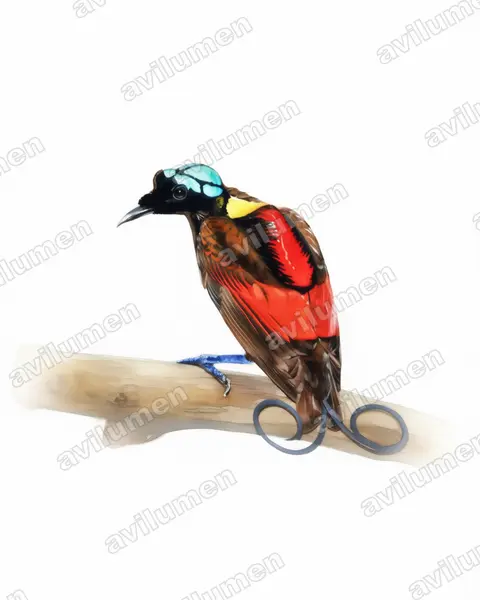
Watercolor 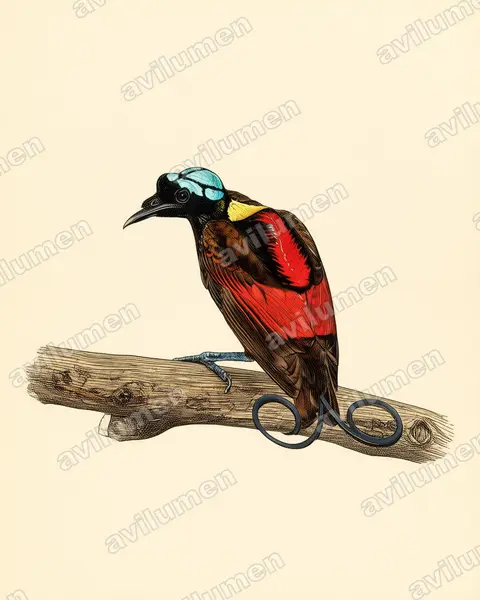
Vintage plate 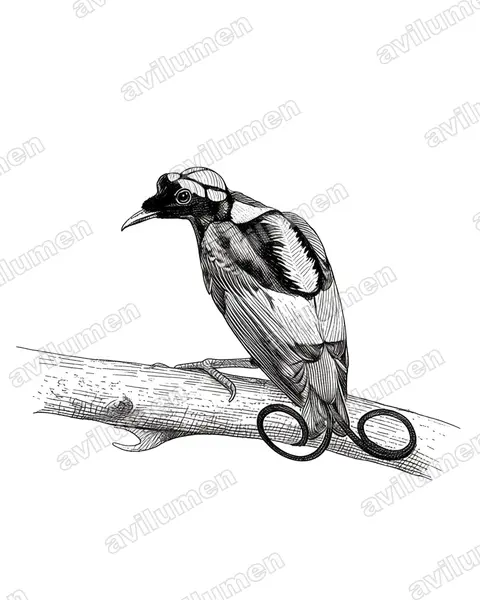
Ink 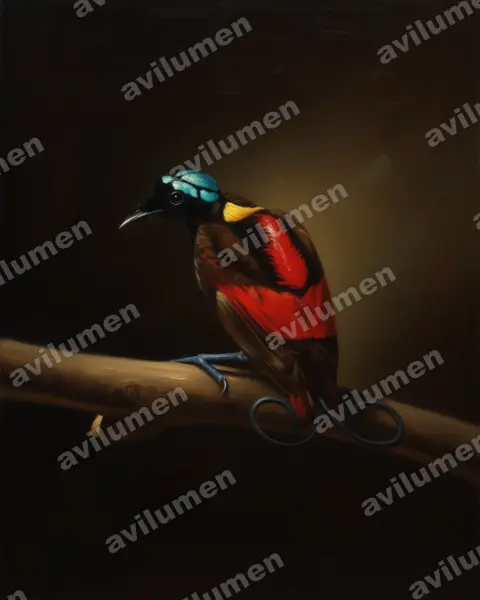
Oil 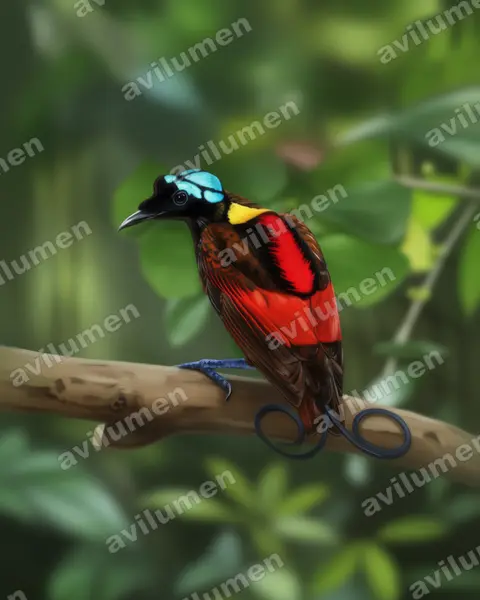
Realistic 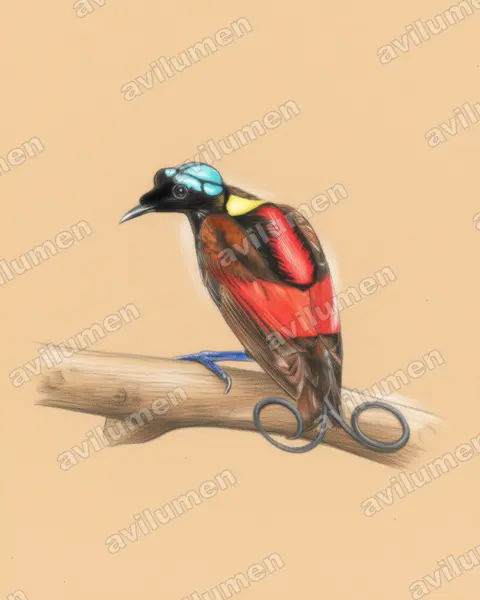
Colored pencil
Illustrations based on the photograph by Serhanoksay (CC BY-SA 3.0), from Wikimedia Commons.
Digital editions
HD Digital Art Pack — Wilson's bird-of-paradise
Digital download: 6 high-resolution illustrations of the Wilson's bird-of-paradise (Diphyllodes respublica), print-ready. This is a digital file; no animal or physical item is included.
AI Avatar — Wilson's bird-of-paradise
Generate an avatar fusing your face with the Wilson's bird-of-paradise (Diphyllodes respublica). Delivered digitally in 8K, watermark-free. Digital product; no animals are sold or brokered.
Instant download. No live birds are sold.
Frequently asked questions
- Is Diphyllodes respublica (Wilson's bird-of-paradise) endangered?
- The IUCN Red List places Diphyllodes respublica, commonly known as the Wilson's bird-of-paradise, in the «Not evaluated» category. «Not evaluated» means the IUCN has not yet assessed this species.
- What family does Diphyllodes respublica (Wilson's bird-of-paradise) belong to?
- Diphyllodes respublica (Wilson's bird-of-paradise) belongs to the family Paradisaeidae, in the order Passeriformes.
- What colour is Diphyllodes respublica (Wilson's bird-of-paradise)?
- The plumage of Diphyllodes respublica (Wilson's bird-of-paradise) combines these colours: Multicoloured.
More from the same family
 Least concern
Ribbon-tailed Astrapia
Astrapia mayeri
The ribbon-tailed astrapia, also known as Shaw Mayer's astrapia, is a species of bird-of-paradise.
from $1.99
 Least concern
Arfak astrapia
Astrapia nigra
The Arfak astrapia is a species of astrapia, a group of birds found in the birds-of-paradise family Paradiseidae.
from $1.99
 Least concern
Huon Astrapia
Astrapia rothschildi
The Huon astrapia, also known as Rothschild's astrapia, Huon bird-of-paradise, or Lord Rothschild's bird-of-paradise, is a species of bird-of-paradise belonging to the genus Astrapia. Like most of its congeners, A. rothschildi is a rather elusive member of its genus and family.
from $1.99
 Least concern
Splendid Astrapia
Astrapia splendidissima
The splendid astrapia is a species of bird in the family Paradisaeidae, native to the montane forests of New Guinea. Males are known for their iridescent plumage and elaborate courtship displays, including branch-hopping, tail-flicking, and frog-like calls; they may also display in leks.
from $1.99