Oaxaca hummingbird
Eupherusa cyanophrys
Avilumen editorial team ·

The Oaxaca hummingbird or blue-capped hummingbird is an endangered species of hummingbird in the "emeralds", tribe Trochilini of subfamily Trochilinae. It is endemic to the Mexican state of Oaxaca.
The Oaxaca hummingbird or blue-capped hummingbird (Eupherusa cyanophrys) is an endangered species of hummingbird in the "emeralds", tribe Trochilini of subfamily Trochilinae. It is endemic to the Mexican state of Oaxaca.
Taxonomy and systematics
The Oaxaca hummingbird is monotypic. At times some authors have treated it as a subspecies of the white-tailed hummingbird (E. poliocerca) and others have treated both of them as subspecies of the stripe-tailed hummingbird (E. eximia).
Description
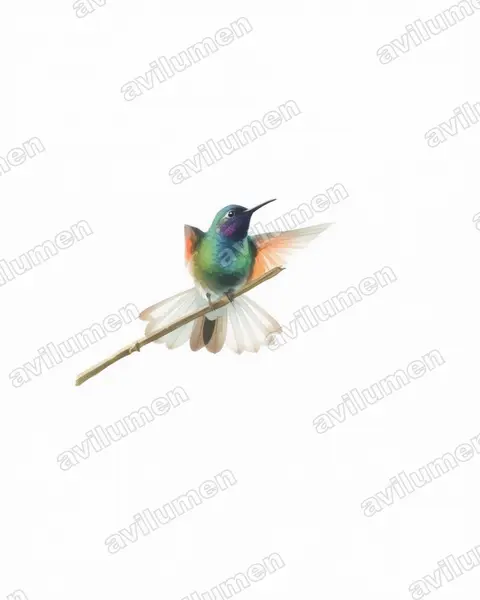
The Oaxaca hummingbird is 10 to 11 cm (3.9 to 4.3 in) long and weighs 4.1 to 5.4 g (0.14 to 0.19 oz). Both sexes have a straight black bill. Males have a violet-blue forehead, turquoise crown, and emerald green upperparts. Rufous secondaries show as a patch on the folded wing. Their central pair of tail feathers are green and the other four pairs whitish. Their underparts are glittering green with white undertail coverts. Females have green upperparts with a similar wing "patch" as the male's. Their central tail feathers are green and the others white with some dusky green. Their underparts are pale gray.
Distribution and habitat
The Oaxaca hummingbird is found only on the Pacific slope of the Sierra Madre del Sur (also called Sierra de Miahuatlán) in southern Oaxaca. It inhabits the edges and interior of humid montane, semi-deciduous, and pine-oak forest. In elevation it ranges between 700 and 2,600 m (2,300 and 8,500 ft) and is most common below 1,800 m (5,900 ft).
Movement
The Oaxaca hummingbird's movements are not well known, but it might make seasonal elevational changes.
Feeding
The Oaxaca hummingbird forages for nectar at all levels of the forest from the understory to the canopy. Its diet has not been described in detail but it is known to feed at flowers of Inga, Lobelia, Malvaviscus, and Psittacanthus and some others. It is also assumed to feed on small arthropods like other hummingbirds.
Breeding
Little is known about the Oaxaca hummingbird's breeding phenology. Active nests have been found in May, October, and November. They were cups made of moss lined with plant down with lichen on the outside and placed between 1.2 and 5.4 m (4 and 20 ft) above the ground. The clutch size is two eggs; the incubation length and time to fledging are not known.
Vocalization
The Oaxaca hummingbird's song is "a high, rapid, warbling" described as similar to that of the white-tailed hummingbird but "jerkier, less hurried". Its calls are not well known but also appear similar to the white-tailed's "liquid to slightly buzzy, rolled chip".
Status
The IUCN originally assessed the Oaxaca hummingbird as Threatened but since 1994 has rated it Endangered. It has a very small range and its estimated population of 600 to 1700 mature individuals is believed to be decreasing. A large part of the forest in its range has been destroyed and much of the rest is being cleared for agriculture. It is, however, considered fairly common to common where its habitat remains undisturbed.
Text adapted from Wikipedia · CC BY-SA 4.0
Distribution

Taxonomy
- Order
- Apodiformes
- Family
- Trochilidae
- Genus
- Eupherusa
- Conservation status
- Endangered
Listen to its call
No recording yet
Illustration gallery
6 illustrations of Eupherusa cyanophrys (Oaxaca hummingbird) in different styles, true to its real plumage. Shown watermarked; the art pack includes the high-resolution originals, ready to print.
Watercolor 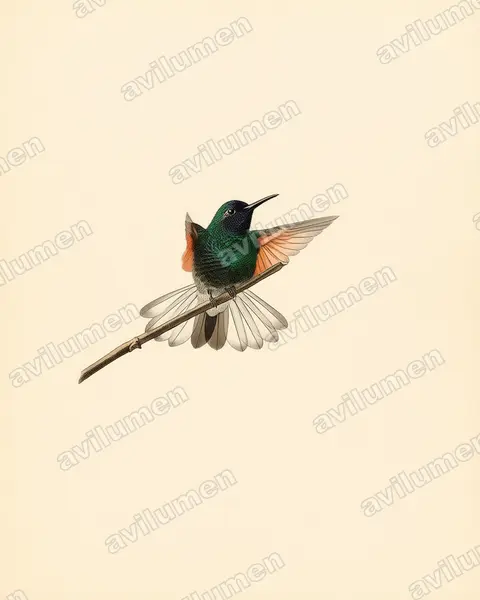
Vintage plate 
Ink 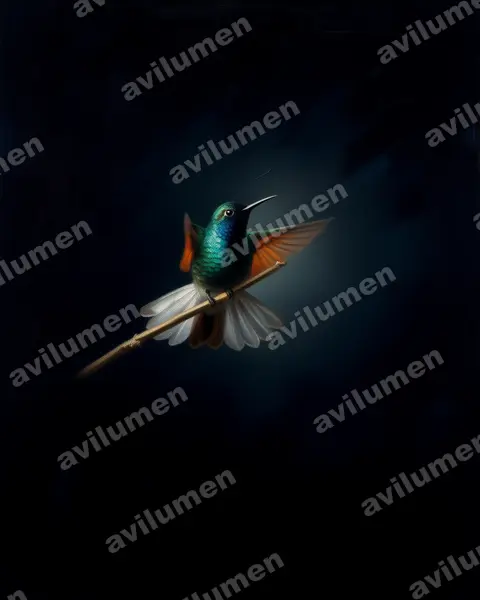
Oil 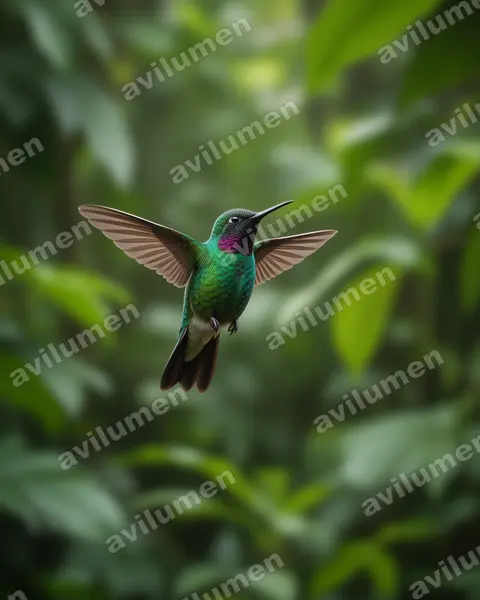
Realistic 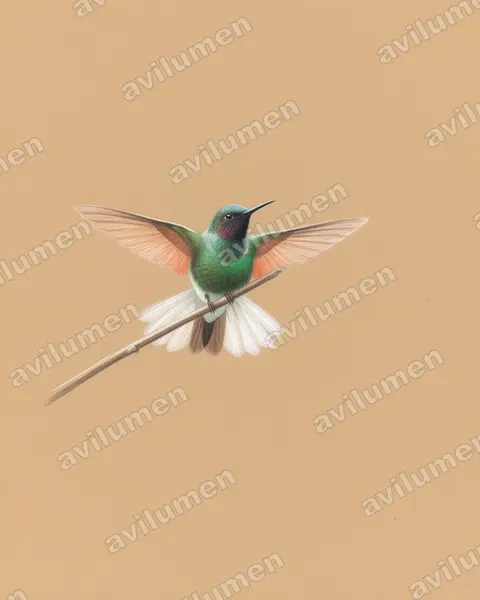
Colored pencil
Illustrations based on the photograph by francisco (CC BY 4.0), from Wikimedia Commons.
Digital editions
HD Digital Art Pack — Oaxaca hummingbird
Digital download: 6 high-resolution illustrations of the Oaxaca hummingbird (Eupherusa cyanophrys), print-ready. This is a digital file; no animal or physical item is included.
AI Avatar — Oaxaca hummingbird
Generate an avatar fusing your face with the Oaxaca hummingbird (Eupherusa cyanophrys). Delivered digitally in 8K, watermark-free. Digital product; no animals are sold or brokered.
Instant download. No live birds are sold.
Frequently asked questions
- Is Eupherusa cyanophrys (Oaxaca hummingbird) endangered?
- The IUCN Red List places Eupherusa cyanophrys, commonly known as the Oaxaca hummingbird, in the «Endangered» category. «Endangered» means it faces a very high risk of disappearing in the wild.
- What family does Eupherusa cyanophrys (Oaxaca hummingbird) belong to?
- Eupherusa cyanophrys (Oaxaca hummingbird) belongs to the family Trochilidae, in the order Apodiformes.
- What colour is Eupherusa cyanophrys (Oaxaca hummingbird)?
- The plumage of Eupherusa cyanophrys (Oaxaca hummingbird) combines these colours: Green and Blue.
More from the same family
 Least concern
Emerald-chinned Hummingbird
Abeillia abeillei
The emerald-chinned hummingbird is a species of hummingbird in the "emeralds", tribe Trochilini of subfamily Trochilinae.
from $1.99
 Least concern
Speckled hummingbird
Adelomyia melanogenys
The speckled hummingbird is a species of hummingbird. It is the only member of the genus Adelomyia. It inhabits Neotropical montane cloud forests at elevations of 1,000–2,500 meters and is confined to the Andes of Argentina, Bolivia, Peru, Ecuador, Colombia and Venezuela; as well as to some isolated montane forests in western Ecuador and Venezuela.
from $1.99
 Vulnerable
Purple-backed sunbeam
Aglaeactis aliciae
The purple-backed sunbeam is a bird species in the family Trochilidae. It is found only in Peru.
from $1.99
 Near threatened
White-tufted sunbeam
Aglaeactis castelnaudii
The white-tufted sunbeam is a species of hummingbird in the family Trochilidae. It is found only in Peru. Its natural habitats are subtropical or tropical moist montane forest and subtropical or tropical high-altitude shrubland.
from $1.99