Diamond Dove
Geopelia cuneata
Avilumen editorial team ·

The diamond dove is a resident bird in Australia. The pigeon predominantly exists in areas near water but which are lightly arid or semi-arid in nature, being Central, West and Northern Australia. They are one of Australia's smallest pigeons along with the peaceful dove. They have been spotted occasionally in Southern Australia in parks and gardens when the centre of Australia is very dry.
The diamond dove (Geopelia cuneata) is a resident bird in Australia. The pigeon predominantly exists in areas near water but which are lightly arid or semi-arid in nature, being Central, West and Northern Australia. They are one of Australia's smallest pigeons along with the peaceful dove. They have been spotted occasionally in Southern Australia in parks and gardens when the centre of Australia is very dry.
Taxonomy and etymology
English ornithologist John Latham first described the diamond dove in 1801. The common name "diamond" is a reference to the white speckles on its wings.
Description
They are small pigeons with a length of 19 to 21 centimeters or 9 to 11 inches. Regardless of sex, they have white spots and black edges on their wings, red eyes and orange eye-rings. The sexes look similar except the female's eye ring is less vivid and has more of a brown colour to the plumage. The male's head, neck, and breast are light blue-grey. The bill is a dark grey colour. The abdomen is a creamy colour while the back and tail is a brown-grey colour. The legs and feet are pink. The juveniles have a light grey bill; the iris and eye ring is fawn in colour; the feet and legs are grey; the breast is grey and does not possess any white spots on their wings.
Regardless of its astoundingly small size (weighing only about 35 g), it has a great tolerance to high heat levels due to adaptations in body temperature, metabolism, respiration, water balance, and behaviour.
Behaviour
The diamond dove is often seen on the ground, where it runs with a waddling gait. Its flight is strong, direct, and sometimes undulating. The wings can make a whistling "frrr" noise when flying.
Diamond doves tend to be seen in pairs or small groups feeding off the ground. They feed off seed mostly from grasses. They will also eat ants.
The doves tend to breed after rain but mostly in spring in Southern Australia. Nests are usually built from interwoven grasses and/or twigs, and are fragile in construction. Two white eggs are usually laid and incubated for 13 to 14 days. Their chicks are fast to grow, and are usually fully feathered and flying by two weeks.
They are known to have a variety of calls. The calls sound mournful, slow and have a soft, pleasant falsetto quality to them. Two calls consist of two long coos followed by a pause and then a long, short and long coo. Sometimes they call two long coos. The alarm coo consists of a few short but loud coos.
Australia
Diamond doves are not listed as threatened on the Australian Environment Protection and Biodiversity Conservation Act 1999.
State of Victoria, Australia
The diamond dove is listed as threatened on the Victorian Flora and Fauna Guarantee Act (1988). Under this Act, an Action Statement for the recovery and future management of this species has not been prepared.
On the 2007 advisory list of threatened vertebrate fauna in Victoria, the diamond dove is listed as near-threatened.
India
In April 2025, a Diamond Dove was sighted in the Northeast Indian state of Assam sparking attention about its presence in this region. Scholars agreed that this is a result of human-mediated introduction as this species is extensively bred and traded at a global level.
Text adapted from Wikipedia · CC BY-SA 4.0
Distribution

Taxonomy
- Order
- Columbiformes
- Family
- Columbidae
- Genus
- Geopelia
- Conservation status
- Least concern
Listen to its call
No recording yet
Illustration gallery
6 illustrations of Geopelia cuneata (Diamond Dove) in different styles, true to its real plumage. Shown watermarked; the art pack includes the high-resolution originals, ready to print.
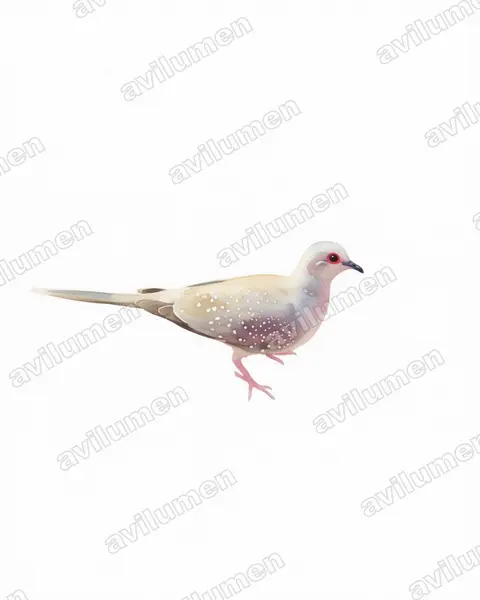
Watercolor 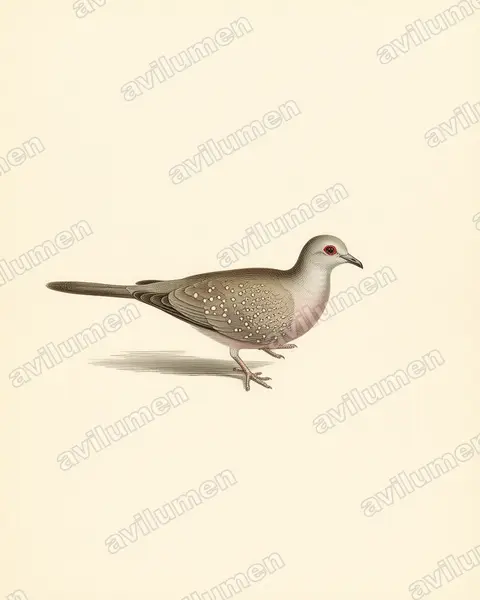
Vintage plate 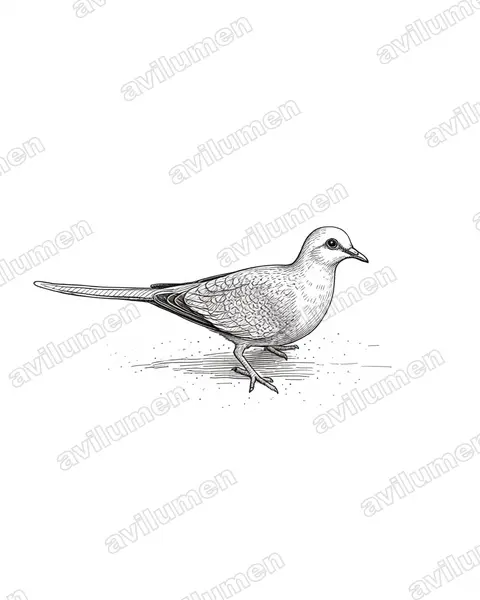
Ink 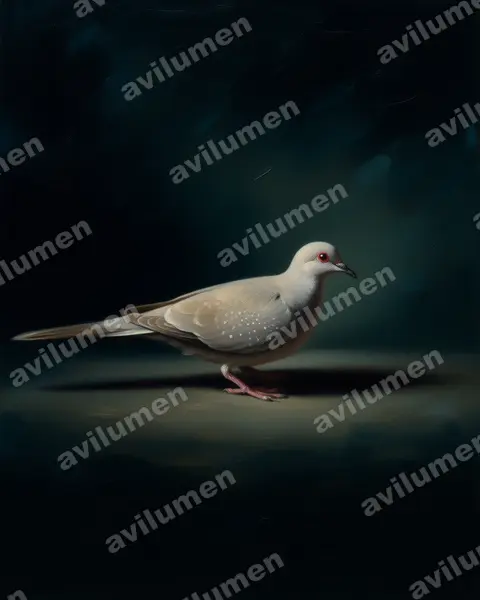
Oil 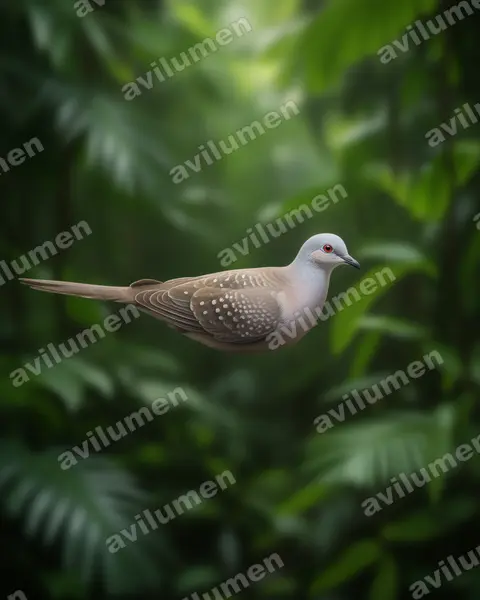
Realistic 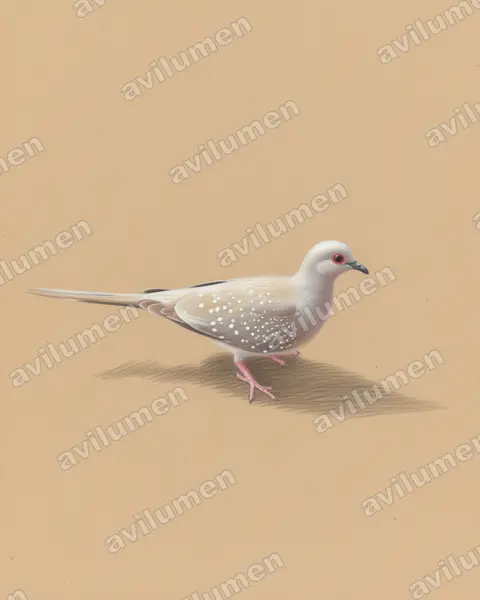
Colored pencil
Illustrations based on the photograph by Jim Bendon from Karratha, Australia (CC BY-SA 2.0), from Wikimedia Commons.
Digital editions
HD Digital Art Pack — Diamond Dove
Digital download: 6 high-resolution illustrations of the Diamond Dove (Geopelia cuneata), print-ready. This is a digital file; no animal or physical item is included.
AI Avatar — Diamond Dove
Generate an avatar fusing your face with the Diamond Dove (Geopelia cuneata). Delivered digitally in 8K, watermark-free. Digital product; no animals are sold or brokered.
Instant download. No live birds are sold.
Frequently asked questions
- Is Geopelia cuneata (Diamond Dove) endangered?
- The IUCN Red List places Geopelia cuneata, commonly known as the Diamond Dove, in the «Least concern» category. «Least concern» means it is not currently threatened.
- Where does Geopelia cuneata (Diamond Dove) live?
- Geopelia cuneata (Diamond Dove) is found in Australia.
- What family does Geopelia cuneata (Diamond Dove) belong to?
- Geopelia cuneata (Diamond Dove) belongs to the family Columbidae, in the order Columbiformes.
- What colour is Geopelia cuneata (Diamond Dove)?
- The plumage of Geopelia cuneata (Diamond Dove) combines these colours: Grey and Brown.
More from the same family
 Near threatened
Nicobar Pigeon
Caloenas nicobarica
The Nicobar pigeon or Nicobar dove is a bird found on small islands and in coastal regions from the Andaman and Nicobar Islands, India, east through the Indonesian Archipelago, to the Solomons and Palau. It is the only living member of the genus Caloenas alongside the extinct spotted green pigeon and Kanaka pigeon, and is the closest living relative of the extinct dodo and Rodrigues solitaire.
from $1.99
 Near threatened
Victoria crowned pigeon
Goura victoria
The world's largest pigeon, turkey-sized, wearing a lace-like blue crest tipped in white.
from $1.99
 Least concern
Wompoo Fruit Dove
Ptilinopus magnificus
The wompoo fruit dove, also known as wompoo pigeon and "magnificent fruit dove" among others, is one of the larger fruit doves native to New Guinea and eastern Australia.
from $1.99