Whitehead's trogon
Harpactes whiteheadi
Avilumen editorial team ·

Whitehead's trogon is a species of bird in the family Trogonidae. It is endemic to the island of Borneo, where it is an uncommon resident in primary mountain forest. One of Borneo's largest trogons at 29 to 33 cm long, it is sexually dimorphic. The male is crimson on the head, nape, and underparts, with a black throat and grey chest; the rest of his upperparts are cinnamon-coloured.
Whitehead's trogon (Harpactes whiteheadi) is a species of bird in the family Trogonidae. It is endemic to the island of Borneo, where it is an uncommon resident in primary mountain forest. One of Borneo's largest trogons at 29 to 33 cm (11 to 13 in) long, it is sexually dimorphic. The male is crimson on the head, nape, and underparts, with a black throat and grey chest; the rest of his upperparts are cinnamon-coloured. The female is similarly patterned, but cinnamon-brown where the male is scarlet. The species was first described for science by Richard Bowdler Sharpe in 1888, who named it for British explorer and collector John Whitehead. There are no subspecies.
It is primarily an insectivore, but also eats various plant materials, including fruits and seeds. Other than the timing of its breeding—typically between April and June—little is known about its breeding biology. The International Union for Conservation of Nature rates Whitehead's trogon as a near-threatened species. While its population numbers have not been quantified, the trogon is thought to be declining. Habitat loss is a key threat.
Taxonomy and etymology
English ornithologist Richard Bowdler Sharpe first described Whitehead's trogon for science in 1888, using a specimen collected on Mount Kinabalu, in the Malaysian state of Sabah. He gave it the scientific name Harpactes whiteheadi, assigning it to the genus containing other Asian trogons. There are no subspecies. Molecular studies indicate that it is most closely related to the Philippine trogon.
The genus name Harpactes is a transcription of the Greek word harpaktes, meaning "robber". The species and common names honor the British explorer John Whitehead, who first collected the bird.
Description
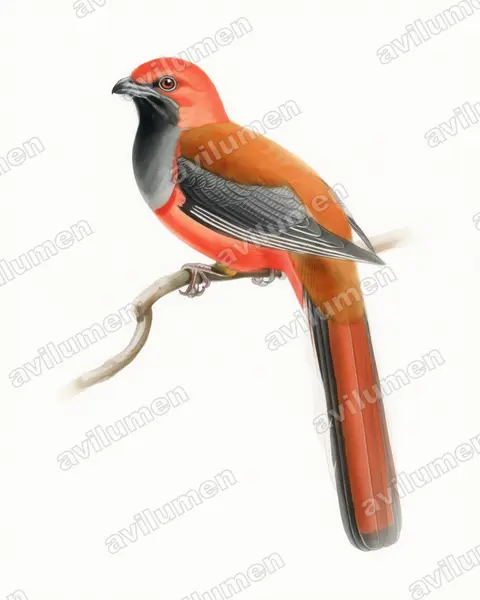
Like most trogons, Whitehead's trogon is sexually dimorphic; the male is considerably more colorful than the female. It ranks among Borneo's largest trogons, measuring 29 to 33 cm (11 to 13 in) in length. The male is crimson on the forehead, crown, nape, and sides of the head, with bare blue skin around the eyes. The rest of his upperparts are cinnamon-brown. His throat is black, shading into a grey breast, but the rest of his underparts are crimson. His wings are primarily black, with fine white barring on the secondaries and coverts. His tail is mostly white underneath; above, the two central tail feathers are cinnamon with a broad black tip, and the remaining tail feathers are primarily black. The outermost tail feathers are white on the terminal half and along the outer web. He has a blue beak, pinkish-brown legs and feet, and reddish-brown irises. The female is similarly patterned, but duller, with cinnamon-brown replacing the crimson of the male. The barring on her secondaries and wing coverts is cinnamon-brown rather than white. The immature female is similar to the adult female, but her entire ventral side is uniformly coloured, lacking the adult's black throat and grey upper breast. She also has less blue coloring on her beak.
Voice
Whitehead's trogon vocalises only rarely. Its song is a loud series of four to five harsh, slow notes, evenly pitched and variously transcribed as "kwau kwau kwau kwau", "wark wark wark wark", or "poop poop poop poop". It also has a rolling "burr" call, which is sometimes followed by a loud, descending "kekekeke".
Distribution and habitat
Whitehead's trogon is endemic to the island of Borneo, where it occurs in mountainous areas between 900 and 2,000 metres (3,000 and 6,600 ft) in elevation. Restricted to primary forest, it favours damp valleys. It is an uncommon and poorly-known resident species.
Behaviour
A shy and unobtrusive bird, Whitehead's trogon is easy to overlook as it sits quietly in the upper storey of dense forest. It is resident where it occurs. It associates loosely with mixed species flocks containing chestnut-hooded and Sunda laughingthrushes, Whitehead's broadbills and Sunda cuckooshrikes.
Feeding
Like all trogons, Whitehead's trogon feeds primarily on insects, which it captures in sallying flight from a perch, or gleans from foliage. Most of this prey is fairly large, including grasshoppers, locusts, stick insects, and leaf insects; however, insects as small as ants are taken. It also eats fruit, seeds and other plant material. Though it generally perches just under the canopy, it typically hunts in the understorey. In the mixed flocks it accompanies, it usually hunts at lower levels than the other species do. Individuals have been found with stones in their stomachs.
Breeding
Very little is known about the Whitehead trogon's breeding ecology. Birds have been found in breeding condition in late March and October; the latter date suggests the possibility of multiple broods or geographical variation in the breeding period. Nesting is known to occur in April, young birds have been collected in June, and family groups have been seen together in July. However, the nest and eggs remain undescribed, and details of its breeding biology—incubation and nesting periods, size of clutch, length of time to fledging, division of nestling care, and so forth—are not known.
Conservation
The International Union for Conservation of Nature has rated Whitehead's trogon as Least Concern due to its large range and slow rate of population decline. Although its population has not been quantified, the estimated loss over the last ten years does not approach the qualifications for Vulnerable status. Habitat loss, both from logging and conversion to agricultural use, is occurring at lower elevations on some of mountains where it lives.
Text adapted from Wikipedia · CC BY-SA 4.0
Taxonomy
- Order
- Trogoniformes
- Family
- Trogonidae
- Genus
- Harpactes
- Conservation status
- Least concern
Listen to its call
No recording yet
Illustration gallery
6 illustrations of Harpactes whiteheadi (Whitehead's trogon) in different styles, true to its real plumage. Shown watermarked; the art pack includes the high-resolution originals, ready to print.
Watercolor 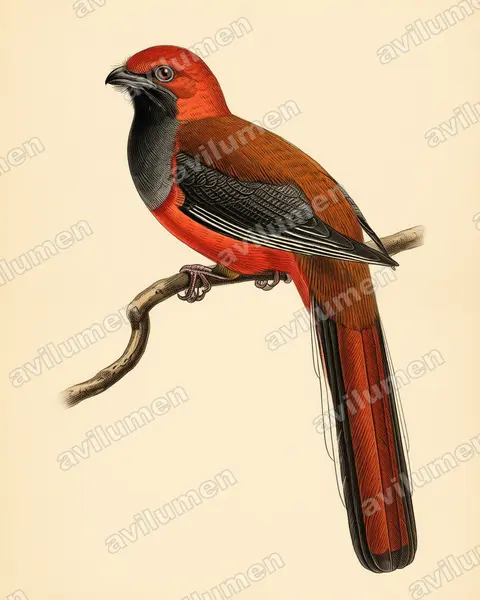
Vintage plate 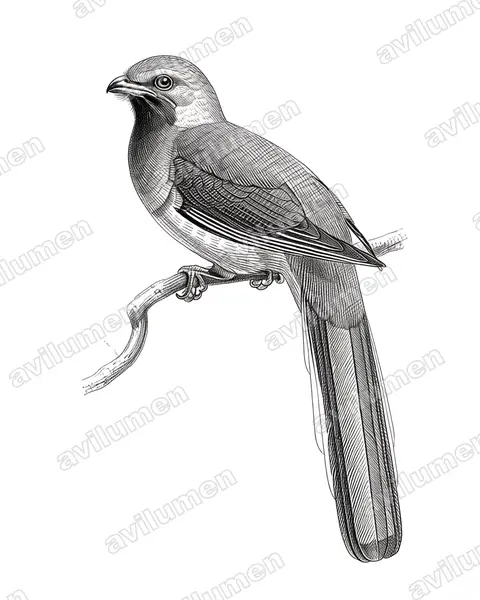
Ink 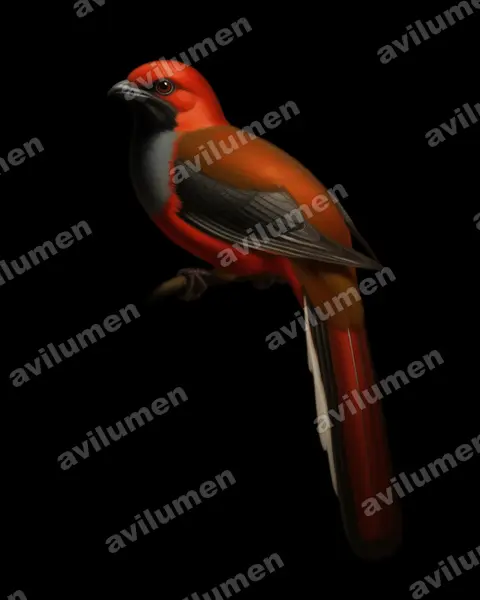
Oil 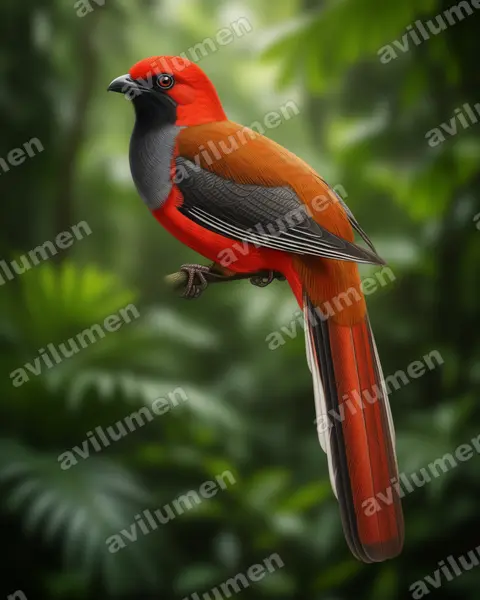
Realistic 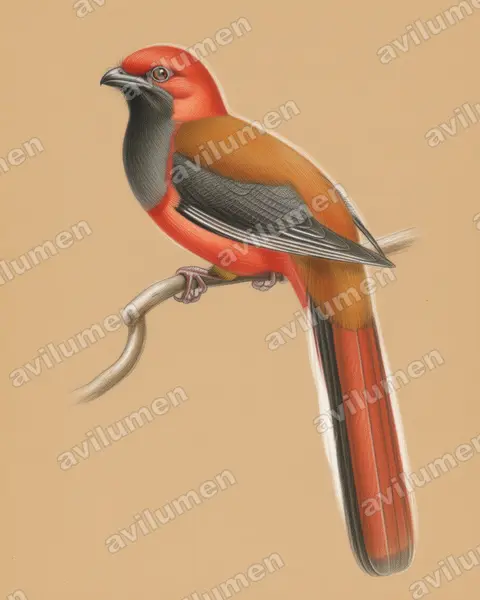
Colored pencil
Illustrations based on the photograph by John Gerrard Keulemans (Public domain), from Wikimedia Commons.
Digital editions
HD Digital Art Pack — Whitehead's trogon
Digital download: 6 high-resolution illustrations of the Whitehead's trogon (Harpactes whiteheadi), print-ready. This is a digital file; no animal or physical item is included.
AI Avatar — Whitehead's trogon
Generate an avatar fusing your face with the Whitehead's trogon (Harpactes whiteheadi). Delivered digitally in 8K, watermark-free. Digital product; no animals are sold or brokered.
Instant download. No live birds are sold.
Frequently asked questions
- Is Harpactes whiteheadi (Whitehead's trogon) endangered?
- The IUCN Red List places Harpactes whiteheadi, commonly known as the Whitehead's trogon, in the «Least concern» category. «Least concern» means it is not currently threatened.
- What family does Harpactes whiteheadi (Whitehead's trogon) belong to?
- Harpactes whiteheadi (Whitehead's trogon) belongs to the family Trogonidae, in the order Trogoniformes.
- What colour is Harpactes whiteheadi (Whitehead's trogon)?
- The plumage of Harpactes whiteheadi (Whitehead's trogon) combines these colours: Red and Grey.
More from the same family
 Least concern
Sumatran Trogon
Apalharpactes mackloti
The Sumatran trogon is a species of bird in the family Trogonidae. It was formerly considered conspecific with the Javan trogon under the common name blue-tailed trogon.
from $1.99
 Vulnerable
Javan trogon
Apalharpactes reinwardtii
The Javan trogon is a bird species in the family Trogonidae endemic to western Java, Indonesia. It was previously grouped with the Sumatran trogon as a single species, known as the blue-tailed trogon. However, differences in size, weight, and plumage have led to their classification as separate species.
from $1.99
 Least concern
Bare-cheeked Trogon
Apaloderma aequatoriale
The bare-cheeked trogon is a species of bird in the family Trogonidae found in the rainforests of western central Africa.
from $1.99
 Least concern
Narina Trogon
Apaloderma narina
The Narina trogon is a largely green and red, medium-sized bird in the family Trogonidae. It is native to forests and woodlands of the Afrotropics. Though it is the most widespread and diverse in habitat choice of the three Apaloderma species, its numbers are locally depleted due to deforestation. Some populations are sedentary while others undertake regular movements.
from $1.99