Amethyst-throated sunangel
Heliangelus amethysticollis
Avilumen editorial team ·

The amethyst-throated sunangel is a species of hummingbird in the "coquettes", tribe Lesbiini of subfamily Lesbiinae. It is found in Bolivia, Ecuador, and Peru.
The amethyst-throated sunangel (Heliangelus amethysticollis) is a species of hummingbird in the "coquettes", tribe Lesbiini of subfamily Lesbiinae. It is found in Bolivia, Ecuador, and Peru.
Taxonomy and systematics
The amethyst-throated sunangel's taxonomy is not settled. The International Ornithological Committee (IOC), BirdLife International's Handbook of the Birds of the World (HBW), and the Clements taxonomy assign these four subspecies to it:
H. a. laticlavius, Salvin (1891)
H. a. decolor, Zimmer, JT (1951)
H. a. apurimacensis, Weller (2009)
H. a. amethysticollis, d'Orbigny & Lafresnaye (1838)
The South American Classification Committee (SACC) of the American Ornithological Society includes three other subspecies. They are H. a. violiceps and H. a. clarisse that IOC, HBW, and the Clements taxonomy treat as Longuemare's sunangel (H. clarisse) and H. a. spencei that they treat as the Mérida sunangel (H. spencei).
Description
The amethyst-throated sunangel, as defined by the IOC, is about 10 cm (3.9 in) long and weighs 3.8 to 7.7 g (0.13 to 0.27 oz). The species has a straight, rather short, black bill. The adult male of nominate subspecies H. a. amethysticollis has shiny dark green upperparts with a bright green frontlet just above the bill. Its throat and upper breast gorget is rosy amethyst. That area has a narrow black border on the neck and a broader cinnamon band below it. The lower breast is glittery green and the rest of the underparts buff with green discs. The central tail feathers are bronze-green and the outer ones blue-black. The adult female is similar to the male but has a rusty throat with black flecks. Immatures are similar to the female.
Subspecies H. a. laticlavius has a reddish purple gorget, a whitish breastband, and a buffy grayish belly. H. a. decolor has a paler frontlet than the nominate; its gorget is a deeper violet, its breast band whiter, and its belly grayer. H. a. apurimacensis has a turquoise-green frontlet, a whitish buff breast, and a pale buff belly.
Distribution and habitat
The four subspecies of amethyst-throated sunangel are found thus:
H. a. laticlavius, the Andes of southern Ecuador south to northern Department of Cajamarca in Peru
H. a. decolor, the eastern slope of the Andes in central Peru from south of the Marañón River to the Department of Junín
H. a. apurimacensis, the valleys of the Apurímac River and upper Urubamba River in the departments of Ayacucho and Cusco, southeastern Peru
H. a. amethysticollis, the eastern slope of the Andes from southern Peru into northwestern Bolivia as far as Cochabamba Department
The species inhabits wet and humid montane forest including cloudforest and elfin forest. Though it is found at forest edges and open bushy terrain, it prefers the interior of closed forest. In elevation it mostly ranges between 1,800 and 3,200 m (5,900 and 10,500 ft) but has been often recorded as high as 3,700 m (12,100 ft) in Peru.
Movement
The amethyst-throated sunangel is sedentary.
Feeding
The amethyst-throated sunangel feeds on nectar and also includes a high percentage of insects in its diet. It defends feeding territories that are dense with nectar sources; with its short bill it primarily feeds at flowers with shallow corollas. It typically feeds at heights up to 6 m (20 ft) and always near cover at the forest edge or interior. It captures insects by hawking from a perch.
Breeding
The amethyst-throated sunangel nests in Peru during February and March. It builds a nest of fine plant fiber, moss, and lichens attached to a strand of moss dangling from a branch. It typically places it about 1.5 m (5 ft) above ground and under a leaf or clump of moss that shelters it from weather. The clutch of two eggs is incubated by the female, who first breeds in her second year. The incubation period and time to fledging are not known.
Vocalization
The amethyst-throated sunangel's call is "a short, buzzy, dry trill...repeated at intervals."
Status
The IUCN has assessed the amethyst-throated sunangel as being of Least Concern. Its population size is not known but is believed to be stable. It is fairly common overall, locally abundant, and occurs in several protected areas.
Text adapted from Wikipedia · CC BY-SA 4.0
Where it lives
Distribution

Taxonomy
- Order
- Apodiformes
- Family
- Trochilidae
- Genus
- Heliangelus
- Conservation status
- Least concern
Listen to its call
No recording yet
Illustration gallery
6 illustrations of Heliangelus amethysticollis (Amethyst-throated sunangel) in different styles, true to its real plumage. Shown watermarked; the art pack includes the high-resolution originals, ready to print.
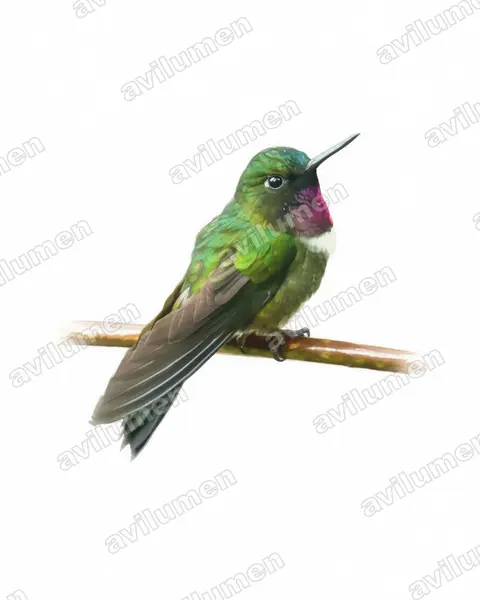
Watercolor 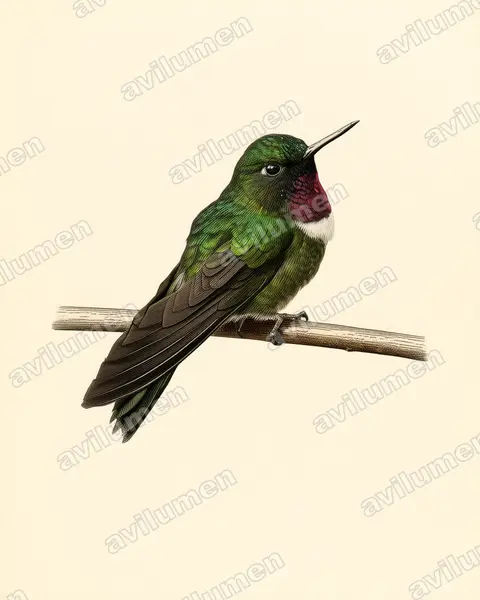
Vintage plate 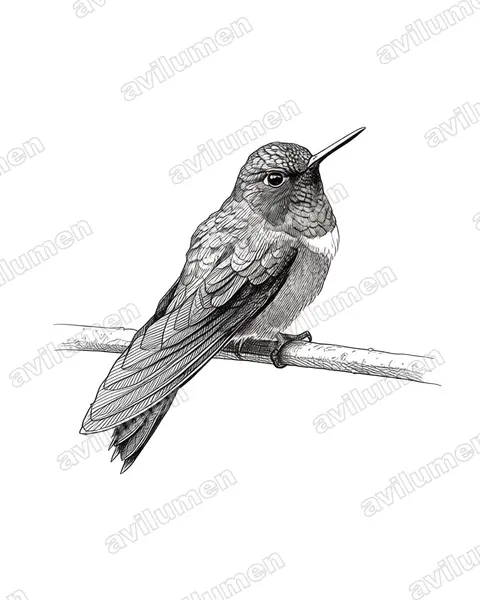
Ink 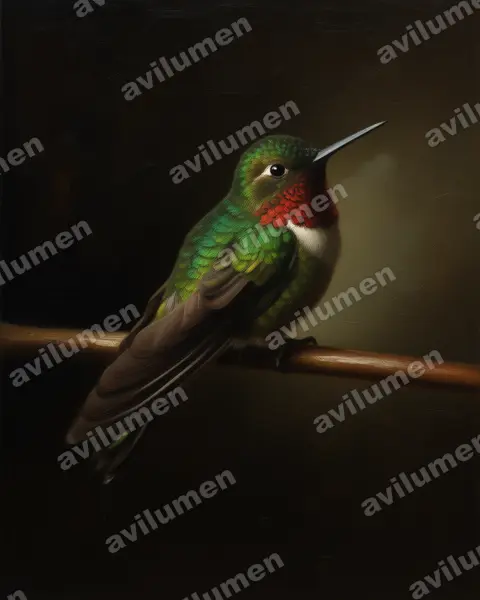
Oil 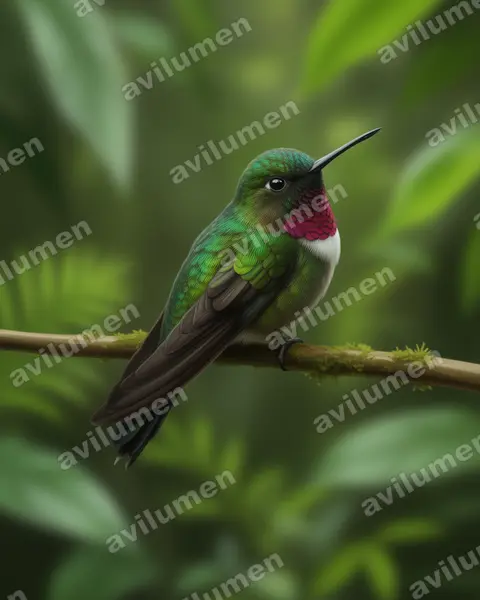
Realistic 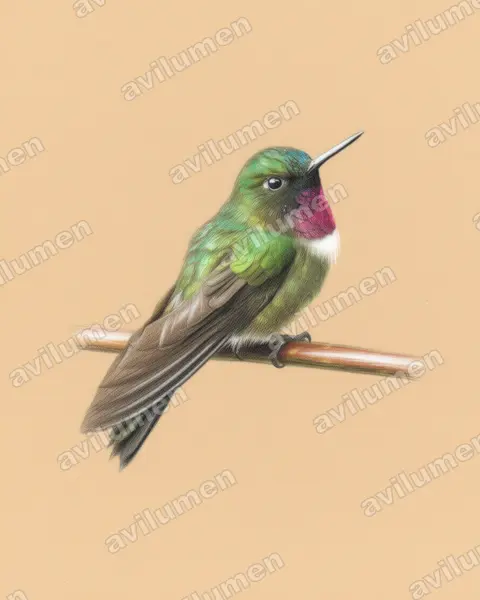
Colored pencil
Illustrations based on the photograph by Francesco Veronesi from Italy (CC BY-SA 2.0), from Wikimedia Commons.
Digital editions
HD Digital Art Pack — Amethyst-throated sunangel
Digital download: 6 high-resolution illustrations of the Amethyst-throated sunangel (Heliangelus amethysticollis), print-ready. This is a digital file; no animal or physical item is included.
AI Avatar — Amethyst-throated sunangel
Generate an avatar fusing your face with the Amethyst-throated sunangel (Heliangelus amethysticollis). Delivered digitally in 8K, watermark-free. Digital product; no animals are sold or brokered.
Instant download. No live birds are sold.
Frequently asked questions
- Is Heliangelus amethysticollis (Amethyst-throated sunangel) endangered?
- The IUCN Red List places Heliangelus amethysticollis, commonly known as the Amethyst-throated sunangel, in the «Least concern» category. «Least concern» means it is not currently threatened.
- Where does Heliangelus amethysticollis (Amethyst-throated sunangel) live?
- Heliangelus amethysticollis (Amethyst-throated sunangel) is found in South America.
- What family does Heliangelus amethysticollis (Amethyst-throated sunangel) belong to?
- Heliangelus amethysticollis (Amethyst-throated sunangel) belongs to the family Trochilidae, in the order Apodiformes.
- What colour is Heliangelus amethysticollis (Amethyst-throated sunangel)?
- The plumage of Heliangelus amethysticollis (Amethyst-throated sunangel) combines these colours: Green and Violet.
More from the same family
 Least concern
Emerald-chinned Hummingbird
Abeillia abeillei
The emerald-chinned hummingbird is a species of hummingbird in the "emeralds", tribe Trochilini of subfamily Trochilinae.
from $1.99
 Least concern
Speckled hummingbird
Adelomyia melanogenys
The speckled hummingbird is a species of hummingbird. It is the only member of the genus Adelomyia. It inhabits Neotropical montane cloud forests at elevations of 1,000–2,500 meters and is confined to the Andes of Argentina, Bolivia, Peru, Ecuador, Colombia and Venezuela; as well as to some isolated montane forests in western Ecuador and Venezuela.
from $1.99
 Vulnerable
Purple-backed sunbeam
Aglaeactis aliciae
The purple-backed sunbeam is a bird species in the family Trochilidae. It is found only in Peru.
from $1.99
 Near threatened
White-tufted sunbeam
Aglaeactis castelnaudii
The white-tufted sunbeam is a species of hummingbird in the family Trochilidae. It is found only in Peru. Its natural habitats are subtropical or tropical moist montane forest and subtropical or tropical high-altitude shrubland.
from $1.99