Violet-headed hummingbird
Klais guimeti
Avilumen editorial team ·

The violet-headed hummingbird is a species of hummingbird in the family Trochilidae. It is the only species in the genus Klais.
The violet-headed hummingbird (Klais guimeti) is a species of hummingbird in the family Trochilidae. It is the only species in the genus Klais.
Its natural habitats are subtropical or tropical moist lowland forest, subtropical or tropical moist montane forest, and heavily degraded former forest.
Taxonomy
The violet-headed hummingbird was formally described in 1843 by the French ornithologist Jules Bourcier from specimens collected near Caracas in Venezuela. Bourcier coined the binomial name Trochilus guimeti. The violet-headed hummingbird is now the only species placed in the genus Klais that was introduced in 1854 by the German naturalist Ludwig Reichenbach. The genus is named after Kleis (or Cleis), the daughter of the Lesbian poet Sappho. The specific name was chosen to honour the French chemist Jean-Baptiste Guimet.
Three subspecies are recognised:
K. g. merrittii (Lawrence, 1860) – east Honduras to east Panama
K. g. guimeti (Bourcier, 1843) – east Colombia and north Venezuela to east Ecuador and extreme north Peru
K. g. pallidiventris Stolzmann, 1926 – east Peru and west Bolivia
Description
Violet-headed hummingbirds are on average 8.1 cm (3.2 in) in length with a short, straight bill that averages 13 mm (0.51 in) in length. The head and throat of the male are intense violet or blue (depending on the angle viewed) with white spots behind each eye that stands out against the dark head. The back is metallic bluish-green (or bronze-green depending on the angle) and breast is green fading to a grey belly. The tail is green with tiny white-grey tail spots. The wings are black.
The female is duller with a blue cap, green back and grey throat, breast and belly. The wings and tail are the same as the male. The female also has the white spot behind the eye.
Distribution and habitat
The violet-headed hummingbird ranges from Central America well into South America. This includes Honduras, Nicaragua, Costa Rica and Panama in Central America and western Venezuela, Colombia, Ecuador, Peru, northern Brazil, western Venezuela and northern Bolivia. The species tends to be local in distribution, common in some areas and rare in other seemingly identical areas.
The violet-headed hummingbird occurs in the mountains and has been recorded to occur from 200 to 850 m (660 to 2,790 ft) in Costa Rica, from 400 to 1,850 m (1,310 to 6,070 ft) in Colombia and 150 to 1,900 m (490 to 6,230 ft) in Venezuela.
Violet-headed hummingbirds are found on the edges of humid primary forest, openings in secondary forests, in shrub and thicket clearings and in various human modified habitat such as Stachytarpheta hedges in Costa Rica and shade-grown coffee plantations in Venezuela.
Breeding
In Costa Rica, males sing in loose leks beginning in October and intensifying until the breeding season in December. The chorus continues until the dry season causes the flowers to disappear in February and March. The chorus picks up again when the rains begin again in April, but the heavy rains of May shut the chorus down again until October. The leks are located 5 to 18 m (16 to 59 ft) above the ground on the edge of clearings where the males sing conspicuously from slender dead twigs. Occasionally, an individual will sing solo without other violet-headed hummingbirds nearby.
The nest is a mossy cup built 1 to 5 m (3.3 to 16.4 ft) above forested mountain streams. They are normally built in February, but sometimes as early as January. The last young fledge in May.
Food and feeding
The violet-headed hummingbird drinks nectar from understory flowering shrubs as well as taking small insects on the wing. In Costa Rica, a particular fondness for Stachytarpheta flowers has been reported with as many as one individual every 5–7 m (16–23 ft) on a hedge near Murcia.
Relationship with humans
The violet-headed hummingbird has been designated as a species of Least Concern due to its large range and ability to exist in human modified habitat. The flowering shrubs near Murcia, Costa Rica, were reported to be in an area cleared for agriculture with very few trees.
Text adapted from Wikipedia · CC BY-SA 4.0
Where it lives
Distribution

Taxonomy
- Order
- Apodiformes
- Family
- Trochilidae
- Genus
- Klais
- Conservation status
- Least concern
Listen to its call
No recording yet
Illustration gallery
6 illustrations of Klais guimeti (Violet-headed hummingbird) in different styles, true to its real plumage. Shown watermarked; the art pack includes the high-resolution originals, ready to print.
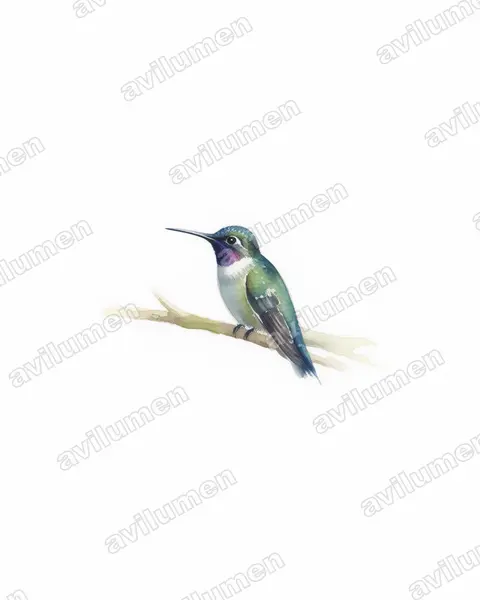
Watercolor 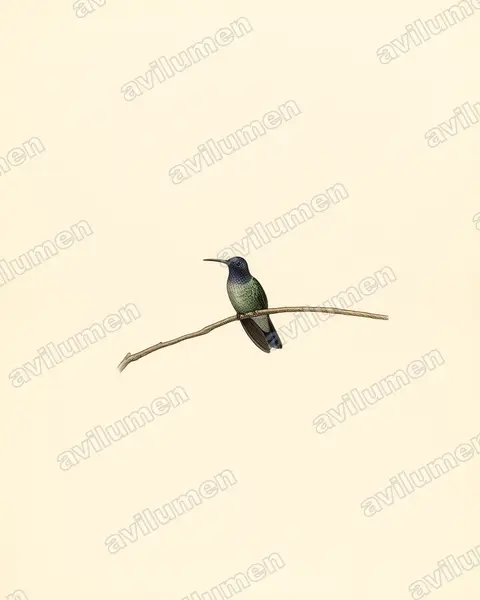
Vintage plate 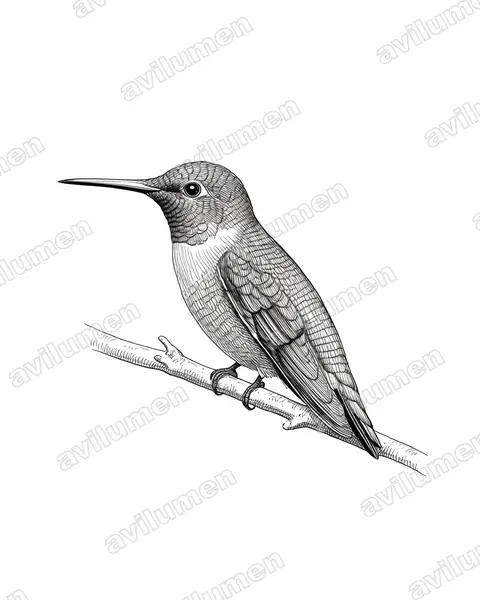
Ink 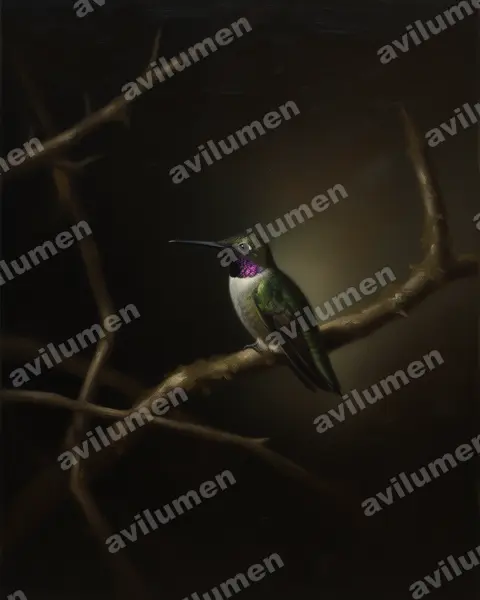
Oil 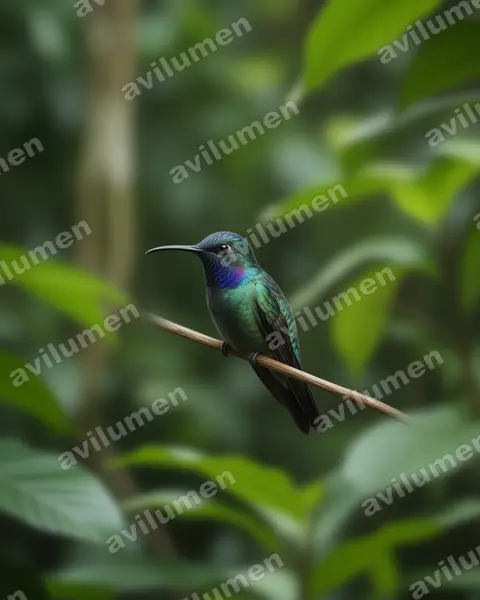
Realistic 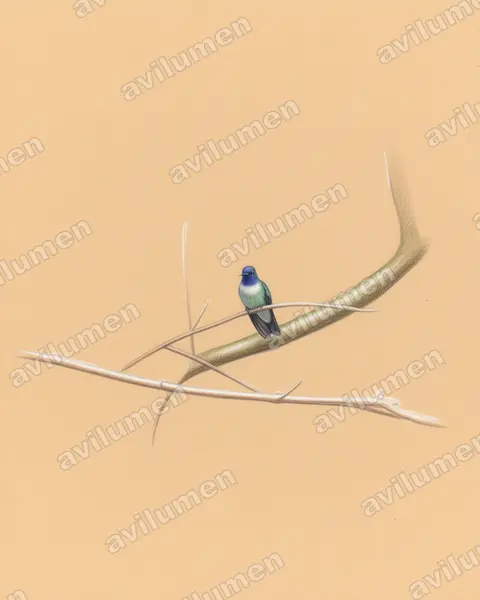
Colored pencil
Illustrations based on the photograph by Don Henise (CC BY 2.0), from Wikimedia Commons.
Digital editions
HD Digital Art Pack — Violet-headed hummingbird
Digital download: 6 high-resolution illustrations of the Violet-headed hummingbird (Klais guimeti), print-ready. This is a digital file; no animal or physical item is included.
AI Avatar — Violet-headed hummingbird
Generate an avatar fusing your face with the Violet-headed hummingbird (Klais guimeti). Delivered digitally in 8K, watermark-free. Digital product; no animals are sold or brokered.
Instant download. No live birds are sold.
Frequently asked questions
- Is Klais guimeti (Violet-headed hummingbird) endangered?
- The IUCN Red List places Klais guimeti, commonly known as the Violet-headed hummingbird, in the «Least concern» category. «Least concern» means it is not currently threatened.
- Where does Klais guimeti (Violet-headed hummingbird) live?
- Klais guimeti (Violet-headed hummingbird) is found in South America.
- What family does Klais guimeti (Violet-headed hummingbird) belong to?
- Klais guimeti (Violet-headed hummingbird) belongs to the family Trochilidae, in the order Apodiformes.
- What colour is Klais guimeti (Violet-headed hummingbird)?
- The plumage of Klais guimeti (Violet-headed hummingbird) combines these colours: Violet and Green.
More from the same family
 Least concern
Emerald-chinned Hummingbird
Abeillia abeillei
The emerald-chinned hummingbird is a species of hummingbird in the "emeralds", tribe Trochilini of subfamily Trochilinae.
from $1.99
 Least concern
Speckled hummingbird
Adelomyia melanogenys
The speckled hummingbird is a species of hummingbird. It is the only member of the genus Adelomyia. It inhabits Neotropical montane cloud forests at elevations of 1,000–2,500 meters and is confined to the Andes of Argentina, Bolivia, Peru, Ecuador, Colombia and Venezuela; as well as to some isolated montane forests in western Ecuador and Venezuela.
from $1.99
 Vulnerable
Purple-backed sunbeam
Aglaeactis aliciae
The purple-backed sunbeam is a bird species in the family Trochilidae. It is found only in Peru.
from $1.99
 Near threatened
White-tufted sunbeam
Aglaeactis castelnaudii
The white-tufted sunbeam is a species of hummingbird in the family Trochilidae. It is found only in Peru. Its natural habitats are subtropical or tropical moist montane forest and subtropical or tropical high-altitude shrubland.
from $1.99