Garnet-throated Hummingbird
Lamprolaima rhami
Avilumen editorial team ·

The garnet-throated hummingbird is a species of hummingbird in tribe Lampornithini of subfamily Trochilinae. It is found in El Salvador, Guatemala, Honduras, and Mexico.
The garnet-throated hummingbird (Lamprolaima rhami) is a species of hummingbird in tribe Lampornithini of subfamily Trochilinae. It is found in El Salvador, Guatemala, Honduras, and Mexico.
Taxonomy and systematics
The garnet-throated hummingbird is the only member of genus Lamprolaima, a name which is a combination of two Greek words: lampros, meaning brilliant or radiant and laimos, meaning throat. The specific epithet commemorates Henry Casimir de Rham Jr., an American naturalist and son of the Swiss diplomat Henry Casimir de Rham.
Description
The garnet-throated hummingbird is 12 to 12.4 cm (4.7 to 4.9 in) long and weighs 5.6 to 7.1 g (0.20 to 0.25 oz). Both sexes have a short, straight, black bill. The adult male's upperparts are iridescent green. Much of the face is black, with a small white spot behind the eye. The gorget is shining rosy pink and the breast iridescent violet-blue. The rest of the underparts are blackish with mottled green flanks. The wings are rufous with dark brown tips to the feathers. The tail is dark purple with gray tips on the outer feathers. The adult female also has iridescent green upperparts. The underparts are dusky gray, usually with small pinkish dots on the throat. The wings and tail are similar to the male's but the outer tail feathers have white tips. Juvenile males are similar to the adult female but with darker underparts and buff fringes on the chest feathers. Juvenile females are similar to the adult but with buff fringes on the head feathers.
Distribution and habitat
The garnet-throated hummingbird is found discontinuously from Mexico's Guerrero, Puebla, and Veracruz states south through Guatemala into El Salvador and Honduras. It inhabits the interior and edges of tropical forest, cloudforest, and pine-oak forest and also scrublands. In elevation it ranges between 1,200 and 3,000 m (3,900 and 9,800 ft) but is most numerous between 1,500 and 2,300 m (4,900 and 7,500 ft); in Honduras it occurs only above 1,600 m (5,200 ft).
Movement
The garnet-throated hummingbird moves between higher elevation during the breeding season to lower elevation outside it.
Feeding
The garnet-throated hummingbird feeds on nectar from flowering shrubs and trees, especially those of genera Inga and Erythrina. It tends to forage below 10 m (30 ft) of the ground. Males defend feeding territories. In addition to nectar, the species feeds on small insects captured by hawking from a perch.
Breeding
The garnet-throated hummingbird breeds in April and May on the Atlantic slope and between December and March on the Pacific slope. The female builds a bulky cup nest of moss, leaf parts, and pine needles lined with softer plant fibers. It often attaches the nest to exposed roots on earth banks such as those of streams. The incubation length and time to fledging are not known.
Vocalization
The garnet-throated hummingbird's song is "a soft, gruff, dry, crackling warble intermixed by nasal, gurgling notes." Its calls include "a nasal 'nyik' and 'choiw', high-pitched chips and a sharp, slightly buzzy 'tis-i-tyu-tyu'."
Status
The IUCN has assessed the garnet-throated hummingbird as being of least concern, though its population size and trend are not known. It is locally common, even in human-modified environments as long as some forest remains. However,
the Mexican government at one time considered it Threatened.
Text adapted from Wikipedia · CC BY-SA 4.0
Distribution

Taxonomy
- Order
- Apodiformes
- Family
- Trochilidae
- Genus
- Lamprolaima
- Conservation status
- Least concern
Listen to its call
No recording yet
Illustration gallery
6 illustrations of Lamprolaima rhami (Garnet-throated Hummingbird) in different styles, true to its real plumage. Shown watermarked; the art pack includes the high-resolution originals, ready to print.
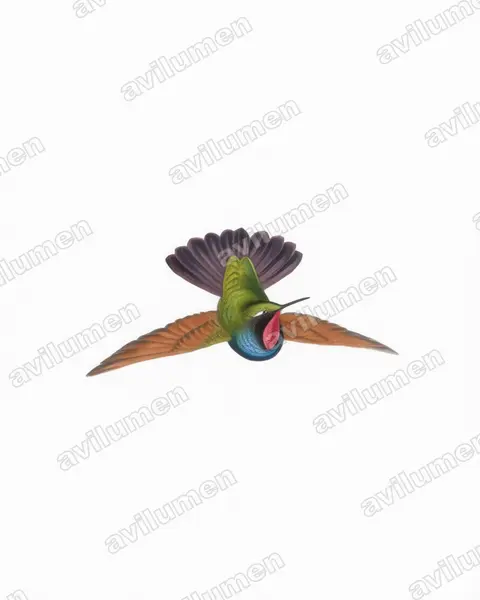
Watercolor 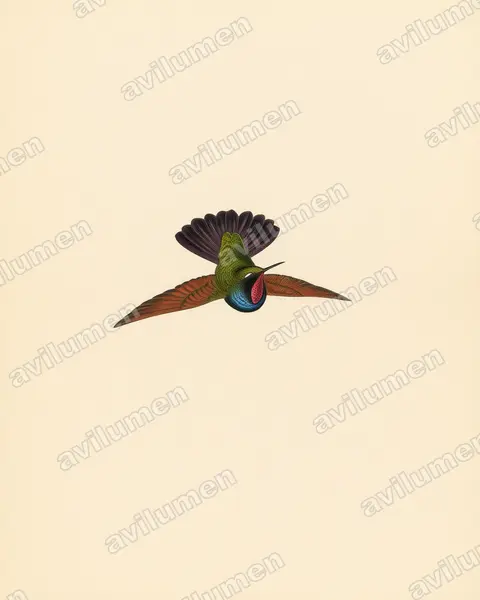
Vintage plate 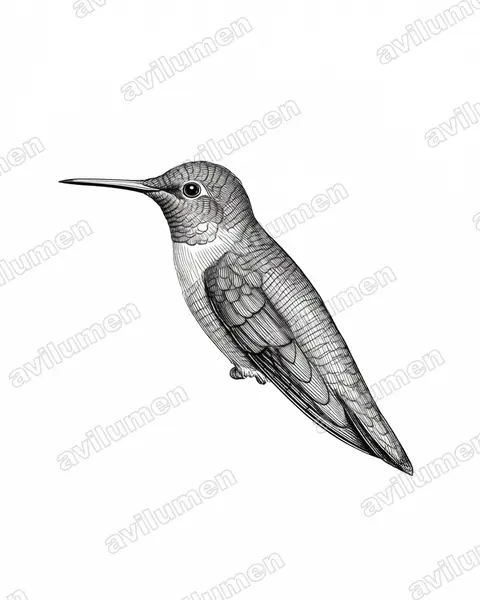
Ink 
Oil 
Realistic 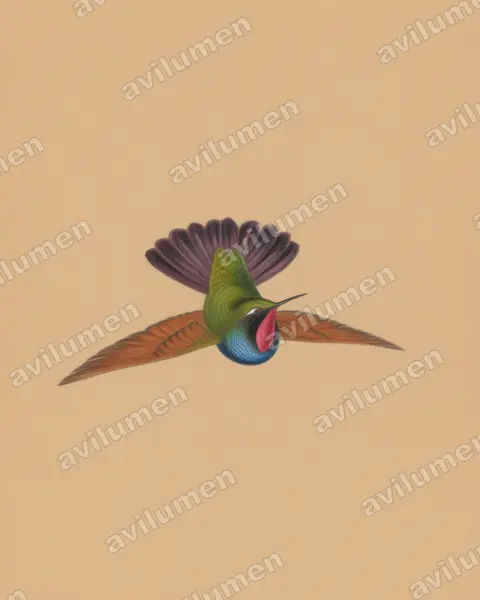
Colored pencil
Illustrations based on the photograph by John Gould / Henry Constantine Richter (Public domain), from Wikimedia Commons.
Digital editions
HD Digital Art Pack — Garnet-throated Hummingbird
Digital download: 6 high-resolution illustrations of the Garnet-throated Hummingbird (Lamprolaima rhami), print-ready. This is a digital file; no animal or physical item is included.
AI Avatar — Garnet-throated Hummingbird
Generate an avatar fusing your face with the Garnet-throated Hummingbird (Lamprolaima rhami). Delivered digitally in 8K, watermark-free. Digital product; no animals are sold or brokered.
Instant download. No live birds are sold.
Frequently asked questions
- Is Lamprolaima rhami (Garnet-throated Hummingbird) endangered?
- The IUCN Red List places Lamprolaima rhami, commonly known as the Garnet-throated Hummingbird, in the «Least concern» category. «Least concern» means it is not currently threatened.
- What family does Lamprolaima rhami (Garnet-throated Hummingbird) belong to?
- Lamprolaima rhami (Garnet-throated Hummingbird) belongs to the family Trochilidae, in the order Apodiformes.
- What colour is Lamprolaima rhami (Garnet-throated Hummingbird)?
- The plumage of Lamprolaima rhami (Garnet-throated Hummingbird) combines these colours: Violet and Green.
More from the same family
 Least concern
Emerald-chinned Hummingbird
Abeillia abeillei
The emerald-chinned hummingbird is a species of hummingbird in the "emeralds", tribe Trochilini of subfamily Trochilinae.
from $1.99
 Least concern
Speckled hummingbird
Adelomyia melanogenys
The speckled hummingbird is a species of hummingbird. It is the only member of the genus Adelomyia. It inhabits Neotropical montane cloud forests at elevations of 1,000–2,500 meters and is confined to the Andes of Argentina, Bolivia, Peru, Ecuador, Colombia and Venezuela; as well as to some isolated montane forests in western Ecuador and Venezuela.
from $1.99
 Vulnerable
Purple-backed sunbeam
Aglaeactis aliciae
The purple-backed sunbeam is a bird species in the family Trochilidae. It is found only in Peru.
from $1.99
 Near threatened
White-tufted sunbeam
Aglaeactis castelnaudii
The white-tufted sunbeam is a species of hummingbird in the family Trochilidae. It is found only in Peru. Its natural habitats are subtropical or tropical moist montane forest and subtropical or tropical high-altitude shrubland.
from $1.99