Crimson-backed Sunbird
Leptocoma minima
Avilumen editorial team ·

The crimson-backed sunbird or small sunbird is a sunbird endemic to the Western Ghats of India. Like other sunbirds, they feed mainly on nectar although they take insects, especially to feed their young. They are tiny birds that are resident and are found in forests but are particularly attracted to gardens at the edge of the forest where people grow suitable flower-bearing plants.
The crimson-backed sunbird or small sunbird (Leptocoma minima) is a sunbird endemic to the Western Ghats of India. Like other sunbirds, they feed mainly on nectar although they take insects, especially to feed their young. They are tiny birds that are resident and are found in forests but are particularly attracted to gardens at the edge of the forest where people grow suitable flower-bearing plants. They usually perch while taking nectar.
Description
Crimson-backed sunbirds are tiny, even by sunbird standards, and are only 8 cm long. They have medium-length thin down-curved bills and brush-tipped tubular tongues, both adaptations for nectar feeding.
The adult male is velvety red on the mantle and wing coverts and there is a broad red breast band. The crown is shiny green and there are pink-violet patches on the throat and rump. The underside from the breast below is yellowish. There is a black edge to the bib that separates the yellow of the underside. The larger purple-rumped sunbird can appear very similar but this sunbird has a darker maroon on the upper side while the flanks and vent are whitish. The eclipse plumage (non-breeding) of the male has more olive on the head and velvet red is restricted to the lower mantle and wing coverts. The female is olive-brown but the rump is distinctly red. They are attracted to flower-rich gardens at the edges of forests or plantations.
The calls include short chik calls and longer chee-chee-which-chee.
Behaviour and ecology
The crimson-backed sunbird is an endemic resident breeder in the Western Ghats of India. The peak nesting season is December to March, but has been known to nest in nearly all months of the year in the southern Western Ghats. Two eggs are laid in a suspended nest on a thin drooping branch of low tree, fern frond or shrub. Both the male and female take part in nest building with the interior mainly built by the female. The eggs are mainly incubated by the female but males may involve themselves in feeding the young. The incubation period is about 18–19 days.
These birds are important pollinators of some plant species.
Males establish and defend feeding territories on flower bearing shrubs and trees. Plants such as Helixanthera intermedia which had a lot of nectar were defended more vigorously.
Being small birds they may be killed by attack from insects like praying mantises too.
Although resident in many areas, they may make altitudinal movements in response to rains. In some areas they move to the foothills during the monsoons and move to the higher regions after the rains.
Text adapted from Wikipedia · CC BY-SA 4.0
Distribution

Taxonomy
- Order
- Passeriformes
- Family
- Nectariniidae
- Genus
- Leptocoma
- Conservation status
- Least concern
Listen to its call
No recording yet
Illustration gallery
6 illustrations of Leptocoma minima (Crimson-backed Sunbird) in different styles, true to its real plumage. Shown watermarked; the art pack includes the high-resolution originals, ready to print.
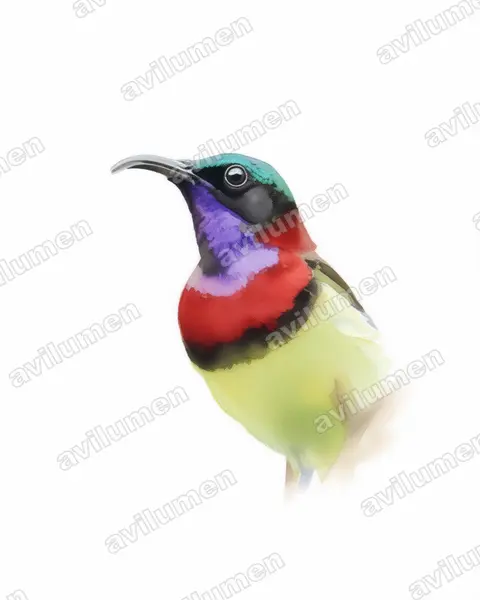
Watercolor 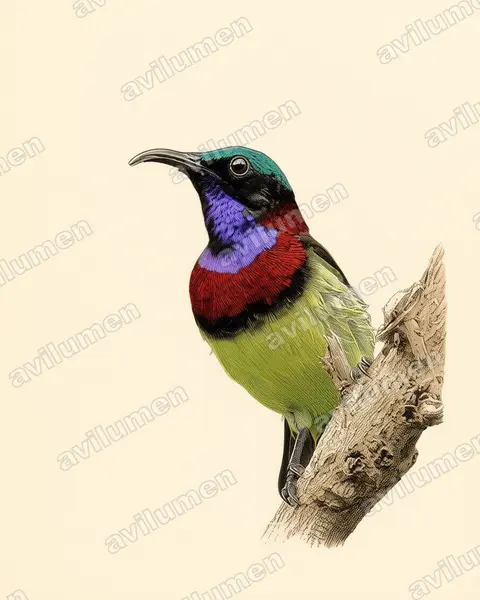
Vintage plate 
Ink 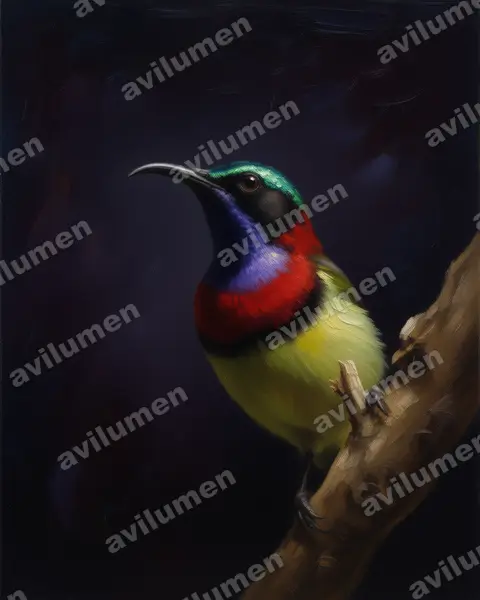
Oil 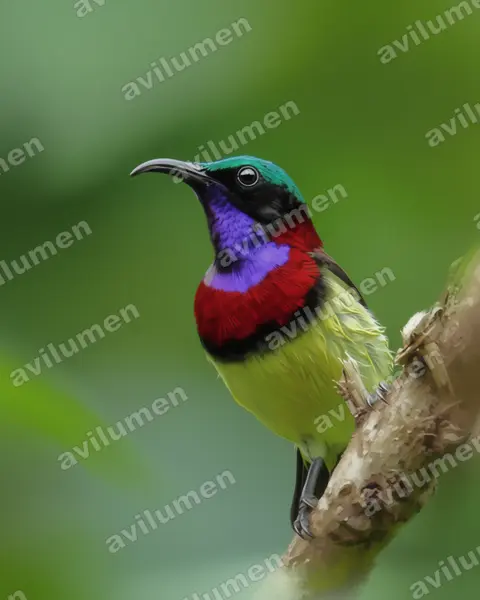
Realistic 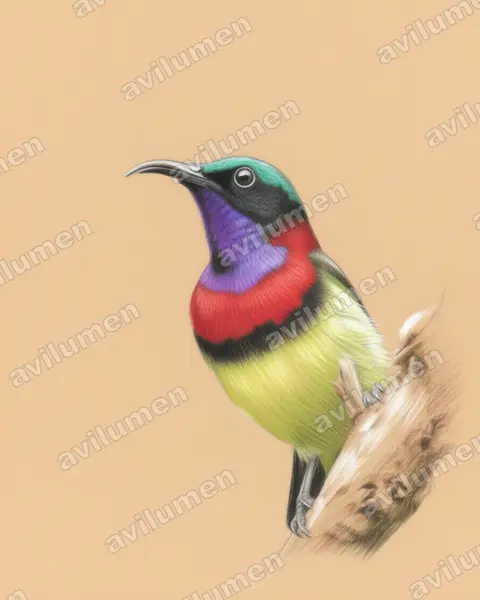
Colored pencil
Illustrations based on the photograph by Shantanu Kuveskar (CC BY-SA 4.0), from Wikimedia Commons.
Digital editions
HD Digital Art Pack — Crimson-backed Sunbird
Digital download: 6 high-resolution illustrations of the Crimson-backed Sunbird (Leptocoma minima), print-ready. This is a digital file; no animal or physical item is included.
AI Avatar — Crimson-backed Sunbird
Generate an avatar fusing your face with the Crimson-backed Sunbird (Leptocoma minima). Delivered digitally in 8K, watermark-free. Digital product; no animals are sold or brokered.
Instant download. No live birds are sold.
Frequently asked questions
- Is Leptocoma minima (Crimson-backed Sunbird) endangered?
- The IUCN Red List places Leptocoma minima, commonly known as the Crimson-backed Sunbird, in the «Least concern» category. «Least concern» means it is not currently threatened.
- What family does Leptocoma minima (Crimson-backed Sunbird) belong to?
- Leptocoma minima (Crimson-backed Sunbird) belongs to the family Nectariniidae, in the order Passeriformes.
- What colour is Leptocoma minima (Crimson-backed Sunbird)?
- The plumage of Leptocoma minima (Crimson-backed Sunbird) combines these colours: Red and Brown.
More from the same family
 Least concern
Handsome Sunbird
Aethopyga bella
The handsome sunbird is a species of bird in the family Nectariniidae. It is endemic to the Philippines.
from $1.99
 Least concern
Apo Sunbird
Aethopyga boltoni
The Apo sunbird is a species of bird in the sunbird family Nectariniidae. It is endemic to the island of Mindanao in the Philippines. It is found in tropical moist montane forests at elevations ranging from 820 to 2,000 metres above sea level.
from $1.99
 Least concern
Fork-tailed Sunbird
Aethopyga christinae
The fork-tailed sunbird is a bird in the family Nectariniidae. The species was first described by Robert Swinhoe in 1869.
from $1.99
 Endangered
Elegant Sunbird
Aethopyga duyvenbodei
The elegant sunbird is a large, up to 12 cm long, Australasian sunbird in the genus Aethopyga. The male has an iridescent blue-green crown, shoulder patch and uppertail coverts, yellow bar across lower back, red ear coverts, olive back, yellow throat, red neck collar and yellow below. The female has a yellowish olive upperparts, scaly crown and yellow underparts.
from $1.99