Green-tailed trainbearer
Lesbia nuna
Avilumen editorial team ·

The green-tailed trainbearer is a species of hummingbird in the "coquettes", tribe Lesbiini of subfamily Lesbiinae. It is found in Bolivia, Colombia, Ecuador, Peru, and possibly Venezuela.
The green-tailed trainbearer (Lesbia nuna) is a species of hummingbird in the "coquettes", tribe Lesbiini of subfamily Lesbiinae. It is found in Bolivia, Colombia, Ecuador, Peru, and possibly Venezuela.
Taxonomy and systematics
The taxonomy of the green-tailed trainbearer is not settled. The International Ornithological Committee (IOC) recognizes these six subspecies:
L. n. gouldii Loddiges (1832)
L. n. gracilis Gould (1846)
L. n. aureliae Weller & Schuchmann (2004)
L. n. pallidiventris Simon (1902)
L. n. huallagae Weller & Schuchmann (2004)
L. n. nuna Lesson (1832)
The Clements taxonomy and BirdLife International's Handbook of the Birds of the World (HBW) recognize a seventh, L. n. boliviana (Boucard, 1892) that the IOC treats as a synonym of the nominate subspecies.
Though the green-tailed trainbearer shares its genus with the black-tailed trainbearer (L. victoriae), they might not be especially closely related. All of the subspecies except the nominate (and boliviana) have at various times been suggested as separate species. Two additional subspecies have been proposed as well, but the weight of evidence is that they are hybrids of the two trainbearers.
Description
The male green-tailed trainbearer is 15.3 to 17 cm (6.0 to 6.7 in) long including the 10.6 to 13.6 cm (4.2 to 5.4 in) long tail. Females are about 11.6 cm (4.6 in) long including their 4.5 to 6.2 cm (1.8 to 2.4 in) long tail. The species weighs 3.1 to 4.3 g (0.11 to 0.15 oz). It has a short, straight, black bill. Males of the nominate subspecies are almost entirely glittering emerald green; the throat is iridescent emerald green and the lower belly grayish with green dots. Its tail is long, forked, and black with green tips to the feathers. The nominate female is similar but has white underparts with glittering green spots and a shorter tail. Juveniles are similar to the adult female but the male in addition has green spots on the throat.
Males of subspecies L. n. gouldii are similar to the nominate but smaller, with a shorter bill and more green on the tail. L. n. gracilis is also similar to the nominate but has a shorter and thicker bill and buffy undertail coverts with green spots. L. n. pallidiventris has a longer bill than the two subspecies above and has paler and less blue-green upperparts than the nominate. L. n. huallagae has a longer bill than pallidiventris that is still shorter than the nominate's; its plumage is somewhat bronzy green and the belly is paler than the nominate's. L. n. aureliae's plumage is rich golden bronze and it has a creamy buff belly.
Distribution and habitat
The six subspecies recognized by the IOC are found thus:
L. n. gouldii, the Eastern Andes of northeastern Colombia and the Central Andes of southern Colombia
L. n. gracilis, the Andes of northern and central Ecuador
L. n. aureliae, the Andes of southeastern Ecuador from Azuay Province to Loja Province
L. n. pallidiventris, the Andes of northern and central Peru from eastern Department of Piura to western Department of Huánuco
L. n. huallagae, the valley of the Huallaga River in central Huánuco, Peru
L. n. nuna, the Andes of southwestern Peru and northern Bolivia
L. n. boliviana, when treated separately from nuna, is found in Bolivia from La Paz Department to Cochabamba Department.
An old record of L. n. gouldii from Venezuela has been questioned on several grounds and the South American Classification Committee (SACC) of the American Ornithological Society does not include that country in the species' range. The IOC includes Venezuela with a question mark and the Clements taxonomy notes the one old record.
The green-tailed trainbearer mostly inhabits secondary woodland and brushy slopes but also occurs in Polylepis woodland and páramo. In elevation it ranges from 1,700 to 3,800 m (5,600 to 12,500 ft).
Movement
The green-tailed trainbearer's movements have not been defined, but elevational changes after the breeding and flowering season are likely.
Feeding
The green-tailed trainbearer forages for nectar at low to medium heights. It has been recorded taking nectar from the flowers of Castilleja fissifolia, Cavendishia cordifolia, Rubus, Cuphea dipetala, and Palicourea angustifolia. It also feeds on insects caught on the wing and gleaned from flowers.
Breeding
The green-tailed trainbearer's breeding season spans from November to April. It builds a cup nest of moss and rootlets lined with soft plant material and typically places it beneath an overhang on a slope about 2 to 4 m (7 to 10 ft) above the slope's base. The clutch size is two eggs; the incubation and fledging times have not been recorded.
Vocalization and non-vocal sound
The green-tailed trainbearer's apparent song is " a repeated gravelly note 'drrrt...drrrt...' and similar variations." Its calls include a repeated "buzzy 'bzzzzt'" and an "accelerating series of high-pitched notes 'tseee...tseee...tseee..tsee-tsi-tsi'." It makes a snapping sound with its tail or wings when displaying.
Status
The IUCN has assessed the green-tailed trainbearer as being of Least Concern. It has a large range and its population, though of unknown size, is believed to be stable. It is locally fairly common and no immediate threats are known. However, deforestation of Polylepis woodlands, ranching, and farming are all potential threats.
Text adapted from Wikipedia · CC BY-SA 4.0
Where it lives
Distribution

Taxonomy
- Order
- Apodiformes
- Family
- Trochilidae
- Genus
- Lesbia
- Conservation status
- Least concern
Listen to its call
No recording yet
Illustration gallery
6 illustrations of Lesbia nuna (Green-tailed trainbearer) in different styles, true to its real plumage. Shown watermarked; the art pack includes the high-resolution originals, ready to print.

Watercolor 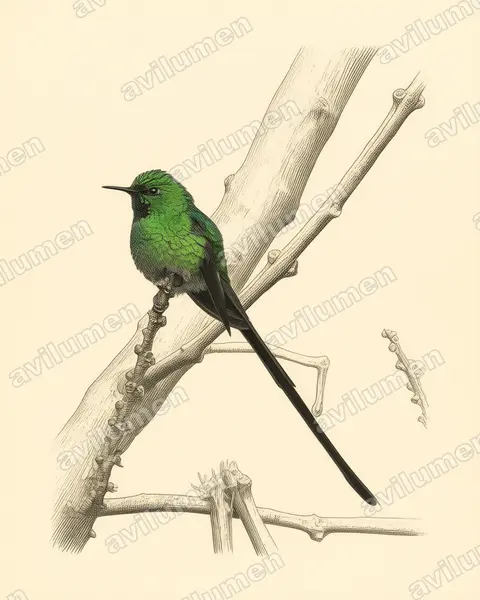
Vintage plate 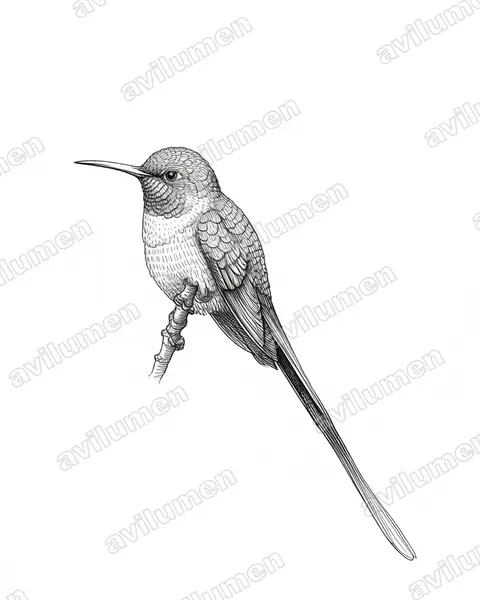
Ink 
Oil 
Realistic 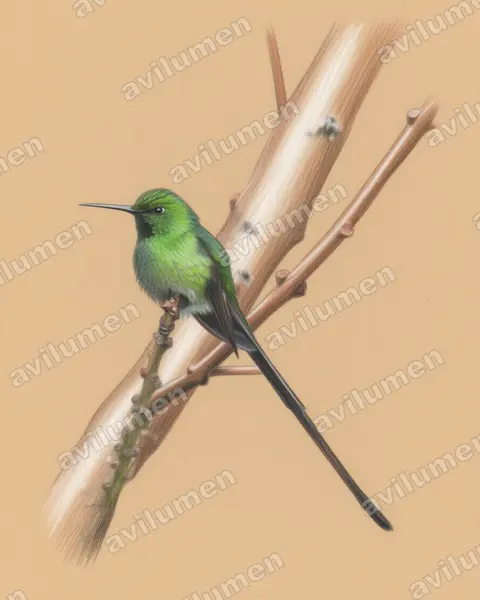
Colored pencil
Illustrations based on the photograph by Félix Uribe from Rionegro, Antioquia, Colombia (CC BY-SA 2.0), from Wikimedia Commons.
Digital editions
HD Digital Art Pack — Green-tailed trainbearer
Digital download: 6 high-resolution illustrations of the Green-tailed trainbearer (Lesbia nuna), print-ready. This is a digital file; no animal or physical item is included.
AI Avatar — Green-tailed trainbearer
Generate an avatar fusing your face with the Green-tailed trainbearer (Lesbia nuna). Delivered digitally in 8K, watermark-free. Digital product; no animals are sold or brokered.
Instant download. No live birds are sold.
Frequently asked questions
- Is Lesbia nuna (Green-tailed trainbearer) endangered?
- The IUCN Red List places Lesbia nuna, commonly known as the Green-tailed trainbearer, in the «Least concern» category. «Least concern» means it is not currently threatened.
- Where does Lesbia nuna (Green-tailed trainbearer) live?
- Lesbia nuna (Green-tailed trainbearer) is found in South America.
- What family does Lesbia nuna (Green-tailed trainbearer) belong to?
- Lesbia nuna (Green-tailed trainbearer) belongs to the family Trochilidae, in the order Apodiformes.
- What colour is Lesbia nuna (Green-tailed trainbearer)?
- The plumage of Lesbia nuna (Green-tailed trainbearer) combines these colours: Green and Blue.
More from the same family
 Least concern
Emerald-chinned Hummingbird
Abeillia abeillei
The emerald-chinned hummingbird is a species of hummingbird in the "emeralds", tribe Trochilini of subfamily Trochilinae.
from $1.99
 Least concern
Speckled hummingbird
Adelomyia melanogenys
The speckled hummingbird is a species of hummingbird. It is the only member of the genus Adelomyia. It inhabits Neotropical montane cloud forests at elevations of 1,000–2,500 meters and is confined to the Andes of Argentina, Bolivia, Peru, Ecuador, Colombia and Venezuela; as well as to some isolated montane forests in western Ecuador and Venezuela.
from $1.99
 Vulnerable
Purple-backed sunbeam
Aglaeactis aliciae
The purple-backed sunbeam is a bird species in the family Trochilidae. It is found only in Peru.
from $1.99
 Near threatened
White-tufted sunbeam
Aglaeactis castelnaudii
The white-tufted sunbeam is a species of hummingbird in the family Trochilidae. It is found only in Peru. Its natural habitats are subtropical or tropical moist montane forest and subtropical or tropical high-altitude shrubland.
from $1.99