Spot-throated hummingbird
Leucippus taczanowskii
Avilumen editorial team ·

The spot-throated hummingbird is a species of hummingbird in the "emeralds", tribe Trochilini of subfamily Trochilinae. It is endemic to Peru but there are uncorroborated sightings in Ecuador.
The spot-throated hummingbird (Thaumasius taczanowskii) is a species of hummingbird in the "emeralds", tribe Trochilini of subfamily Trochilinae. It is endemic to Peru but there are uncorroborated sightings in Ecuador.
Taxonomy and systematics
The spot-throated hummingbird was formerly placed in the genus Leucippus. A molecular phylogenetic study published in 2014 found that Leucippus was polyphyletic. To resolve the polyphyly the spot-throated hummingbird and the Tumbes hummingbird (Thaumasius baeri) were eventually moved by most taxonomic systems to the resurrected genus Thaumasius.
The spot-throated hummingbird is monotypic.
Description
The spot-throated hummingbird is 11.5 to 12.5 cm (4.5 to 4.9 in) long and weighs about 6 to 7 g (0.21 to 0.25 oz). The sexes are essentially alike. They have a somewhat decurved black bill, though sometimes the mandible is gray-brown or even yellow with a black tip. Their upperparts are grayish green to bronze green with a bronze crown and uppertail coverts. Their inner tail feathers are grayish green to bronze green that progresses to grayish on the outer ones, which also have a bronze band near the end. Their underparts are drab gray with golden green speckles on the chin, throat, and flanks. The undertail coverts have pale brown centers and whitish edges.
Distribution and habitat
The spot-throated hummingbird is generally considered to occur only in Peru, on the west slope of the Andes and the Marañon River valley from near the Ecuadorean border south to Ancash Department. Undocumented sight records in far southern Ecuador lead the South American Classification Committee of the American Ornithological Society to list it as hypothetical in that country. It inhabits arid scrublands and the edges of deciduous forest. In elevation in the Andes it mostly occurs between 900 and 1,900 m (3,000 and 6,200 ft) but is found locally as low as 200 m (660 ft). In the Marañon valley it occurs between 350 and 2,800 m (1,100 and 9,200 ft).
Movement
The movements of the spot-throated hummingbird, if any, have not been documented.
Feeding
The spot-throated hummingbird forages for nectar from the understory to the mid-strata. Though details of the flowering plants it favors are lacking, it is known to feed at Inga trees, Agave, and banana (Musa). In addition to nectar, it feeds on small arthropods caught on the wing.
Breeding
The spot-throated hummingbird's nest and eggs remained undescribed until 2024. The description's authors examined specimens that had apparently been collected in the late 1800s and preserved in the Natural History Museum of Berlin. The nest is a small cup of plant fibers, seeds, and thin twigs with plant fragments at its base and lined with plant down and other plant material. Photographs of a nest taken in January 2016 show an external covering of lichens. The single 1800s egg was white without other markings. The 2016 photograph includes a female on the nest; a photograph of a nest with two eggs was taken in November 2007. These data indicate a breeding season that includes at least November to January. The incubation period and time to fledging remain unknown.
Vocalization
The spot-throated hummingbird's song is "a complex series of chips and wheezing electric warbles." It also makes "a dry chatter and tip notes."
Status
The IUCN has assessed the spot-throated hummingbird as being of Least Concern. It has a fairly large range; its population size is unknown but is believed to be stable. No immediate threats have been identified. It is considered fairly common, and "[h]uman activity has little effect on Spot-throated Hummingbird, at least in the short term".
Text adapted from Wikipedia · CC BY-SA 4.0
Plumage colours
Distribution

Taxonomy
- Order
- Apodiformes
- Family
- Trochilidae
- Genus
- Leucippus
- Conservation status
- Least concern
Listen to its call
No recording yet
Illustration gallery
6 illustrations of Leucippus taczanowskii (Spot-throated hummingbird) in different styles, true to its real plumage. Shown watermarked; the art pack includes the high-resolution originals, ready to print.
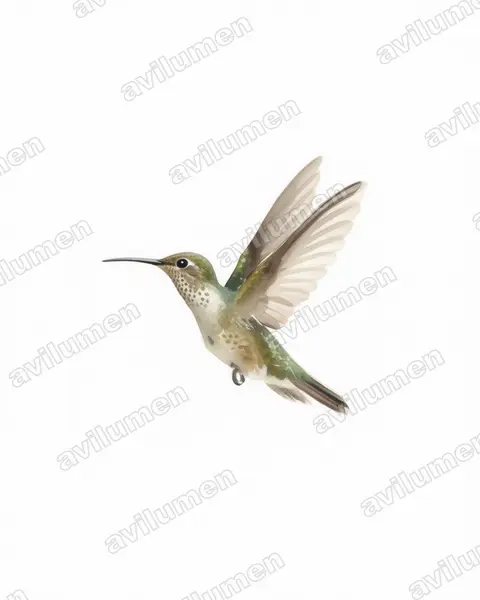
Watercolor 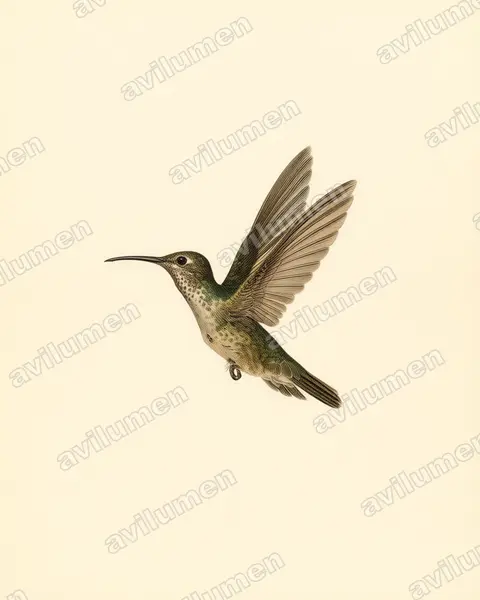
Vintage plate 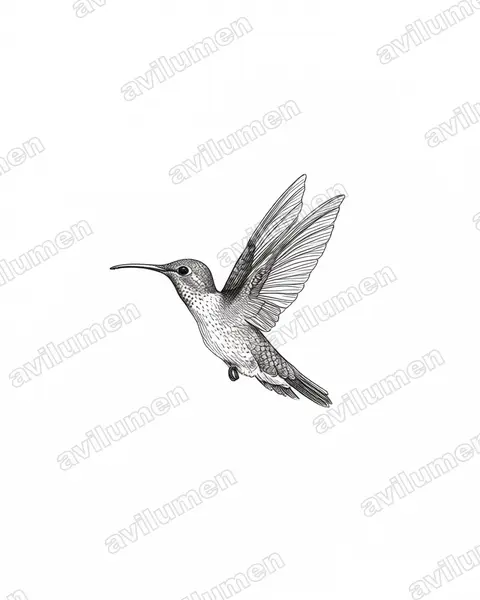
Ink 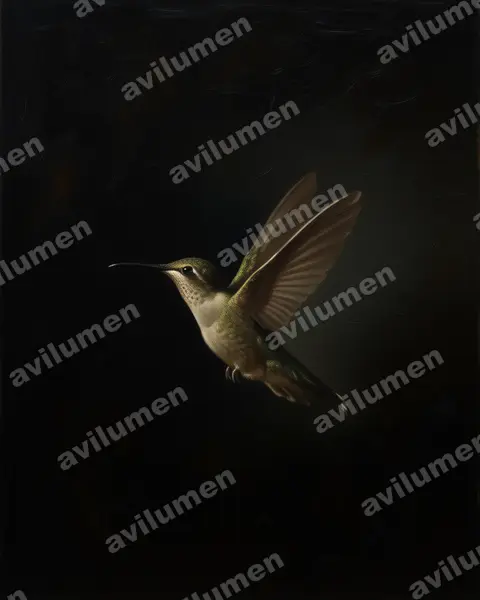
Oil 
Realistic 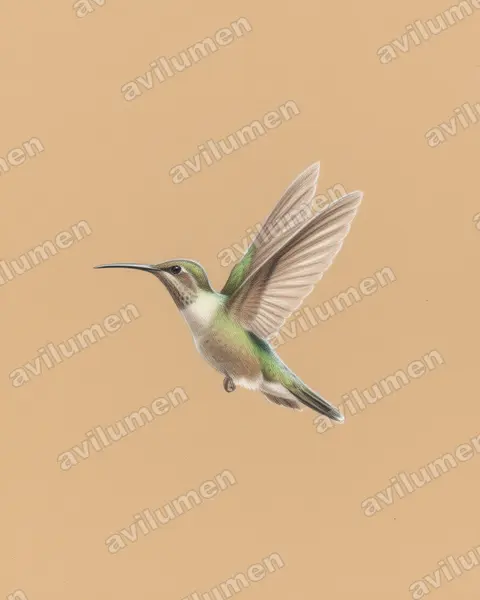
Colored pencil
Illustrations based on the photograph by Opisska (CC BY-SA 4.0), from Wikimedia Commons.
Digital editions
HD Digital Art Pack — Spot-throated hummingbird
Digital download: 6 high-resolution illustrations of the Spot-throated hummingbird (Leucippus taczanowskii), print-ready. This is a digital file; no animal or physical item is included.
AI Avatar — Spot-throated hummingbird
Generate an avatar fusing your face with the Spot-throated hummingbird (Leucippus taczanowskii). Delivered digitally in 8K, watermark-free. Digital product; no animals are sold or brokered.
Instant download. No live birds are sold.
Frequently asked questions
- Is Leucippus taczanowskii (Spot-throated hummingbird) endangered?
- The IUCN Red List places Leucippus taczanowskii, commonly known as the Spot-throated hummingbird, in the «Least concern» category. «Least concern» means it is not currently threatened.
- What family does Leucippus taczanowskii (Spot-throated hummingbird) belong to?
- Leucippus taczanowskii (Spot-throated hummingbird) belongs to the family Trochilidae, in the order Apodiformes.
- What colour is Leucippus taczanowskii (Spot-throated hummingbird)?
- The plumage of Leucippus taczanowskii (Spot-throated hummingbird) combines these colours: Green.
More from the same family
 Least concern
Emerald-chinned Hummingbird
Abeillia abeillei
The emerald-chinned hummingbird is a species of hummingbird in the "emeralds", tribe Trochilini of subfamily Trochilinae.
from $1.99
 Least concern
Speckled hummingbird
Adelomyia melanogenys
The speckled hummingbird is a species of hummingbird. It is the only member of the genus Adelomyia. It inhabits Neotropical montane cloud forests at elevations of 1,000–2,500 meters and is confined to the Andes of Argentina, Bolivia, Peru, Ecuador, Colombia and Venezuela; as well as to some isolated montane forests in western Ecuador and Venezuela.
from $1.99
 Vulnerable
Purple-backed sunbeam
Aglaeactis aliciae
The purple-backed sunbeam is a bird species in the family Trochilidae. It is found only in Peru.
from $1.99
 Near threatened
White-tufted sunbeam
Aglaeactis castelnaudii
The white-tufted sunbeam is a species of hummingbird in the family Trochilidae. It is found only in Peru. Its natural habitats are subtropical or tropical moist montane forest and subtropical or tropical high-altitude shrubland.
from $1.99