Neblina metaltail
Metallura odomae
Avilumen editorial team ·

The neblina metaltail, locally called metalura neblina or colibrí de neblina, is a species of hummingbird in the "coquettes", tribe Lesbiini of subfamily Lesbiinae. It is found in Ecuador and Peru.
The neblina metaltail (Metallura odomae), locally called metalura neblina or colibrí de neblina, is a species of hummingbird in the "coquettes", tribe Lesbiini of subfamily Lesbiinae. It is found in Ecuador and Peru.
Taxonomy and systematics
The neblina metaltail was described in 1980 following expeditions sponsored by Louisiana State University's Museum of Zoology. The species is monotypic.
Description
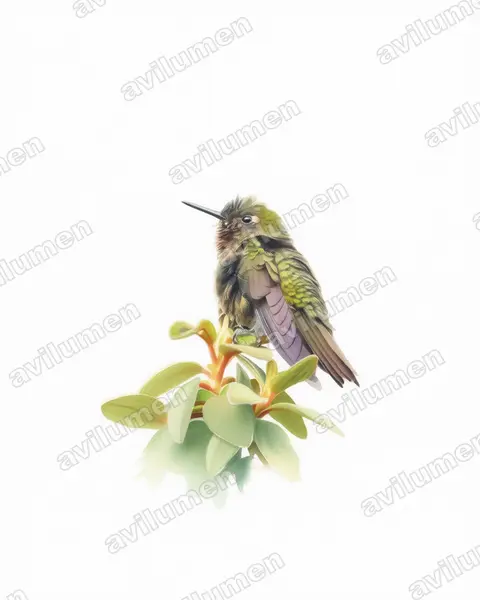
The neblina metaltail is 9 to 10.5 cm (3.5 to 4.1 in) long. Males weigh about 5.2 g (0.18 oz) and females about 4.8 g (0.17 oz). It has a medium length, straight, black bill. The adult male has iridescent dark green upperparts. Its slightly forked tail is dark olive green on its upper side and shining golden green on its underside. The sides of its head and neck vary from bronzy olive to coppery bronze and its gorget is reddish purple to rosy red. The rest of its underparts are olive bronze with a buffy spotted appearance. Its undertail coverts are bronzy green with buffy cinnamon edges. The adult female is a duller version of the male. Its throat is spotted with rosy red and the rest of its underparts are tan with heavy bronzy spotting.
Distribution and habitat
The neblina metaltail is found from the northern part of Podocarpus National Park in Ecuador's Loja Province south to northern Piura and Cajamarca departments in Peru. It inhabits the edges of elfin forest and páramo, moist landscapes characterized by shrubby growth and small trees. ("Neblina" is Spanish for fog or mist.) In elevation it ranges between 2,600 and 3,650 m (8,500 and 12,000 ft) and is most common between 2,900 and 3,400 m (9,500 and 11,200 ft).
Movement
The neblina metaltail is resident throughout its range.
Feeding
The neblina metaltail feeds mostly on nectar but details of its diet are lacking. Males defend feeding territories. In addition to nectaring, it catches small arthropods by sallies from a perch.
Breeding
Very little is known about the neblina metaltail's breeding phenology. The only nest was found in August; a female was on it. The nest was a cup made mostly from moss with lichens on the outside placed in a small cavity on a rock face.
Vocalization
The neblina metaltail's vocalizations have variously been described as "a rather loud seet-seet-seet-ti-tttt...and 'a jerky, wiry chatter'."
Status
The IUCN originally assessed the neblina metaltail as Threatened. The assessment was changed to Near Threatened in 2004 and to the present Least Concern in 2012. Though its population is estimated at fewer than 6700 mature individuals and is believed to be decreasing, much of its range is remote, protected, and not severely fragmented. It is considered fairly common in much of its range but local in Ecuador.
Text adapted from Wikipedia · CC BY-SA 4.0
Where it lives
Distribution

Taxonomy
- Order
- Apodiformes
- Family
- Trochilidae
- Genus
- Metallura
- Conservation status
- Least concern
Listen to its call
No recording yet
Illustration gallery
6 illustrations of Metallura odomae (Neblina metaltail) in different styles, true to its real plumage. Shown watermarked; the art pack includes the high-resolution originals, ready to print.
Watercolor 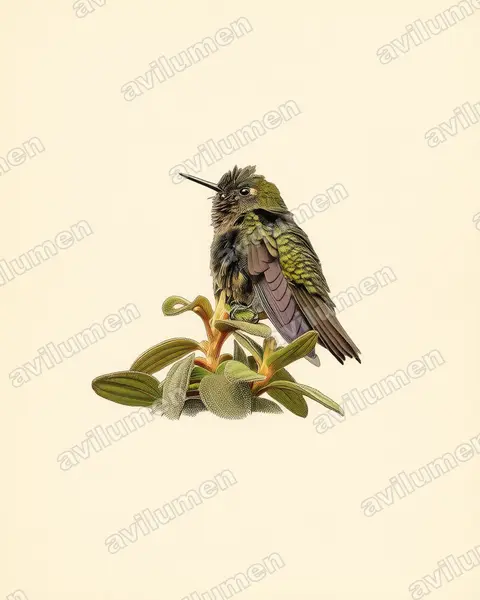
Vintage plate 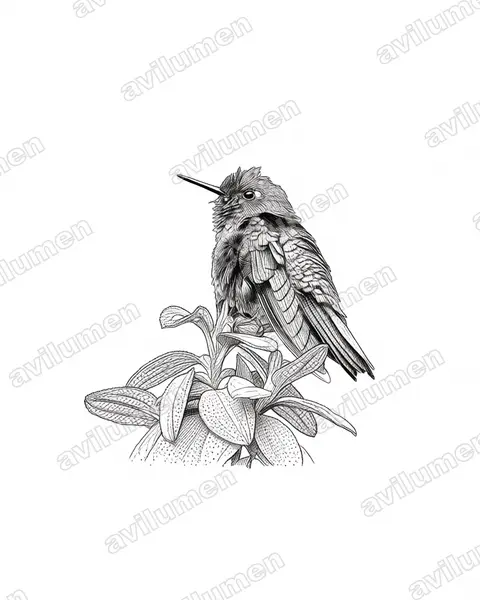
Ink 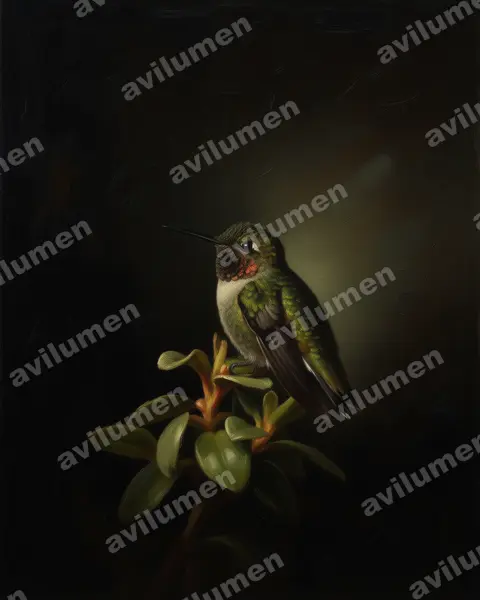
Oil 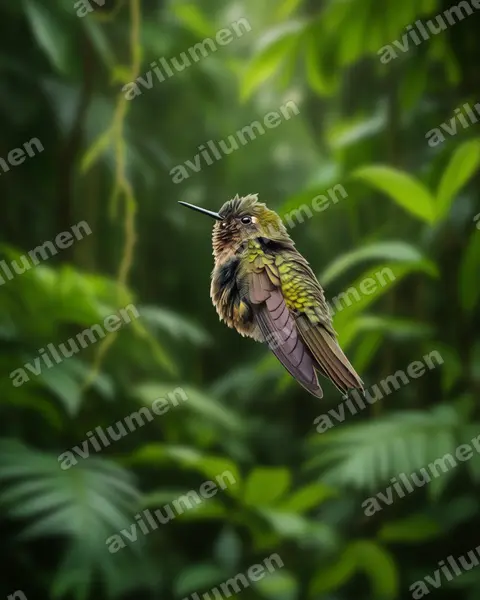
Realistic 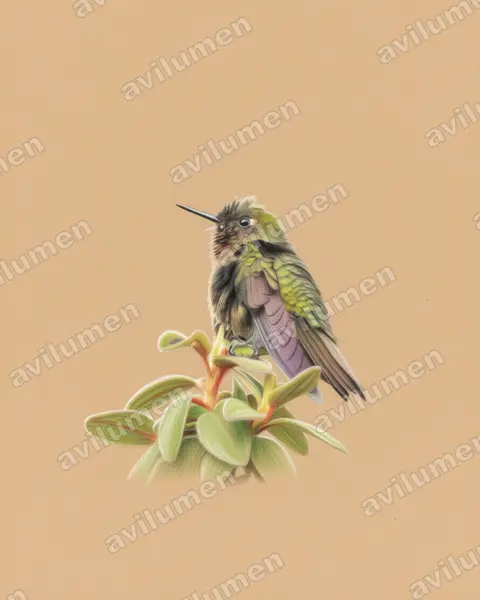
Colored pencil
Illustrations based on the photograph by Thibaud Aronson (CC BY-SA 4.0), from Wikimedia Commons.
Digital editions
HD Digital Art Pack — Neblina metaltail
Digital download: 6 high-resolution illustrations of the Neblina metaltail (Metallura odomae), print-ready. This is a digital file; no animal or physical item is included.
AI Avatar — Neblina metaltail
Generate an avatar fusing your face with the Neblina metaltail (Metallura odomae). Delivered digitally in 8K, watermark-free. Digital product; no animals are sold or brokered.
Instant download. No live birds are sold.
Frequently asked questions
- Is Metallura odomae (Neblina metaltail) endangered?
- The IUCN Red List places Metallura odomae, commonly known as the Neblina metaltail, in the «Least concern» category. «Least concern» means it is not currently threatened.
- Where does Metallura odomae (Neblina metaltail) live?
- Metallura odomae (Neblina metaltail) is found in South America.
- What family does Metallura odomae (Neblina metaltail) belong to?
- Metallura odomae (Neblina metaltail) belongs to the family Trochilidae, in the order Apodiformes.
- What colour is Metallura odomae (Neblina metaltail)?
- The plumage of Metallura odomae (Neblina metaltail) combines these colours: Green and Blue.
More from the same family
 Least concern
Emerald-chinned Hummingbird
Abeillia abeillei
The emerald-chinned hummingbird is a species of hummingbird in the "emeralds", tribe Trochilini of subfamily Trochilinae.
from $1.99
 Least concern
Speckled hummingbird
Adelomyia melanogenys
The speckled hummingbird is a species of hummingbird. It is the only member of the genus Adelomyia. It inhabits Neotropical montane cloud forests at elevations of 1,000–2,500 meters and is confined to the Andes of Argentina, Bolivia, Peru, Ecuador, Colombia and Venezuela; as well as to some isolated montane forests in western Ecuador and Venezuela.
from $1.99
 Vulnerable
Purple-backed sunbeam
Aglaeactis aliciae
The purple-backed sunbeam is a bird species in the family Trochilidae. It is found only in Peru.
from $1.99
 Near threatened
White-tufted sunbeam
Aglaeactis castelnaudii
The white-tufted sunbeam is a species of hummingbird in the family Trochilidae. It is found only in Peru. Its natural habitats are subtropical or tropical moist montane forest and subtropical or tropical high-altitude shrubland.
from $1.99