Short-tailed woodstar
Myrmia micrura
Avilumen editorial team ·

The short-tailed woodstar is a species of hummingbird in tribe Mellisugini of subfamily Trochilinae, the "bee hummingbirds". It is the only species placed in the genus Myrmia. It is found in Ecuador and Peru.
The short-tailed woodstar (Myrmia micrura) is a species of hummingbird in tribe Mellisugini of subfamily Trochilinae, the "bee hummingbirds". It is the only species placed in the genus Myrmia. It is found in Ecuador and Peru.
Taxonomy and systematics
The short-tailed woodstar was originally placed in genus Calothorax but since approximately 1876 has been placed in its current myrmia. It is the only species in its genus and has no subspecies.
Description
The short-tailed woodstar is about 6 cm (2.4 in) long and weighs about 2.3 g (0.081 oz). It and the gorgeted woodstar (Chaetocercus heliodor) are the smallest birds in South America, though the little woodstar (C. bombus) is only slightly longer. It has a very short, slightly decurved, black bill. Both sexes have shining green upperparts. Males have a white stripe from the bill to below the eye. Their gorget is glittering violet and the breast white with dingy flanks. Their very short tail's central feathers are green and the rest blackish. Females lack the bright gorget; their underparts are pale buffy whitish to cinnamon buff. Their tail is like the male's with the addition of white tips on the outer feathers.
Distribution and habitat
The short-tailed woodstar is found from the southern part of Ecuador's Manabí Province south into Peru as far as northern La Libertad Department. It inhabits arid scrub, shrublands, and gardens. It is mostly a bird of the lowlands. In Ecuador it usually occurs below 200 m (660 ft), though in Loja Province it can be found as high as 800 m (2,600 ft). Similarly, in Peru it is usually found within a few hundred meters of sea level but occurs locally as high as 1,200 m (3,900 ft).
Movement
The short-tailed woodstar is a year-round resident in most of its range but seems to leave the immediate coastal areas in the rainy season.
Feeding
The short-tailed woodstar forages for nectar at all heights but most often feeds close to the ground. It also eats small arthropods. Details of its diet are lacking, but it has been recorded feeding at flowers of families Malvaceae and Fabaceae. It is often attracted to flowers planted around houses.
Breeding
Almost everything that is known about the short-tailed woodstar's breeding phenology comes from observations in southwestern Ecuador, where the breeding season is mostly from March to May. Males make a U-shaped courtship flight. Females build a cup nest of plant down and spiderweb in a fork of a thin branch. It is typically 0.6 to 2.6 m (2 to 9 ft) above the ground. The female incubates the clutch of two eggs for 15 to 16 days and fledging occurs 22 to 23 days after hatch.
Vocalization
The male short-tailed woodstar's song, given during the display flight, is "a sweet, high series of tititi notes interspersed with a high sweee." The species' call is a "thin tchi-tchi-tchi."
Conservation status
The IUCN has assessed the short-tailed woodstar as being of Least Concern. It has a fairly large range, and though its population size is not known, it is believed to be stable. It is considered fairly common to common in Ecuador and uncommon to fairly common in Peru. "At least in the short term, [it] seems to be little affected by human activities"
Text adapted from Wikipedia · CC BY-SA 4.0
Where it lives
Plumage colours
Distribution

Taxonomy
- Order
- Apodiformes
- Family
- Trochilidae
- Genus
- Myrmia
- Conservation status
- Least concern
Listen to its call
No recording yet
Illustration gallery
6 illustrations of Myrmia micrura (Short-tailed woodstar) in different styles, true to its real plumage. Shown watermarked; the art pack includes the high-resolution originals, ready to print.
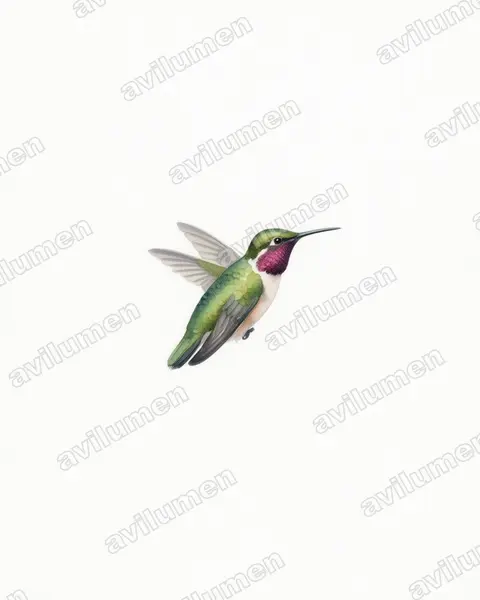
Watercolor 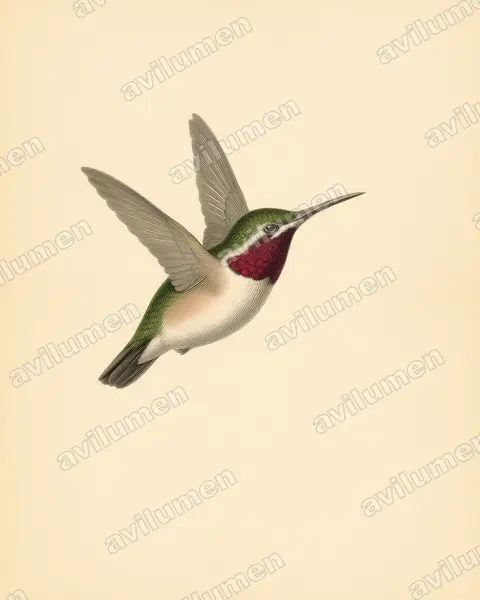
Vintage plate 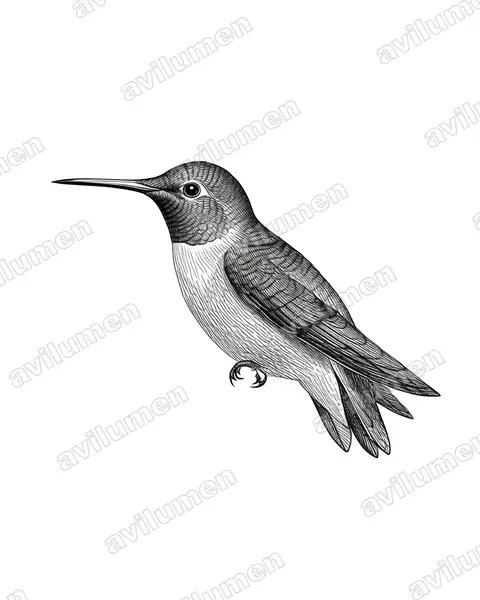
Ink 
Oil 
Realistic 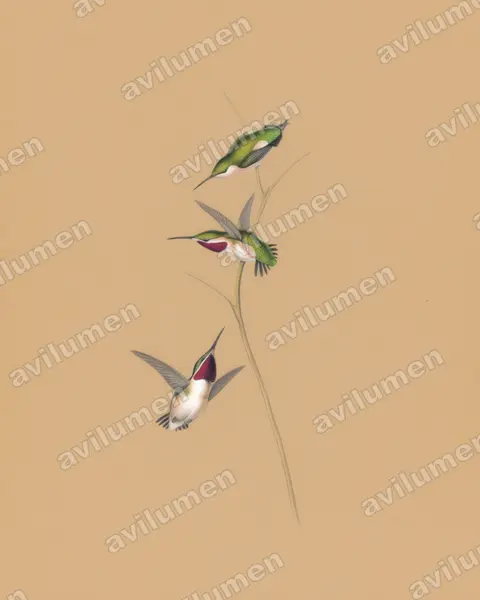
Colored pencil
Illustrations based on the photograph by John Gould (Public domain), from Wikimedia Commons.
Digital editions
HD Digital Art Pack — Short-tailed woodstar
Digital download: 6 high-resolution illustrations of the Short-tailed woodstar (Myrmia micrura), print-ready. This is a digital file; no animal or physical item is included.
AI Avatar — Short-tailed woodstar
Generate an avatar fusing your face with the Short-tailed woodstar (Myrmia micrura). Delivered digitally in 8K, watermark-free. Digital product; no animals are sold or brokered.
Instant download. No live birds are sold.
Frequently asked questions
- Is Myrmia micrura (Short-tailed woodstar) endangered?
- The IUCN Red List places Myrmia micrura, commonly known as the Short-tailed woodstar, in the «Least concern» category. «Least concern» means it is not currently threatened.
- Where does Myrmia micrura (Short-tailed woodstar) live?
- Myrmia micrura (Short-tailed woodstar) is found in South America.
- What family does Myrmia micrura (Short-tailed woodstar) belong to?
- Myrmia micrura (Short-tailed woodstar) belongs to the family Trochilidae, in the order Apodiformes.
- What colour is Myrmia micrura (Short-tailed woodstar)?
- The plumage of Myrmia micrura (Short-tailed woodstar) combines these colours: Green.
More from the same family
 Least concern
Emerald-chinned Hummingbird
Abeillia abeillei
The emerald-chinned hummingbird is a species of hummingbird in the "emeralds", tribe Trochilini of subfamily Trochilinae.
from $1.99
 Least concern
Speckled hummingbird
Adelomyia melanogenys
The speckled hummingbird is a species of hummingbird. It is the only member of the genus Adelomyia. It inhabits Neotropical montane cloud forests at elevations of 1,000–2,500 meters and is confined to the Andes of Argentina, Bolivia, Peru, Ecuador, Colombia and Venezuela; as well as to some isolated montane forests in western Ecuador and Venezuela.
from $1.99
 Vulnerable
Purple-backed sunbeam
Aglaeactis aliciae
The purple-backed sunbeam is a bird species in the family Trochilidae. It is found only in Peru.
from $1.99
 Near threatened
White-tufted sunbeam
Aglaeactis castelnaudii
The white-tufted sunbeam is a species of hummingbird in the family Trochilidae. It is found only in Peru. Its natural habitats are subtropical or tropical moist montane forest and subtropical or tropical high-altitude shrubland.
from $1.99